



Muslim leader reflects on Gaza’s local impact
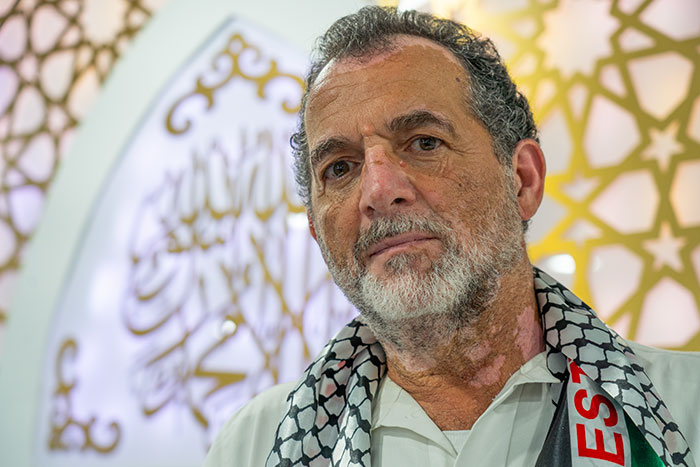
Mahmoud Tarifi, president of the Islamic Center of Claremont's Board of Directors. Courier photo/Andrew Alonzo
by Mick Rhodes | editor@claremont-courier.com
With the horrific images of dead and starving Palestinian children now reaching mainstream U.S. media, members of Congress on both sides of the aisle are speaking up, some now calling the 22-month old conflict in Gaza a genocide.
And as our social media feeds are flooded with photos and videos of the escalating humanitarian crisis, conversations about Gaza are taking place with increasing frequency in places of worship, at Trader Joe’s, in town halls, and around the kitchen table.
To better understand the impact of this conflict on our local Jewish and Muslim communities, I spoke separately with Rabbi Jonathan Kupetz, 55, from Pomona’s Temple Beth Israel, and Mahmoud Tarifi, 67, president of the Islamic Center of Claremont’s Board of Directors.
Below is the full, unedited transcript of my July 30 interview with Tarifi.
Courier: How has the genocide in Gaza impacted the local Islamic community? How has it changed the day-to-day for people you work and live with, and for you?
Tarifi: “First of all, this is a daily conversation in every family in our community. It’s a daily conversation between men, women, teenagers, my daughters, my sons, and everyone else’s. The worst part about this crisis is the inability to do something about it, because of the so-called restriction of us sending support to Gaza. That is, we, as an American, we cannot financially say, ‘Let’s donate. Let’s do A, B, and C.’ There’s restriction on that. The government has done these restrictions. That’s even more frustrating.”
Tell me more about that.
“People who are here, they understand that, from experience, that the United States considers that Hamas is a terrorist organization and it’s on the terrorist list. As a terrorist organization who supposedly controls Gaza, if you send any money, people are scared to be labeled; if I send money to Gaza they’re going to say, ‘You’ve given it to Hamas.’ It has happened. We’ve known people who have taken money to Gaza and they were arrested when they got back into the United States, accused of supporting Hamas. And these people were taking it for humanitarian reasons. They were American citizens supporting clinics, supporting workshops, supporting orphans, supporting widows, injured people and so on and so forth. So people are frustrated because you cannot send money to say here’s the way out.”
“We have families here in our community that literally have daughters living in Gaza that are stuck there. We have other families that their relatives died in Gaza in high numbers. They were bombed and killed.”
Tarifi said in early 2025 one ICC community member’s sister, husband, and all of their children died in a single bombing.
“Between his sister’s, and other bombing from other relatives, he said they have over 30 people who have died in their family” in Gaza since October 2023.
“Two weeks ago we had a family member of an ICC community member who was killed in a village in the West Bank by the settlers. Two young people. This person was an American citizen. He had gone for the summer there, and the settlers came and attacked one village, so he went with his friend to support the villagers, and they both were killed.”
“They set up condolence events, memorial events. We had gone to these memorials.”
“These things are really … they really impact us. This is not something that we watch on the news. It’s something that we live every day in this community. And I’m sure most of the Middle Eastern community who are from Arab speaking [countries], whether it’s Syria or Lebanon, Palestine, Jordan, Egypt; we all have a connection to Gaza and the West Bank and we know people from there.”
Tarifi also expressed frustration with U.S. elected officials.
“We raised our voices to our elected official. We have organized a group, we went to our Congresspeople, to Norma Torres. I was with a group from my community. We met the Congresswoman. She told us she’s doing her best. She was also frustrated with her inability to influence. She was saying, ‘I am trying to support the women and the children and the families.’ She’s very pro-refugees. When the Syrian refugees came in 2015 she got involved with us and she supported us in the resettlement of these refugees from Syria.”
“Their inability to stop hunger, their inability to stop the war, their inability to stop the bloodshed of civilian people … Pictures don’t lie. Children carrying pots and pans don’t lie. These people have been left by the world community to someone who is pushing them around every day to a different location, to different areas, leaving their homes, even bombing their tent. The story is very clear what’s going on.”
“The inability of our government, when supposedly we live in a Western country [that] supposedly holds those universal values of human rights, and they lecture us about women’s rights and minority rights and children’s rights and all these things, and when it comes to Palestine and Gaza, all these values they’re dumped for the security of Israel, the security of Israel, the security of Israel; we’ve been hearing that for the last 50 years. The other side is inhuman. They don’t consider us people. Their blood is not equal. They don’t count. They say, ‘The Hamas-controlled health department says 50,000 people are killed.’ Even when they do the statistics and the dead and the injured, they throw the word Hamas in there, they [say] it like it’s not really credible, there’s doubt.”
“And yet, those people are real. Those people are injured. Those people’s houses have been destroyed.”
Tarifi also decried what he sees as a lack of support from neighboring Jewish communities.
“When we went to the cities of Claremont and Pomona and other cities to get resolutions to call on the city for resolutions to stop the genocide in Gaza, our Jewish neighbors came out to those city halls and they stood against us. They urged the City of Claremont [in February 2024] to deny that resolution, and they were successful in doing that. Claremont said we’re not getting involved with that, go to the federal government. We’re a small city. They felt under pressure.”
“And on top of that, [neighboring Jewish community members] started saying, ‘We are fearful.’ They said they are fearful of our presence, and our students’ presence inside the city hall. And they’re saying, thank you to the police officer for being here, ‘because as a Jewish person I’m scared of being on the street now because I might get hurt by these people who are violent.’ These students who were practicing their fundamental right to speak up against the war crimes in Gaza, now they’re being called criminals and they are a threat because they went to lobby local government to make a resolution condemning the action of the Israeli military.”
“In our ceremony, when we have our Friday lectures, you cannot ignore this subject. This subject is brought up every Friday in the speeches of the speakers. One time one of the speakers mentioned this, and that time it was the students at UCLA, and USC, and Harvard, and all these universities, they were protesting and they were camping. He was talking about that subject and the students’ rights, and how the LAPD is taking those camps and arresting the students, and harassing the students, and they shouldn’t be doing that because the students have the right to protest.”
Tarifi described a pivotal moment in his community’s relationship with Pomona’s Temple Beth Israel.
“A few days later, our friends from [Temple Beth Israel] they were complaining about that Friday’s ceremony. They were saying ‘We need to sit down. This speech is anti-Jewish. This speech is anti-Israel. We need to sit down, communicate with us, to discuss, because we saw this vigil of your speaker’ on this pro-Zionist institution that connects hate speech, ‘and this is hate speech and we need to come together.’ And I said, ‘No.’”
“They came through the Interfaith Council, and I told the Interfaith Council president, ‘We are not sitting down, talking to them, about someone’s right to give a speech. That’s number one; number two, we are not sanctioning that speaker; number three, we are not afraid to sit down and talk to them about what’s going on and the history of Israel in the past 50 years, but right now we don’t want to add fuel to the fire. Right now we are frustrated, and they have to stay away. Just stay away from us. People are being killed every day. Blood is being shed. We don’t need to be sitting down and arguing because in the Middle East the war is raging. I’m not going sit down with you to discuss a person who gave a ceremony and he criticized the LAPD, and he criticized Israel, and he criticized Zionism, and the Israeli army. I’m not sitting down. We’re not talking about it.”
“We made that strategic decision.”
“We know we have the intelligence and the experts to argue with them and discuss and debate them. They did not bring this for debate; they brought it here because the speaker criticized the LAPD and they want you to get in trouble, that now you have criticized the LAPD [you will] get the local community who support the police — and we all support the police — involved.”
“With today’s ability to rescue a dog in a well, where people will … rescue an animal from a well and it will capture the world’s attention, the people in Gaza are deserving of this attention and deserving of the rescue of every decent human being in the 21st century.”
“We are really behind in recognizing that these people deserve self-determination, these people deserve a state, and these people deserve to live in peace.”
“History will be written that the Western value is a double standard, only [for] certain people because of their color or faith or ethnic [makeup], and it does not [apply to] people that they don’t believe. So, this is really something that … it’s been a long time. I’m talking about the recognition of France, and the British government, the promise of recognizing a Palestinian state. It’s on conditions, but it should have been done a long time ago.”
“When you relax and you don’t take any firm action, you give the radicals an ability to say, ‘You know what? The world doesn’t care; we can kill, we can destroy and nobody pays attention, nobody’s stopping you.’ And you saw that settler who pulled that gun and shot that person on video two days ago. He shot that activist and killed him, and nothing happened.”
“We are living in the 21st century and that is really unbelievable.”
In the face of all that is happening, Tarifi said he remains hopeful.
“Listen: the cream always rises to the top. The world will eventually find out who has the will to live. The people in the Middle East are proving every single day — not only in Gaza — that we are people who are pro-life.”
“The will to live is not only demonstrated by the people in Gaza, it’s been demonstrated all over the Middle East. Look at Syria, look at Saudi Arabia, look at Lebanon: these people, they want to look at the future. Look at the United Arab Emirates, look at Qatar. They hosted the World Cup and did a beautiful job. Saudi Arabia, they’re opening up; they want development. United Arab Emirates, Dubai. We are pro-life people. All that image of us being radical, being crazy, we like to blow ourselves up, that’s 100 percent false. We are people who want to live, who want to build, and who want to see peace in the world. And we will prove to the world that the Arabs and the Muslims in general — the Arabs in specific — will be leaders in the positiveness of developing peace in this world. We are builders; we are not people who call on destruction.”
“Look at the pictures of Gaza. Do you see any buildings standing? No building is standing. They even bombed the tents. They destroyed the wells. They destroyed the electricity, the solar. Everything’s [destroyed] and these people are still hanging on. They want to live. They don’t want to die. They like life. And that’s our message for the world, and it will continue to be our message. And we will be victorious to be the people who will make the Middle East and the world positiveness and a light that shines into this new 21st century. In this 21st century everyone’s optimistic that it will be a century of peace. And, God willing, we have all the mechanisms and material to make this. Between the young people, between the land, between the wealth, between the values, between the history, between the ethics and honesty … those things are rich in the Middle East. They’re not imaginary. They still exist and they are coming back out.”
“With all this darkness, I am still optimistic. I am super optimistic.”
Are you reticent to use the word genocide when describing the conflict in Gaza?
“Not at all because there’s an even stronger word that should be used. With today’s technology, with today’s world order, with today’s superpower, with today’s universal values …”
What is that word?
“We have to create it.”
1 Comment
Submit a Comment
You must be logged in to post a comment.




In Mr. Tarifi’s comments, he references an incident when the Temple approached him and asked to meet regarding a highly problematic speaker. He describes the speaker as a person who “criticized the LAPD, and he criticized Israel, and he criticized Zionism, and the Israeli army.” That is not entirely true. In the comments, the speaker could be heard calling for the “annihilation” of Zionists. He did not distinguish between certain types of Zionists. Just Zionists. This is not criticism. This is language that advocates violence. Given the most of the members ot the Temple community are Zionists, it was reasonable to conclude that these words were directed at the Temple community. That was the concern.