





Jewish leader reflects on Gaza’s local impact
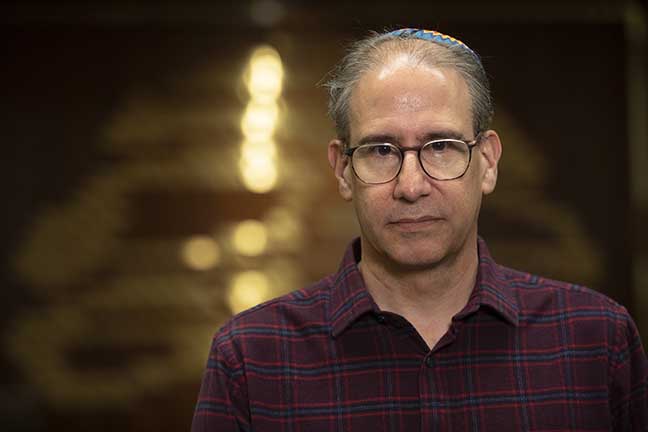
Rabbi Jonathan Kupetz, from Pomona’s Temple Beth Israel. Courier file photo
by Mick Rhodes | editor@claremont-courier.com
With the horrific images of dead and starving Palestinian children now reaching mainstream U.S. media, members of Congress on both sides of the aisle are speaking up, some now calling the 22-month old conflict in Gaza a genocide.
And as our social media feeds are flooded with photos and videos of the escalating humanitarian crisis, conversations about Gaza are taking place with increasing frequency in places of worship, at Trader Joe’s, in town halls, and around the kitchen table.
To better understand the impact of this conflict on our local Jewish and Muslim communities, I spoke separately with Rabbi Jonathan Kupetz, 55, from Pomona’s Temple Beth Israel, and Mahmoud Tarifi, 67, president of the Islamic Center of Claremont’s Board of Directors.
Below is the full, unedited transcript of my August 11 interview with Kupetz.
Courier: So I wanted to talk to you about the impact of the genocide in Gaza that it has had on your constituents, congregation, community, and how it has affected you personally, your family, and loved ones.
Kupetz: “Well, first I would start off by saying that while I think the situation in Gaza is quite terrible, I don’t believe that it’s a genocide. Genocide has within it, intent. The definition is acts committed with the intent to destroy in whole or in part a national, racial, ethnic, or religious group. And I think the intent that Israel has is the same goals that it set out at the beginning, which is to make it impossible for Hamas to reconstitute itself and to attack Israel again and its ability to govern and to release the hostages. Those are the goals. And if Israel’s goal was to kill as many Palestinians as possible, it could have happened in 24 hours and continued at that point.”
“But beyond that point, there will certainly be people in the Jewish community who disagree with me on that.”
Kupetz said the Jewish community is diverse, with many opinions.
“There’s not a Jewish position on anything. As a whole, the Jewish community has much closer ties to Israel. Most Jews have relatives or friends who live in Israel. So we get another perspective that’s mostly missing from the narrative that we get through U.S. media. Unless you’re somebody who’s reading the English language Israeli media, or other kinds of things, we get a different perspective.”
Can you speak to how that perspective differs from what we Americans are seeing in our media?
“Yeah, I think that the perspective is much more … the debate is not really about whether we should be trying to disarm Hamas or its ability to govern and get rid of the hostages. The debate is really about what’s the best way to do that.”
“There’s a very vigorous debate about the war in Israel; over 70% of Israelis, for many months now, would be willing to end the war in exchange for the hostages, even if it meant that Hamas is not incapacitated. But almost all of them believe that that will lead to another war in the future, that they’re just willing to make that trade, get their people back, and eventually when Hamas attacks them again, they’ll have to go back to war. So I think that’s the gap.”
“Very few people would say that Hamas is a partner that they can have peace with because it’s proven over and over again that it doesn’t … even Hamas’s charter calls for the death of Jews and the destruction of Israel.”
“Personally, I have great concern and I have … I could tell you that prior to the war ever breaking out, I gave a sermon at the High Holy Days that was highly critical of this government of Israel that is the most right-wing government in Israel’s history. And that had nothing to do with the war. It had to do with its own attacks on the democratic system and checks and balances, something that we see some of, obviously, in our own country at this time.”
“And I’ve had all sorts of qualms about the way the war has been carried out and certainly in recent weeks with the inability to get aid to people.”
“You know, just [August 5] on its own, and this is repeated lots and lots of times, there were almost two million meals delivered in Gaza. But the distribution is the problem. I mean, there is food sitting on trucks, and mostly because I’m not – you know, people want to point blame to the UN about that or whatever. The UN feels they can’t safely deliver the food, so it’s much more complicated than blaming any one organization.”
But, Jonathan, all the news agencies have reported that there are people being shot while they’re waiting in line to try to get some food.
“Well, there have been very, very serious problems at … the Gaza Humanitarian Foundation sites. But also, the UN reported just this week that from May 19th to August 4th — and these are UN trucks. These aren’t the Gaza Humanitarian Foundation trucks — that they had a total of 2,545 trucks that entered Gaza, and of those, 2,310, which is about 90 percent, were intercepted by armed actors or by, in some cases, by hungry individuals who overtook the trucks. And so only 10 percent of the food the UN is trying to deliver is actually getting to the places it’s trying to deliver it. And that’s a real problem, obviously, for food.”
“Now, I believe, and my movement, the reform movement, put out a message two weeks ago, and another message this week that Israel needs to be making the delivery of aid its first priority.”
“And, when they’ve talked about expanding the war in the last week or so, that that’s not in the interest of … I don’t believe that’s in the interest of Israelis. I know it’s not in the interest of Gazans. And, you know, if we could bring the hostages home and create a coalition of Arab nations with the U.S. and others to rebuild Gaza, I would take that risk. But there are no good choices. The truth is there are no good choices. Every choice at this point has very real risk for violence now or violence in the future.”
“If Hamas has any real power still, then the Arab countries that are around will not go in and help govern Gaza, because they don’t want to be there with Hamas. And, you know, Hamas is the one, even according to Qatar — who’s one of Hamas’s patrons, along with Iran — that they were the ones who decided that they didn’t want to negotiate for an end to the war. So it’s a challenging situation.”
“I can hold multiple truths at one time that the primary responsibility for this war is, from my perspective, on Hamas, and that Israel needs to do much more to make sure that humanitarian aid gets to the people. If Israel now controls, which it claims to, about 70% of the land in Gaza, then it needs to use that control in order to help safely get humanitarian aid into where it needs to be.”
“At the same time, most of the population of Gaza is in places that Israel doesn’t control, which is part of the plan that’s going forward, is to try to control those areas, a plan I happen to think is a mistake, but that’s the plan as it goes forward.”
Jewish-Israeli rights groups inside Israel, including B’Tselem, which was founded in 1989 and calls itself “the Israeli Information Center for Human Rights in the Occupied Territories,” have recently said Israel is committing genocide in Gaza. Do you believe that these groups are not legitimate?
“They certainly resisted longer than many of the organizations we tend to think of as part of the more activist human rights community. But they tend to see themselves as part of that community, and usually, historically, they align with them. And other groups like Yad Vashem, which is the [World Holocaust Remembrance Center] in Israel, and their director of genocide studies there has said that they don’t believe that’s the case. If we’re talking about a legal definition that in some way … without knowing people’s motivations … because there are far right wing ministers who are part of Israel’s government, who have said things that are terrible and in my perspective, genocidal. And if you think that those perspectives are the governing perspectives of Israel’s policy, even though they’re not part of the security cabinet who makes war decisions, then you could decide to come to that conclusion. If you don’t, you don’t.”
“At this point, the [International Criminal Court] has not come to that conclusion, even, and it’s not exactly a pro-Israel body. If you look at the warrants that they’ve put out, they do not include that. There are other things that are there. But, I think for me, it’s a distraction; which is to say that I can argue and fight about does it fall into a particular category or not. I think what’s important here is that there’s real humanitarian need. There needs to be a flood of humanitarian aid. We need to find a way to get the hostages back and end this war. We need to try to bring a horizon of hope to Palestinians in Gaza. Those are the places that I’m going to focus my energy.”
How is the conflict affecting the local Jewish community and/or American Jews?
“The primary way it affects Jews in the United States is that it has been an excuse by many for antisemitic attacks on Jews in this country. I was at Jewish summer camp for two weeks, and I was working with, with kids who were entering 12th grade. I’ve been working, going to camp forever, and if you were to ask kids a decade ago, ‘How many of you have experienced some kind of antisemitic incident or hostility toward you because you were Jewish in the last year?’ I might’ve gotten one — this was a group of 28 kids — I might’ve gotten one or two or three kids prior to a decade ago. There was not one kid there who had not had some kind of antisemitic incident directed toward them in the last year. And that’s the experience I have in the synagogue.”
Some people have labeled U.S. pro-Palestinian protesters as antisemitic. What is your take on that?
“I think again, if the question is can we hold multiple truths at once, this is challenging for people on both sides of this divide. Obviously criticizing Israel in itself is not antisemitic; advocating for Palestinian rights or freedom or against the war is not antisemitic.”
“Using antisemitic tropes in doing so, from my perspective, I don’t know what the intent is here, but the impact of people calling for globalizing the intifada means that people attack Jews in this country. Because rhetoric leads to action. And so those are real challenges for us. Anybody who thinks that all Palestinian protesters are antisemitic, I would stand up to them and say that’s obviously not the case. But within many of the Palestinian protests, there have been elements of people and signs and other kinds of things that are antisemitic.”
“And, depending on what you mean by various things, if you think that Israel is the only state in the world that doesn’t have a right to exist, or Jews should go back to Poland, which was a sign I saw in a protest, well, there are millions of Jews who live in Israel; they were never at home in Poland. We were exiled to those places from the land of Israel.”
“So, I believe that Jews have a right to self-determination. And I also believe that Palestinians have a right to self-determination.
Would that self-determination include a state and freedom of movement?
“I think if we could negotiate. I think in the long term, I think you have to … I don’t think there’s any long-term security or peace for either Palestinians or for Jews, unless both people can live in dignity and have a state of their own.”
“The question just becomes; how do you get there? How do you ensure security? And how do you get to that place, right? There was an attempt to do that with Oslo. I lived in Israel for a period of that time. It was a very hopeful time. And then the second intifada came and buses started blowing up in pizza parlors, and it sort of destroyed the peace movement in Israel because people felt like they had been willing to give up a lot, and they did those things, and then they were blown up for it.”
“But that’s always the challenge is that the extremists — whether they be Palestinian extremists or Jewish extremists — find ways to blow up either literally or figuratively chances for peace. And I think what we really need to do is just try to wage a peaceful path forward harder than those who would wage war against peace. That becomes the challenge, right?”
“I really do believe that — and I can’t prove this to you yet — that the timing of the Hamas attack on October 7th was because we were moving toward normalization with Saudi Arabia, and that was seen as a bad, a terrible thing. Obviously they’d been planning the attack for years, but the timing of when they decided to do it was to blow up that opportunity to have closer relations between Israel and Saudi Arabia. And they were successful, at least for now. And that’s a shame.”
“But that’s the nature, unfortunately, of extremists. You have people, these radical right-wing parties in the Israeli system, who are also saying things, who would like nothing more than to make sure that nothing ever moves forward toward a peaceful resolution as well.”
To be fair about the Palestinian protesters and antisemitism, as we saw at UCLA, there’s also an element of counter-protests in which people attack the protesters …
“The people who attacked the protesters at UCLA should be, if they could, they should be arrested and they should be in jail.”
And the Trump Administration just sued UCLA for antisemitism, which was surprising to me.
“Well, yeah, the police would claim that they weren’t there in the numbers that they needed to be there. And there was all sorts of things, but it was a huge problem and a huge lapse. And I don’t care who the vigilantes are, they should be not allowed, right? I don’t think there’s an argument there, at least in the mainstream Jewish community. We all have our radicals. Every community has them.”
“By the way, again, multiple truths: I believe on one hand, because I’ve heard it and I’ve seen it, that antisemitism has been and continues to be in many places, a real problem and a real issue on many college campuses. And I believe that there are those, both non-governmental folk and governmental folk, who are using antisemitism as an excuse to go after anybody who doesn’t agree with them. And those things can be simultaneously true.”
“And generally what you have is people on different sides saying, ‘There is no antisemitism on college campuses,’ or, you know, defending things that to me are anti-democratic and don’t respect the rights of people. Speech is protected. Conduct is not. We should not go after speech. We should go after conduct that is threatening and is violent.”
“So, I think, again, we lose nuance in these conversations because it’s very hard in a social media world to have complex, nuanced conversations. Whether it’s people who think all Israel is evil and Israel is terrible, or whether it’s there are no innocent Palestinians — please don’t take any of those lines out of context because you know I don’t believe either of those things that I just said — that those are, from my perspective, terrible things to say. They don’t reflect the complexity of humanity and of societies. And even when we’re at war with people — this has always been difficult for every society — I believe we have to see the humanity of people.”
“I spoke a year ago at Yom Kippur about the fact that, I used the metaphor of we need both the sword and the book. We can’t commit suicide. We have to defend ourselves. We have to do that. And, we have values, and we are told not to rejoice even in the deaths of our enemies. And we are told to care about people and to feed the hungry and to do all these kinds of things. And so, even if they’re not things that people usually do in war, I believe they’re things that we need to do.”
I think there’s a strong argument to be made that the Israeli army has certainly not taken that to heart in many instances where there have been children hit with sniper fire in the head and the genitals and the chest.
“And it’s the most difficult war zone … We haven’t seen a war zone like this in modern history. So if you take …”
But that doesn’t excuse …
“I’m not saying that it does. I’m not saying that it does. But John Spencer, who’s head of the Urban Warfare Studies at West Point’s Modern War Institute, points out [Note: Kupetz is referencing a July 28 Jerusalem Post opinion piece by Spencer.] that — and again, I’m a great critic of the war — but he points out that there has been, proportionally, if you talk about combatant to civilian deaths, actually a much smaller proportion of civilians to combatants killed here than there were in any other urban warfare that’s been engaged in, that Israel is doing something that no nation has had to do or been expected to do, which is to feed the population of the aggressor force that has attacked while the war is still going on. That there’s absolutely no historical precedent for a military providing this level of direct aid to an enemy population that has taken place. And I believe we need to do those things. I’m not saying we don’t need to do those things. And Hamas has hundreds of miles of tunnels under houses and hospitals and schools. And the Hamas folks are … when you saw the starving hostage the other day in the video [Note: Kupetz is referencing the early August release of two videos from Hamas of videos showing Israeli captives], if you saw … the captor with them, the captor was plump. They have food. It’s not shared with the population. So, it’s a very challenging situation.”
You said something earlier that I want to go back to. You said — I’m paraphrasing here — that no other army in history has provided this level of aid to an enemy population. But another thing that’s totally unique about this conflict is that we are all seeing images — and yes, there are images we can trust and images we can’t trust — but the overwhelming majority of images we’re seeing from Gaza are trustworthy, and they’re showing unbelievable levels of actual starvation. So, your statement that the Israeli army is going over and above to provide aid for this population, the images and the facts and reports from NGOs and doctors and aid groups that have been in Gaza contradict that directly.
“One of the things that makes this conflict different is that … there’s been no place … this is the only conflict, at least the only one I can think of, If you can think of [another] let me know … The normal way to get humanitarian relief to civilians in wartime is to allow them to leave the conflict zone as refugees. For example, there are more than 5 million Ukrainian refugees in Europe. Poland has taken in nearly a million. Germany has accepted a million, 1.2 million. During the civil war in Syria, more than 4.2 million civilians fled that conflict, taken in by Turkey and Lebanon and Jordan and other neighboring countries. But in this case, Egypt sealed its border, Jordan has said they would take no refugees. And so it’s a situation in which — the only situation I can think of — in which there’s a war in which there is no exit. There is no place for civilians who want to leave to go elsewhere. And that has made the toll of this war much worse.”
But I’m talking about aid …
“I’m all for aid. I’ve said to you already I think Israel should do everything to flood the country with aid. And, again, I think multiple things can be true at the same time. Aid’s being stolen, aid’s doing other kinds of things. Hamas sells aid to fund itself. And so it takes it over and sells it at very high prices. At the same time, you know, my response to that would be if there’s tons of aid and you flood it, the price of aid will come way down, and Hamas won’t be able to sell it for a lot of money because there’ll be a glut of aid.”
“I just don’t want to paint a picture … I don’t think anybody at this point … I think right now, as it’s become clear that hunger is a crisis, I think everybody is trying to do everything they can to get as much aid in as possible. And it’s very difficult to get aid in to the people because, remember, I just told you that 90 percent of the aid from the U.N. between May 19th and August 4th was intercepted.”
Just last month the New York Times and Reuters, citing an internal U.S. government analysis, both reported that there is no proof Hamas has routinely stolen aid meant for Palestinians in Gaza.
“The U.N. just reported it. [Note: the UNOPS report, which was updated August 12, did not name Hamas, or any other group, as the entity responsible intercepting aid deliveries in Gaza.] The U.N. reported it last week. And they’re not exactly a pro-Israel organization. The United Nations reported that from May 19th to August 4th, a total of 2,544 trucks entered. Of those, 90 percent were intercepted, some by armed actors, and some by hungry Gazans. They did not give a percentage as to how many were overcome by people who attacked the trucks because they were trying to get food, and how many were armed actors. But, 31,000 tons of aid was taken.”
“I don’t usually give credence to what the U.N. says, because they can’t function in Gaza without — although it’s becoming less true because Hamas is less strong — but, they can’t function without the support of Hamas. So, they tend to parrot Hamas. But in this case, even the U.N. says that trucks were being intercepted.”
How have the past 22 months affected you and your family?
“Oh, they’ve been incredibly difficult. They’ve been difficult because I’ve had lots of people who have experienced harassment within my own community. I’ve had students that I know who have had to transfer from the universities that they were attending because they didn’t feel safe. I’ve been dealing with, obviously, there’s division within the community. And there are divisions within many families. And so, that takes up a lot of my own time personally as that plays out. It sucks up a lot of my emotional energy. It’s not a conflict that we have any direct control over.
“So, this idea that somehow Jews are responsible for what’s going on in Gaza, which is basically why people attack Jews, they think we’re responsible. But nobody attacks Russians on the streets of the United States, people of Russian descent, because of what’s going on in Ukraine. Or nobody attacks Chinese folks on the streets of the United States because of Tibet or the Uyghurs or anything else like that.”
“But it’s been an excuse for people who harbor antisemitic tendencies, even if they don’t know it, because antisemitism is deeply interwoven into Western culture, to harass and to attack Jews. And my biggest challenge with definitions and with rhetoric and with whatever, is that they affect us here.
You mean the rhetoric coming from overseas and Israel?
“No, the rhetoric from those who are attacking, who are delegitimizing Israel. My issue with the rhetoric is it’s not about Israel; it’s about my community. These same people tend to use language that is inciteful and affects the lives of people in my community. You know, no other religious groups in the United States have to have guards at their services and at their campus. But there isn’t a synagogue that doesn’t. And we’re told basically by the FBI that we need to, because there have been attacks on synagogues throughout the United States. We spend a tremendous amount of money every year to have to do those kinds of things.”
“I get pastors and stuff all the time when they come to the temple, they say, ‘I had no idea you had to have security.’ But this is part of being Jewish in the United States right now. And, by the way, it got worse after October 7th. But I gave sermons about this. The incidents of antisemitism were rising long before October 7th. So we can’t just blame them on the war as that plays out.”
“It affects my family because I have kids on college campuses. I have a son who was at UCLA and a daughter who’s at the University of Wisconsin. It affects my family because it affects what I carry around as a rabbi in the community. It affects my family because we have friends and even distant family in Israel and some are at protest, and some have been called into the reserve duty, and some have been doing other kinds of things. And these are all things that affect us in ways that I don’t think affect those who are further from the conflict. Obviously, there are people who are other people other than Jews who are much closer to the conflict. There are people who have family in Gaza. But the average American is much further from the conflict and is just absorbing what they’re reading in the paper or wherever else.”





0 Comments