



Retired energy exec’s new role: activist

Mount San Antonio Gardens resident Peter Coye has been pushing to inform the public about the effects of climate change since his retirement in 2011. Courier photo/Andrew Alonzo
by Andrew Alonzo | aalonzo@claremont-courier.com
Mount San Antonio Gardens resident Peter Coye made a career working with renewable energy companies, such as founding wind turbine company California Energy and Power and working with Energy Vault, which provides solutions for accelerating the transition to renewable resources.
But since his 2011 retirement he has taken on a new role: climate activist. Drawing on his extensive inside knowledge of the renewable energy industry and decades of climate research study, Coye has made it a personal goal to inform others about the dangers of climate change.
“I try to draw attention to the simple fact that the industrial world is very dependent, as I’m sure you know, on fossil fuels,” he said. “And this is quite simply killing the planet. And for some reason I think that’s a bad idea, particularly given the fact that we can replace everything with renewables.”
“Renewables” are renewable energy sources: solar, wind, biofuels and others. According to research from the U.S. Department of Energy’s National Energy Technology Laboratory, increased carbon dioxide levels, along with other greenhouse gases, contribute significantly to a warming Earth.
Greenhouse gases “can be compared to the glass panes in the greenhouse example, since they trap indirect heat from the sun,” according to National Energy Technology Laboratory’s website. “Carbon dioxide and other GHGs help create and maintain the natural greenhouse effect that keeps Earth hospitable to life. GHGs do not have a negative effect when present in natural amounts; in fact, the Earth’s average temperatures would be much cooler without them.”
Coye cited the Global Carbon Project’s annual Global Carbon Budget report to articulate the dilemma. It states that in 2024, “fossil carbon dioxide (CO2) emissions of 37.4 billion [tons], up 0.8% from 2023.” Last year, carbon dioxide emissions from fossil fuels reached 36.8 billion tons, up 1.1% from 2022, according to the report.
In his new role, Coye contributes to lowering carbon dioxide levels with his volunteerism. This includes informing businesses and organizations about grants that could help to lower their carbon footprints. To date, he has helped three long-time local businesses and nonprofits find programs and grants to cover these costs, including The Claremont Club and Mt. San Antonio Gardens. Those businesses benefitted from an incentive program by Southern California Edisonand the Public Utilities Commission that covered the cost of new, all-electric heat pumps to replace their previous gas-fired water heaters. Fourteen new pumps, worth $356,000, went to Mt. San Antonio Gardens, and nine, valued at $235,000, went to The Claremont Club.
“We share in his vision to expand renewable energy and appreciate his dedication and support with the Gardens sustainability programs and initiatives,” wrote Will Levitt, Mt. San Antonion Gardens’ vice president of facilities and project management, in an email.
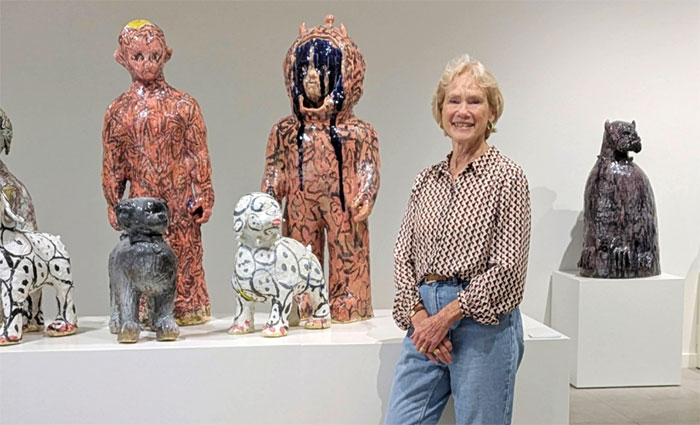
Coye, a member of American Museum of Ceramic Art’s Board of Directors since 2021, recently connected its Executive Director Beth Ann Gerstein with Sigway Energy and ReJoule.
“ReJoule secured a California Energy Commission grant for a pilot project focused on repurposing vehicle batteries as backup systems for solar installations,” Gerstein wrote in an email. “AMOCA was selected to participate in this innovative pilot program, which we successfully completed by installing 120 solar panels and a backup battery system housed in a container unit.” Coye then helped AMOCA create a plan to increase its solar capturing capabilities and secured another $50,000 grant from the Frankenthaler Climate Initiative to fund the installation of additional solar panels.
The Trump administration’s skepticism about climate change could impact his future advocacy, Coye said.
“The stability that was held out by the Biden administration for a nonprofit institution, for example up to 50% of a solar panel, 50% of a battery, could be paid for by the U.S. Treasury,” he said. “So, there were real subsidies to make it more and more economic, and unfortunately, the Trump administration has upended that. And that’s unfortunate because there’s tremendous uncertainty and confusion about the financial viability going forward.”
Still, Coye has no plans on slowing down.
“Whether I can make any impact on this or not, who knows,” he said. “But it’s worth an effort.”
Doing his part in weaning local businesses and nonprofits off fossil fuels is a significant motivator, Coye said. Family is another.
“I have five grandchildren,” he said. “I wonder what kind of life they will have as we cook the planet.”





0 Comments