



Where does Claremont’s trash go?
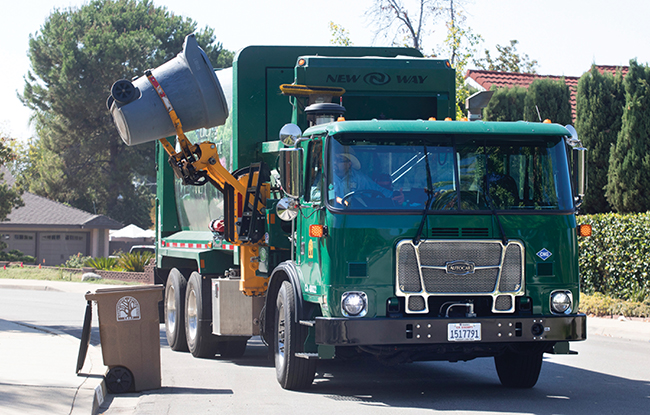
A City of Claremont garbage truck collects residential trash during its weekly pickup route. Courier file photo
by Andrew Alonzo | aalonzo@claremont-courier.com
Have you ever wondered what happens to the trash, recycling, and green waste hauled away each week by those large, lumbering garbage trucks? Following a prompt from a Courier reader, we asked Claremont Community Services Director Jeremy Swan.
After collection, the next stop for black bins — used for non-recyclable materials such as hard plastics and Styrofoam — is Claremont’s City Yard at 1616 Monte Vista Ave. They are then transferred onto trailers and taken to Mid-Valley Landfill in Rialto for disposal.
Blue bin recycling materials go on to Pomona Valley Transfer Station, where they are transferred into trailers then taken to Grand Central Recycling and Transfer Station in City of Industry, where it is sorted, processed, and prepared for marketing to end-user manufacturers.
Organic waste from green bins is delivered to the city yard, transferred into trailers, and hauled to American Organics, a composting facility in Victorville, where it “is composted and marketed to end-users such as agricultural uses,” Swan wrote in an email.
The city contracts with several vendors for its trash handling, including San Bernardino County for landfill services, Grand Central Recycling and Transfer Station for recyclable material processing and transfer trailer hauling services, Athens Services for organic waste processing services (composting), and Burrtec Waste Industries for construction and demolition debris processing. Claremont’s fiscal year 2025-26 sanitation budget is approximately $2.5 million.
Are Claremont’s waste management practices and policies considered environmentally friendly?
“Yes, the City was one of the first agencies in the region to roll out an organic waste recycling program to residential customers,” Swan wrote. “Unlike most other agencies, the City’s fee structure establishes fees based upon trash disposal volumes/frequency for both residential and commercial customers. Recycling and organic recycling collection is highly subsidized through the rates, offering a financial incentive to all customers to reduce trash and increase recycling and organic recycling. The City also offers programs uncommon in other jurisdictions including a free drop-off recycling center, curbside electronic waste collection, curbside used oil collection, and a sharps disposal site.”
City staff conducts contamination audits on each route each year, inspecting a random sample of customers to determine contamination rates. “When contamination is noted, education information is provided to help improve sorting,” Swan wrote. The City recently incorporated organics recycling education with its annual Fats, Oils, and Grease (FOG) inspections of food service establishments. This provides an opportunity to speak directly with food service establishments about their sorting practices and to provide educational information and follow up.”
For tips on sorting and contamination, view the city’s online trash brochure at claremontca.gov, the city manager’s weekly update, or the quarterly city newsletter mailed to Claremont homes.
Trash collection begins at 6 a.m. Monday through Thursday. See claremontca.gov, and search “trash collection schedule” for your area’s collection date. Call the community services department at (909) 399-5431 for more info.



0 Comments