





Neiuber: CGU, Claremont Colleges celebrate 100th anniversary
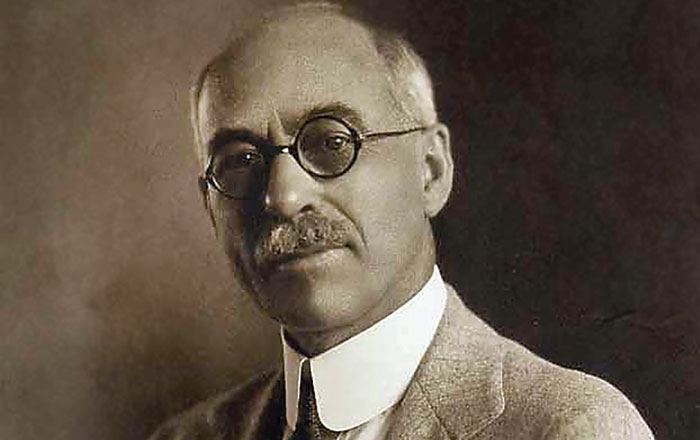
James Arnold Blaisdell was the fourth president of Pomona College and the visionary and driving force behind the formation of the group plan of the Claremont Colleges. Photo/ courtesy of Claremont Heritage
by John Neiuber
“Knowledge has to be improved, challenged, and increased constantly, or it vanishes.” – Peter Drucker
This October Claremont Graduate University celebrates its 100th anniversary. The founding of the graduate school also marks the 100th anniversary of the Claremont Colleges consortium. It is a simultaneous anniversary because its founding is what constituted the first step of “the group plan,” the idea brought forth by Pomona College President James A. Blaisdell, modeled after other consortiums of colleges such as Oxford and Cambridge.
Blaisdell was responding to a resolution put forth at the annual conference of congregational pastors in 1922 that urged Pomona College to increase its student body to 1,500 “as soon as possible,” at a time when the college had an enrollment of 750 students. The college debated three alternatives: limiting enrollment and remaining small; expanding into a large institution; and initiating a new model to meet the increased demand for education in Claremont.
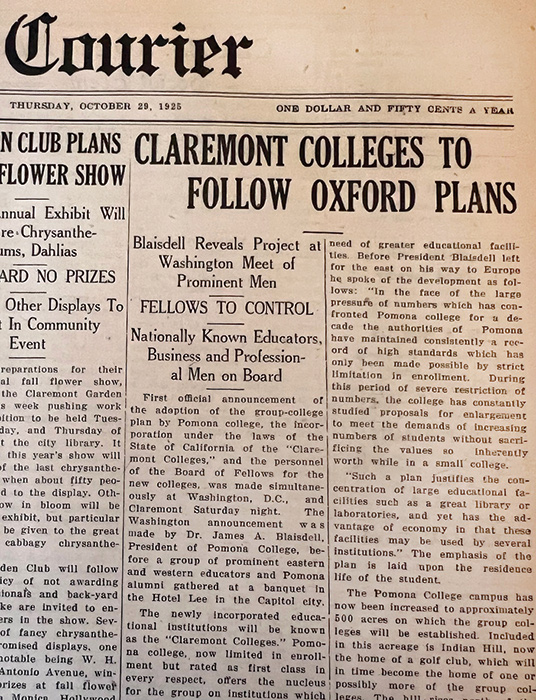
The October 29, 1925 Claremont Courier reported on the announcement of the formation of the Claremont Colleges. Photo/by John Neiuber
“Results are obtained by exploiting opportunities, not by solving problems.” – Peter Drucker
At the February 12, 1923 Pomona College trustee meeting, president Blaisdell suggested that “the advantage of close relationship between students and faculty might perhaps be preserved by developing a group system.” By October 1923, he had begun to formulate his ideas and shared them in a letter to Ellen Browning Scripps: “My own very deep hope is that instead of one great undifferentiated university, we might have a group of institutions divided into small colleges — somewhat on the Oxford type — around a library and other utilities which they would use in common. In this way I should hope to preserve the inestimable personal values of the small college while securing the facilities of the great university. Such a development would be a new and wonderful contribution to American Education.”
“Unless commitment is made, there are only promises and hopes; but no plans.” – Peter Drucker
On March 29, 1924, the trustees charged “the president of the Board, along with the trustee Committee on Education, with the duty of studying the future organization of this institution and such matters as may be involved with in any form of reorganization.” A committee was formed to investigate the group plan. They not only investigated, but they also formed a plan.
Blaisdell found a patron in Ellen Browning Scripps, who made a gift in early 1924 for the purchase of 250 acres that now includes California Botanic Garden, the Robert J. Bernard Biological Field Station, Claremont McKenna, Harvey Mudd, Pitzer, and Claremont Graduate University. Later in the year she made another gift that would establish Scripps, in 1926.
In “This is Claremont,” published in 1941, the authors report that “On October 14, 1925, the thirty-eighth anniversary of the founding of Pomona College, the Claremont Colleges drew its first corporate breath. It is now the graduate institution in the group of Associated Colleges, all of which have a relationship to each other in their origin, in their activities, and in their responsibilities.”
On Thursday, October 29, 1925, the Claremont Courier published a front page article, “Claremont Colleges to Follow Oxford Plans.” It reported on the simultaneous announcement of the group plan on Saturday, October 24, in both Washington, D.C. and Claremont. The Courier reported “The plan calls for the colleges to be as largely self-governing as possible, and to that end each college will be organized independently and will be encouraged to develop a special personality and character.”
Now, 100 years later, we see how Blaisdell’s vision has come to pass. Each of the colleges is organized independently, and each does have its own special personality and character.
The name and official seal of CGU have changed over the years since its founding as Claremont Colleges. It was next called Claremont College, then Claremont University College, then Claremont Graduate School, then Claremont University Center, and since it became dedicated to graduate study in 1999, Claremont Graduate University.
CGU has more than 26,000 alumni, and this month, many will return to celebrate its 100th anniversary. Beginning with its founders day on October 14, the university has a week of events planned, culminating with its centennial celebration dinner on Saturday, October 18.
CGU has contributed to the history and culture of Claremont, the state, the nation, and the world. It has reinvented itself over the years, and is poised to do so once again. Michelle Bligh, interim president of CGU, said the “Centennial is more than a look back. It’s a launch point. We look ahead with fresh energy, renewed purpose, and the same spirit of innovation that has always defined us.” That approach is embodied in Peter Drucker’s words: “The best way to predict your future is to create it.”






0 Comments