





This is Claremont: the origins of Pomona College
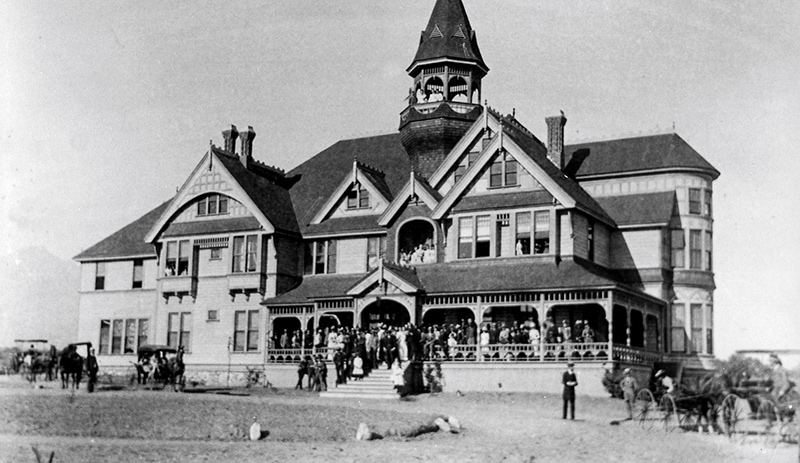
The Hotel Claremont became Claremont Hall when Pomona College moved in during the winter of 1888-89. Photo/courtesy of Claremont Heritage
by John Neiuber
The economic collapse that left the proposed town of Claremont with only brush, stones and white stakes, was also the death knell of the proposed site of Pomona College on Scanlon (Piedmont) Mesa by the end of September 1888, in spite of the laying of the cornerstone on the future college site on College Way.
Trustee the Rev. T.C. Hunt, of Pomona College, along with several other trustees, including Henry Austin Palmer, made good on his declaration of securing the empty Hotel Claremont for the college.
Hunt did not come across the idea of using the hotel on his own, but from lived experience. Hunt had attended the preparatory school of Carlton College when that institution began life in an abandoned hotel. Fortunately for Pomona College he recalled those days and was in a position to secure another abandoned hotel on another educational frontier.
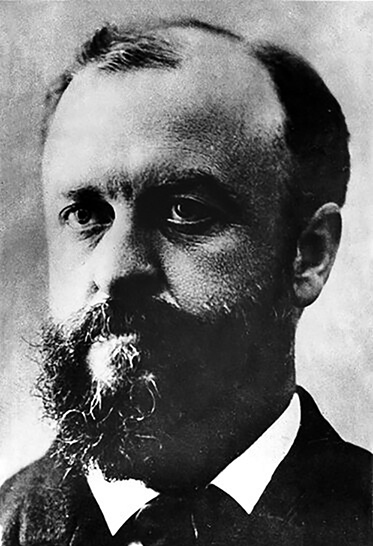
Cyrus Baldwin became the first president of Pomona College in 1890. Photo/courtesy of Claremont Heritage
However, the donors of the hotel stipulated that Claremont should be the permanent seat of the college, no doubt due to their extensive land holdings in the fledgling city and their inability to sell the plots. The site on Scanlon Mesa was so beautiful and the Pomona trustees were so convinced that it should be kept for the college, that the deed to the Claremont property was written to read “that some department of the college should have there its permanent seat.” The idea at the time was that a preparatory school would remain at Claremont and the college would eventually move to the mesa.
The idea was so well accepted and the work at Claremont so informed by the notion that the growth of the community was impeded for a few years, because people didn’t want to make their homes in an educational community that could very well soon be abandoned.
During the holiday season of 1888-89, the college moved its possessions in what was described as “a not overloaded one-horse wagon from the rented house in Pomona in which its first term of twelve weeks had been held, into the gift boom-hotel at Claremont.” Harold Davis, editor of the book, “This is Claremont,” tells us about the college and its move: “It could count as its valuable assets a little portion of solid earth, an unfinished shelter (too large to meet any visible needs) and, most valuable of all, an invisible idea.”
In 1890 the Rev. C.G. Baldwin was elected as the first president of the college. With his arrival the young institution took on new life. “Claremont the beautiful” woke from its boom-induced coma to become a college community. But the location of the permanent seat of the college was still in question. It was a question that was constantly in the collective mind of the community; but the conviction gaining ground with both the trustees and faculty was that there should be no further attempt to establish two institutions in different locations.
The matter came to a head at a trustees meeting in the winter of 1892-93, where the debate became heated. The Rev. J.K. McLean of Oakland interceded, “Now, brethren, let us take hold of this poker by the cool end.” A more measured debate then ensued and the vote was taken. It was decided that Claremont would be the permanent seat of all educational efforts of the board of trustees. The original site on Scanlon Mesa was deeded back to Henry Austion Palmer with damages, asked and awarded, for the hole dug in it as a basement for the proposed building.
The cornerstone that was laid with such high hopes remained in place on the mesa until it was recovered by the class of 1895 and installed where it still stands south of Carnegie Hall on College Avenue. It was inscribed in Greek with the class motto taken from Plato that translated means, “Not to live, but to live well.” Again, Harold Davis, tells us, “In the light of history this motto possibly might signify that the college could not live where originally intended, but could live well in Claremont.” That is how Pomona College came to be located in Claremont, where it has indeed lived well.
The first trustees were devoted to the interests of the college. Without their gifts of thought, time and money it is doubtful the young institution would have survived the hardships of those early days. Contributions by trustees such as Marston, Sumner, Blanchard, and Palmer cannot be overestimated, but not one of them could have or would have claimed to be the founder of the college. Or as Harold Davis said, “History should not in so short a time be superseded by legend.” The trustees functioned as the agents of a group of churches that made Claremont an educational center.




0 Comments