



Viewpoint: Claraboya’s pines must go
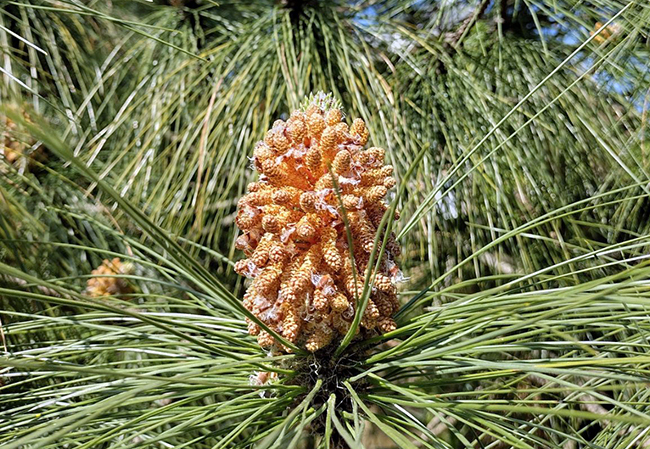
Photo/by John Grimshaw
by Michael Hertel
My family and I have lived in the Claraboya neighborhood since 1986 (and in Claremont since the late 1960s). Around 2 a.m. on October 26, 2003, I was awakened by loud pounding on our front door. It was the police telling us to evacuate in 20 minutes. Fire was racing toward our neighborhood. We grabbed everything we could think to carry and rushed down Mountain Avenue to safer ground.
That was the Grand Prix Fire. On October 19, 2023 the Courier published an article on its 20th anniversary, “Claremonters remember the ‘Fire from Hell,’” including reporter Patricia Yarbough’s account of the blaze: “Behaving in a manner apt for its name … the conflagration that literally sped through Claremont … at one point consumed an astounding 2,700 acres in a two-hour period.”
We were lucky. We got out down Mountain Avenue (the only way in and out of our foothill neighborhood) and our home was spared. Others were not. Fourteen of our neighbors lost their homes. Fifteen other neighbors’ homes were damaged.
Important things to remember from that fire: it moved with lightning speed. We had only a few minutes to get out (and that only because the police alerted us). The fire moved in ways that firefighters had not foreseen, racing down to the bottom of our hills and then back up. If residents hadn’t promptly evacuated, they could easily have been trapped, and there could have been injury and loss of life. (The contemporaneous Courier article reported some area residents suffered fatal heart attacks occasioned by the stress of the fire.)
Claraboya’s Canary Island pines (city trees) are big. Many are 100 feet tall. They grow large, thick limbs. Most are situated on Mountain Avenue but are also on the residential streets intersecting Mountain Avenue. Sources say they can live 100 years. They are native to the Canary Islands, a chain of Spanish islands off the northwest coast of Africa. They are known for their lengthy pine needles and for their ability to sprout after fires.
While some argue the trees are beautiful (I can’t argue that point) and add a “mountain like” character to Claraboya, the trees don’t ecologically fit; and Claraboya isn’t in the mountains. Claraboya’s foothills might be characterized as chaparral habitat that includes various oak species and relatively low trees, but nothing like these majestic pines. But then again, some would argue houses probably don’t belong in the high fire hazard foothills either.
Nevertheless, the homes are there, and public safety trumps an ersatz mountain forest. If Mountain Avenue had even one of the Canary Island pines come down during the Grand Prix Fire, or even a large limb, things could have been much worse.
There are lots of other complaints about the trees, including roots, debris, and blocking views (ironically, Claraboya Homeowners Association rules require flat roofs in Claraboya so as not to block the views of the valley below). In my book, public safety is the “killer argument” in this debate. (One could add city liability.)
We were lucky in the Grand Prix Fire. It could happen again. It makes sense to consider the unlikely toppling of one of the large number our majestic Canary Island pines onto Mountain Avenue (or that matter, any of the several side residential streets with Canary Islands pines towering over them) in a windstorm or fire creating a very real potential for injury or death.
Notwithstanding arborists’ reassurances the pines are healthy (implying low risk), if residents can’t evacuate or if first responders can’t reach them in an emergency, we will rue the day we thought “it can’t happen here,” or that the risk is sufficiently low we can ignore the outsize consequences of being wrong. Reluctantly, the trees should go.
Michael Hertel is a Claraboya resident.
Claremont Tree Committee’s next open to the public meeting takes place at 6 p.m. Wednesday, November 19 at Council Chambers, 225 W. Second St.



0 Comments