





Claremont Heritage: 100 years ago
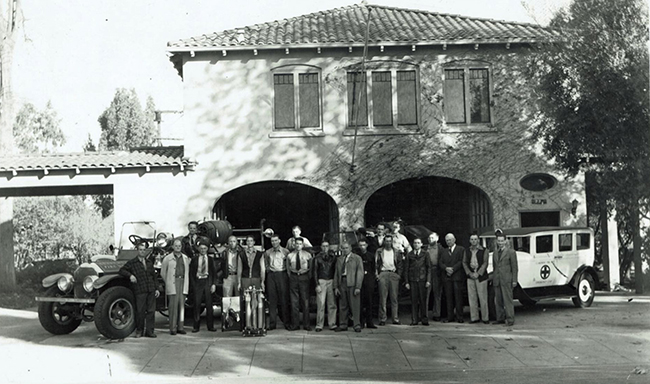
The December 3, 1925 Courier reported on the dedication of new city offices, fire department, and jail that are today home to the City Council chamber. This photo was taken in approximately 1947. Photo/courtesy of Claremont Heritage
by John Neiuber
I get a lot of my news from my devices; my computer, my cell phone, and my tablet connect me with the latest information. However, for local news I rely on the Claremont Courier. Sure, I visit the Courier website also, but I look forward to the mail delivery of the newspaper each Friday.
It is in my blood. My grandfather, Harry H. Hobart, was an owner and publisher of small-town newspapers. Newspapers he published are still in business today, the Princeton-Times Republic in Princeton, Wisconsin, and the nearby Chino Champion, now the Chino Valley Champion.
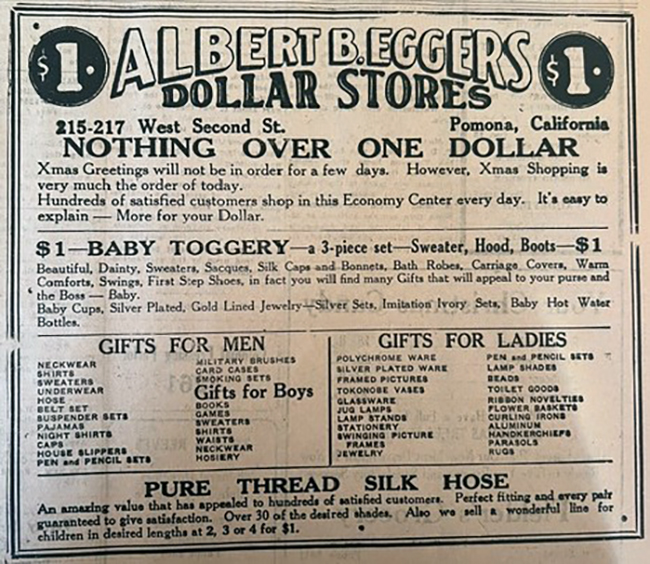
Lest we think the dollar store is a modern retail invention, this ad touts one in Pomona in 1925. Courier archive
He also published a dairy magazine, The Southlander, that served the dairy industry in the Chino/Corona area and Southern California. Playing with the linotype letters and words and arranging them in the wooden trays was a favorite pastime when a child. I loved the smell of the ink, newsprint, and the hot metal from the linotype machine in the print shop.
The bound books of Courier newspapers from 100 years ago are a particular pleasure to browse. It is interesting to read the news of the day, understand the perspectives, and to see what was being marketed in the advertising.
On December 3, 1925 the Courier reported on a major milestone in the city’s history: the construction and opening of the new city council rooms, city jail, and fire hall. The building still exists today on Second Street as part of city hall and houses the council chambers on the first floor, and city offices and a conference room on the second floor. The fire pole can still be seen in the foyer.
The opening was held on Monday, November 30th. The Courier reported “decorations and speeches alike were flowery Monday evening at the new fire hall and city council rooms when nearly three hundred people of the community gathered for the open house celebration of completion of the new municipal building,” where even “the new city jail, thrown open impartially to all residents of Claremont for the evening, temporarily took on a festive appearance.”
Also found in the December 3rd issue was an ad for the sale of a bungalow court near Pomona College that was listed for $21,000. It was a six-bungalow court, each with its own garage. It was advertised as bringing in an annual income of about $2,500 after taxes and expenses.
For the citrus industry in the December 3rd addition was an article entitled “Compressed Air Cure for Grove Troubles.” It was reported that the Soil Service Corporation of Los Angeles forced compressed air into the soil. The company claimed that forcing air into the earth stimulated soil bacteria into action and loosens the ground so that irrigation would penetrate deeper. Three groves in Claremont had recently been treated.
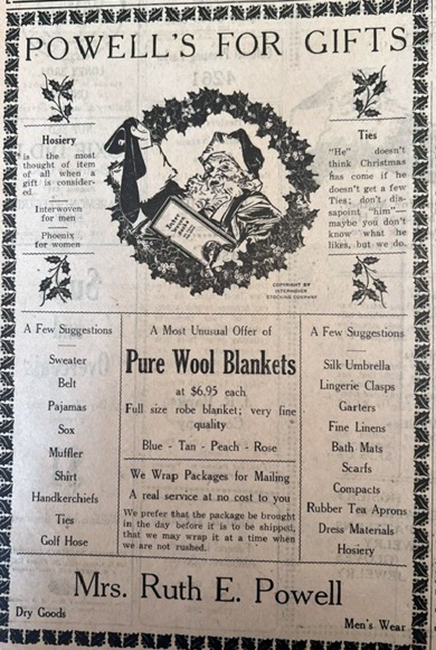
Ruth Powell’s was the go-to-store for gifts in Claremont. Courier archive
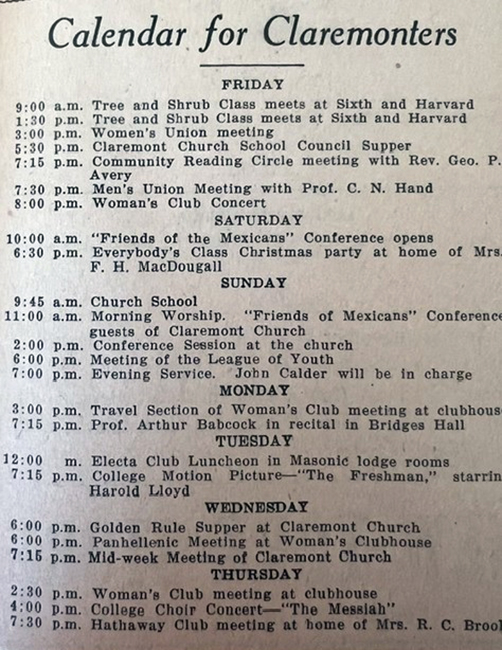
The “Calendar for Claremonters” appeared each week in the Courier just as it does today. Courier archive
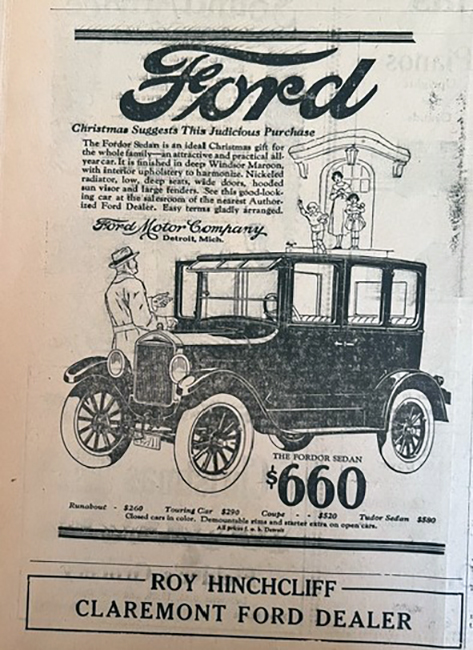
Claremont was home to a Ford dealership for many years that once occupied the building where the Village Grille is today. Courier archive
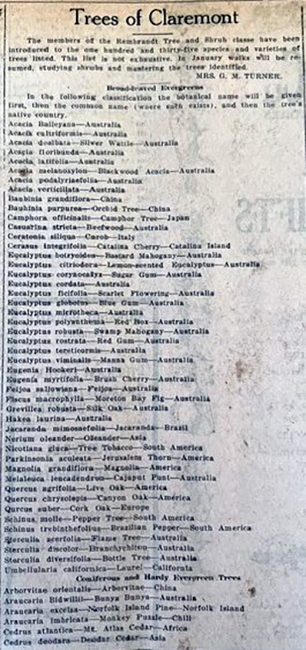
“Trees of Claremont” was a regular feature in the Courier. Courier archive
The Pomona Valley Telegraph and Telephone Union published a column called “Telephone Talks” that gave instruction on the proper etiquette for “party lines.” It was called “Don’t Listen In On A Party Line.” A party line was a single telephone line shared by multiple users, anywhere from two to over a dozen people. In addition to laying out the etiquette of hanging up if one picks up the phone and hears voices, it was suggested that “The Golden Rule comes in handy in such cases.”
The Roy Hincliff Claremont Ford Dealer ran an ad in the Courier during December that “The Fordor Sedan is an ideal Christmas gift for the whole family—an attractive and practical all-year car.” The Fordor Sedan was the highest priced vehicle in the Ford lineup at $660; however, a Runabout could be purchased for $260.
In the early days of Claremont, the predecessor to the City Council was the Board of Trustees. The December 10th edition reported on the new city ordinance for regulating businesses passed by the Board of Trustees that would take effect January 1. Business licenses would be required going forward. According to the new ordinance, it provided “for licensing and regulating certain kinds of business, trades, professions, exhibitions and occupations transacted and carried on in the city of Claremont, fixing the amount and providing for the collection thereof.”
The December 31st edition touted the achievements of 1925, including the new city hall, a new building ordinance, new water and sewer lines, gas mains, sidewalks, and curbs. Improvements for the coming year included many new paving programs and the installation of additional streetlights.
One editorial was about paying taxes. Taxes had increased due to various improvement bonds, but were still lower than most surrounding cities. Courier editor Tobias Larson concluded that “instead of kicking about the taxes we pay, let us be thankful we have property on which we have the privilege to pay a tax.”


0 Comments