





Diego Rios’ death is ruled a homicide
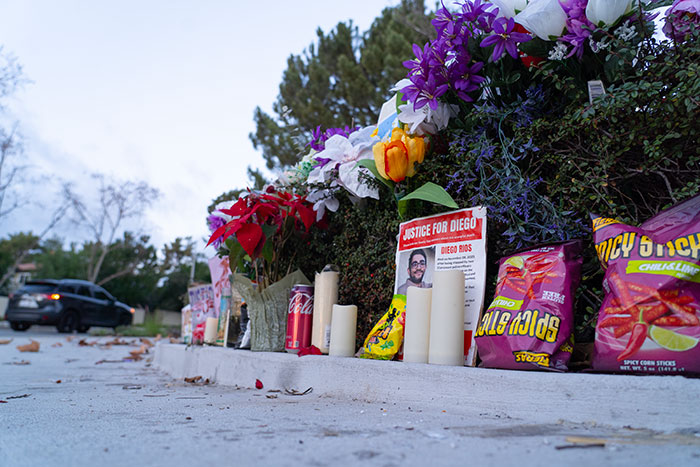
Fresh flowers, candles, and other items adorn the memorial for Diego Rios at the corner of Claremont Boulevard and Andrew Drive on Wednesday, near the spot where the 30-year-old died after a November 2025 traffic stop by Claremont police. Courier photo/Andrew Alonzo
by Andrew Alonzo | aalonzo@claremont-courier.com
The Los Angeles County Medical Examiner’s Office has ruled the death of Diego Rios a homicide.
Rios, 30, died November 28, 2025 following a traffic stop by Claremont Police Department officer Joshua Orona and Corporal Benjamin Alba.
On Thursday, the LA County Deputy Medical Examiner’s office released its autopsy and toxicology findings. Its “summary and opinion narrative” reads in part:
“Body camera footage of Mr. Rios’ encounter with law enforcement personnel was reviewed. It showed the use of a choke hold and prone physical restraint, including a knee on Mr. Rios’ right upper back, during his interaction with law enforcement personnel. The choke hold itself did not incapacitate Mr. Rios as he continued to move and react after it was released.
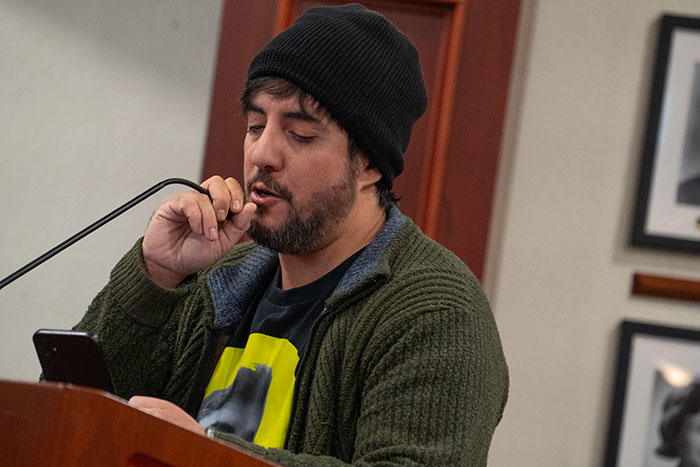
Victor Rios Jr. pictured at Tuesday’s Claremont City Council meeting urging the city to release information regarding two Claremont Police officers who were involved in the November 2025 traffic stop that resulted in the death of his brother. Courier photo/Andrew Alonzo
“At autopsy there were no traumatic injuries to the anterior or posterior neck. The knee on his right upper back did not cause any fractures or injuries to internal organs. Based on the video footage there does not appear to be an overt asphyxial event throughout the encounter. However, the temporal relationship between the prone physical restraint and cardiopulmonary arrest suggests that these two events were likely not simply coincidental. Based on the autopsy findings, toxicology testing, and body camera footage Mr. Rios’ death was multifactorial in etiology. Autopsy cannot determine the extent to which each individual factor played a role in death.
“The cause of death is cardiopulmonary arrest due to effects of cocaine and atherosclerotic cardiovascular disease in the setting of prone physical restraint. The manner of death is homicide due to volitional human involvement regardless of the intent of any individuals’ actions.”
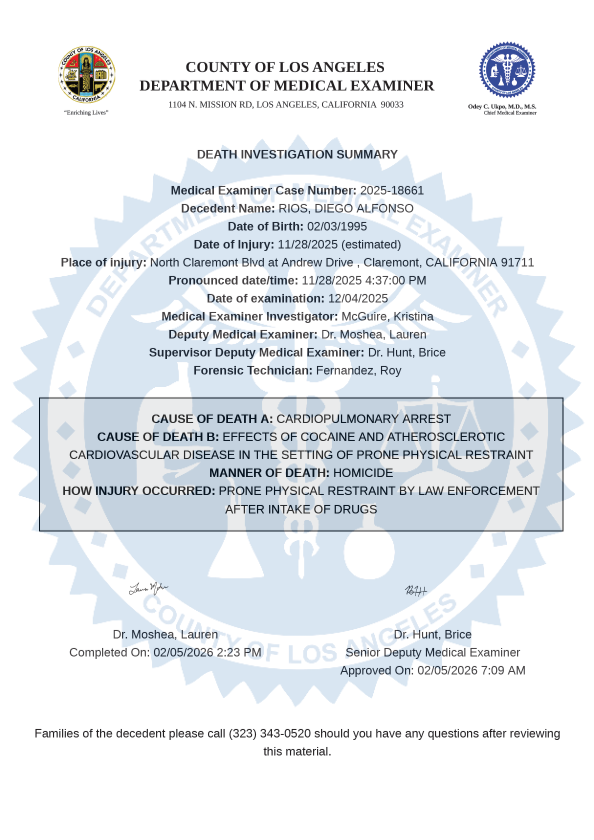
On Thursday, the LA County Deputy Medical Examiner’s office released its autopsy and toxicology findings. Click on the image above to read the report.
“Cardiopulmonary arrest,” also known as cardiac arrest, occurs when a person’s heart suddenly stops beating. “Effects of cocaine and atherosclerotic cardiovascular disease in the setting of prone physical restraint,” relates to a combination of factors including the effects of cocaine; plaque accumulation in a person’s arterial walls, also known as atherosclerotic cardiovascular disease; and physical restraint of a person in a prone position.
“They found cocaine in [Diego’s] system, but the important takeaway is that this was a homicide,” said Rios family lawyer Arnoldo Casillas of Casillas & Associates. “He died because the officers. Part of our conclusion is because of their unlawful and wrongful chokehold as well as improper and unlawful physical restraint.” Casillias said the family intends to file a lawsuit against the city. “All of this will be spelled out in a lawsuit once it’s filed. As soon as our investigation ends, we’ll make a decision as to that lawsuit.”
On Monday, LA County District Attorney’s Office spokesperson Greg Risling said the incident was still under review by the DA’s Justice System Integrity Division, which evaluates allegations of criminal misconduct and prosecutes public officials who engage in criminal activity in their official capacities. An investigations by the Sheriff Department’s Homicide Bureau is also ongoing. Claremont officials have vowed to release the findings to the public once they have been finalized.
Claremont Public Information Officer Bevin Handel released a written statement Thursday: “The Homicide determination from the Medical Examiner’s office is not an investigative finding nor a criminal charge. The Medical Examiner does not make this determination. The case is still under investigation by the Los Angeles County Sheriff’s Department’s Homicide Bureau and the Los Angeles County District Attorney’s Office of Justice System Integrity Division.”
The City of Claremont released 18 videos of the fatal traffic stop last month, which are viewable at vimeo.com/cityofclaremontca. On Monday, the city posted a frequently asked questions page at claremontca.gov (search “Use of force release of records”). The page addressed concerns from Rios family members and members of the public about approximately three minutes of missing footage from Alba’s body camera, from 3:25 to 3:28 p.m.
“Corporal Benjamin Alba’s body worn camera was inadvertently paused during the struggle to handcuff Mr. Rios,” reads the explanation at claremontca.gov. “During Corporal Alba’s attempt to bring Mr. Rios’s hand behind Mr. Rios’s back, their arms hit the button on Corporal Alba’s body worn camera that starts and stops the recording. Hitting this button paused Corporal Alba’s camera. Corporal Alba’s camera was paused for approximately two and a half minutes. When Corporal Alba realized his camera had been paused, he pushed the button to resume recording.”
Footage reviewed by the Courier among the 18 videos released by the city, begins at approximately 3:19 p.m. with Rios in an apparent mental health crisis prior to the traffic stop. It shows Orona pulling Rios over at 3:22. Alba arrives at 3:24, Rios gets out of his car, a struggle ensues, with Alba and Orona trying repeatedly to handcuff Rios, Alba using a chokehold to bring Rios to the ground then unholstering his taser and threatening to use it on Rios, Alba with his knee on Rios’ back for 1 minute, 55 seconds, Orona in a seated position on Rios’ buttocks for 1 minute, 52 seconds, and both officers turning Rios over and beginning to administer CPR after noticing he is unresponsive. EMTs arrive at 3:36 p.m. and continue CPR at the scene until 4:10, at which time Rios is loaded into an ambulance and taken to Pomona Valley Hospital Medical Center, where he was later pronounced dead.
During public comment at Tuesday’s Claremont City Council meeting, Rios’ brother, Victor Rios Jr., asked why the city is not saying whether or not Alba and/or Orona are still on the job.
“The medical examiner defines homicide as ‘The action of one person directly causing the death of another,’” Rios Jr. said. “My brother is dead, and the only two people present in his final moments were Alba and Orona. So, I’m asking a question here, if a homicide determination is not grounds for an officer to be considered unfit or a risk to public safety, then what is? What does an officer of Claremont have to do to cross that line?”
The City Council or City Attorney Alisha Patterson did not respond. But on Monday the city posted this on its FAQ page:
“While certain information related to an officer’s employment status is subject to disclosure under the [California Public Records Act] … whether an officer is currently on leave or out in the field is not generally subject to disclosure and is protected by general privacy rights and confidentiality provisions … The City would not allow a police officer to remain on active duty if the City had reason to believe the officer was unfit to serve or would otherwise present a risk to public safety.”
The case has rocked the community, with Rios family members and friends, other concerned citizens, and college students attending recent City Council meetings to push for answers.
The Claremont Police Commission is set to address “state laws and processes that govern public disclosure of information relating to police incidents” at its 7 p.m. Thursday, April 2 open to the public meeting at City Council chambers, 225 W. Second St., Claremont, CA 91711. For more info, go to claremontca.gov/home and search “police commission meetings.”




0 Comments