





CUSD report: LA County may intervene on budget deficit
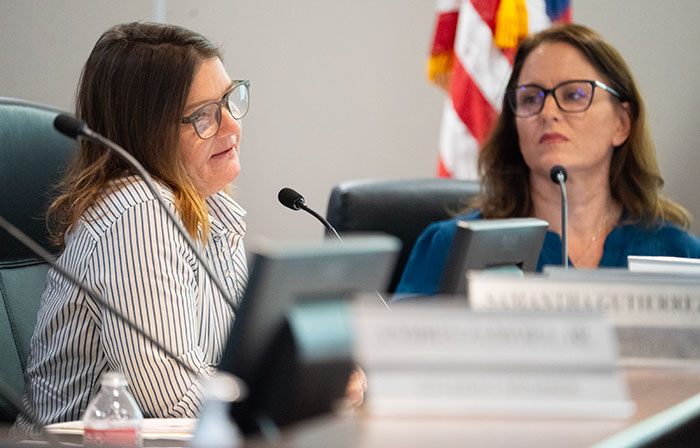
(L-R) CUSD Board of Education member Kathryn Dunn and Clerk Cheryl Fiello at the March 19 meeting. Courier photo/Andrew Alonzo
by Andrew Alonzo | aalonzo@claremont-courier.com
The Los Angeles County Department of Education has put Claremont Unified School District on notice: tighten up your budget or face “difficult decisions.”
The news came during Assistant Superintendent of Business Services Desiree Reyes’ presentation of CUSD’s second interim budget report at the March 19 Board of Education meeting, and on the heels of the December 2025 announcement that CUSD’s budget deficit estimate had ballooned to $11.49 million.
But there is a bit of good news for CUSD: its deficit shrunk by $654,589 in the interim.
Los Angeles County Department of Education, “indicated that if the deficit spending continues at this level, the district may be required to develop a fiscal stabilization plan, identifying areas of expenditure reductions to address the structural deficit and ensure the district maintains the minimum required reserve levels in future years,” Reyes said. “As reflected in our second interim report, the deficit spending trend continues and the county office may initiate the request upon review of this report. If required, this would involve a comprehensive review of all areas of the budget, including staffing, programs and operational costs, and could result in difficult decisions. Closing a structural deficit is not a single action. It is a multi-year process of aligning staffing, programs and operations with ongoing revenues.”
Reyes’ report included real budget figures through January 31 and the district’s projections for the next two fiscal years. It is linked in the March 19 agenda under item 15.01 at cusd-claremont.community.highbond.com.
District revenues are projected at $104,769,407 for 2025-26, expenditures $115,604,818, leaving the updated deficit of $10,835,411. The district plans to tap its reserve fund — currently at $22,817,526 — to make up the deficit. More deficits — $3.9 million in 2026-27 and $3.2 million in 2027-28 — are projected.
The $654,589 deficit reduction over the last three months “is primarily the result of additional Local Control Funding Formula revenue tied to transitional kindergarten average daily attendance, along with a modest increase in Special Education revenue,” CUSD spokesperson Elaine Kong wrote in an email.
Another notable change between the December and March reports was estimates of cost of living adjustments in 2026-27 shrunk from 3.02% to 2.41%, and from 3.42% to 3.06% in 2027-28. Cost of living adjustments are applied to the district’s annual allocation of its local control funding formula, a state funding source tied to attendance that helps pay employee salaries, benefits, supplies, and operating expenses. Estimates put CUSD’s share of the state’s local control funding formula money at $75.4 million in 2025-26, $76.2 million in 2026-27, and $77.2 million in 2027-28. Reyes said CUSD currently serves 6,010 students but projects a decline of approximately 125 per year in the coming years. And as enrollment declines, so does LCFF funding.
Reyes told the board that CUSD’s cost of living adjustments do not keep pace with state projections included in Governor Gavin Newsom’s 2026-27 budget proposal.
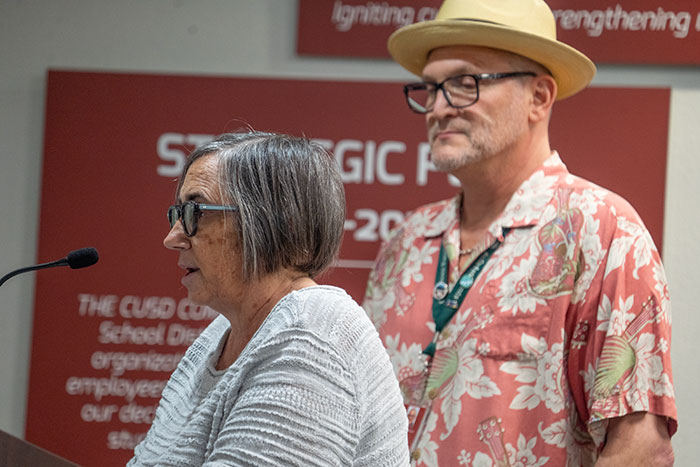
(L-R) CUSD Director of Educational Technology and Innovation Kara Evans and teacher on special assignment Brian D’Ambrosia-Donner presented an update on the district’s AI task force at the March 19 board of education meeting. Courier photo/Andrew Alonzo
“When compared to the [cost of living adjustment], CUSD’s [local control funding formula] based funding increase is lower due to declining enrollment and declining attendance rates. In 2025-26, with a COLA of 2.30 percent, we see an increase in LCFF funding of approximately 4.46 percent. With a COLA of 2.41 percent in 26-27, we see an increase of 1.08 percent. And in 27-28, with a projected COLA of 3.06 percent, we see an increase of 1.27 percent in LCFF funding. Due to declining enrollment, we are still not projected to receive a total funding increase to match the COLA.”
The board approved Reyes’ report with a “positive certification,” indicating CUSD will be able to maintain the state’s minimum reserve requirement for this and next two fiscal years.
Kong wrote in an email that, “As part of its ongoing fiscal planning, the District is reviewing expenditures across all departments and will bring any recommended adjustments to the Board of Education through the regular budget process.”
As for next steps, Reyes said CUSD will monitor wide economic risks such as stock market gains, the high cost of living in California, revenue reliance on high income earners, federal policy changes, declining enrollment, lower attendance rates, and pending compensation increases.
The board will hear its next financial update in June.
AI task force update
CUSD Director of Educational Technology and Innovation Kara Evans and educational technology teacher on special assignment Brian D’Ambrosia-Donner delivered an update on the district’s artificial intelligence task force, made up of CUSD faculty, administrators and staff.
Formed in October 2025, the goal of the group is to “move from broad conversation about artificial intelligence to clear district direction,” Evans said.
The task force has solicited input from constituents on the uses of AI across the district. Discussions have ranged from pros and cons to research on its impacts in education. Feedback will ultimately help CUSD craft a policy on the use of AI focusing on “responsible use, protecting student and staff privacy, and ensuring that any future use of AI aligns with the values of our district,” Evans said. “It’s about making sure that as AI is more present in schools and becomes an essential part of all of our lives, that CUSD is moving forward intentionally rather than reactively.”
D’Ambrosia-Donner spoke about crucial guardrails such as ensuring privacy; considering human judgment; and being sure policies are not ignorant to “classroom reality.”
“Students and teachers are already encountering AI in different ways,” D’Ambrosia-Donner said. “So the district’s approach needs to acknowledge that while we develop clearer guidance including a future scope and sequence for student use.”
Evans said the task force’s work will come with complex decisions.
“Every decision we make protects something and risks something,” Evans said. “Innovation can increase opportunity, but it introduces safety questions. Gaining clarity supports consistency, but too much rigidity can limit professional discretion. Efficiency is appealing, but not at the expense of human judgment. And moving quickly, while it feels proactive, if we move too quickly it erodes trust. No district can avoid these tradeoffs; the work is deciding which values we are committed to protecting. Our goal is not simply to respond to new technology, but to ensure that CUSD students graduate prepared to think critically, use emerging tools responsibly, and thrive in a world where AI will increasingly share how we work and how we learn.”
The next CUSD Board of Education meeting is set for 6 p.m. Thursday, April 2, at 170 W. San Jose Ave., Claremont.



0 Comments