





1991 was a good year …
by Mick Rhodes | editor@claremont-courier.com
There’s a lot going on in “1991: The Year Punk Broke,” but the most impactful character in the documentary film, which includes Kurt Cobain no less, does not appear on screen: it’s the approaching cultural tsunami that would be felt around the world just months later.
“It’s interesting, because this was a movie that was a mistake,” said Dennis Callaci, whose nonprofit event production company, Dirty Opera, is screening the film by director Dave Markey at 7:30 p.m. Thursday, September 18 at the Laemmle Claremont 5. “You see all this possibility and hope, and just like, what the f&#! is going to happen?”
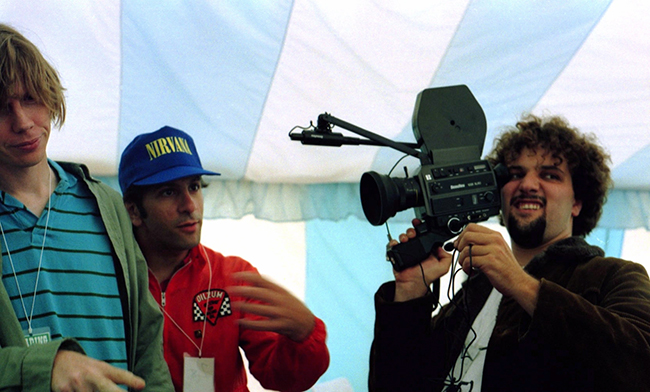
(L-R) Sonic Youth’s Thurston Moore and Lee Ranaldo, with filmmaker Dave Markey, during the making of “1991: The Year Punk Broke,” which is screening at the Laemmle Claremont 5 at 7:30 p.m. Thursday, September 18. Photo/courtesy of Dave Markey
What happened shortly after Markey shot the footage for “1991: The Year Punk Broke” was the September 24, 1991 release of Nirvana’s major label debut, “Nevermind,” which hit mainstream culture like an atomic bomb. The record cleared the decks of the vacant pomposity of the Poisons and Whitesnakes of the world, violently supplanting the overwrought, over-rouged status quo with punk-infused noise and abandon. “Nevermind” — which has sold 30 million copies to date — also reset America’s then massively influential rock radio playlists and sent the suits scrambling up to Seattle to find the next punk rock payday.
Markey, who is perhaps best known for directing the 1986 cult classic “Lovedolls Superstar,” will be on hand for a Q and A following the Claremont screening.
The film came about after Markey was asked by headliners Sonic Youth to bring his super 8 camera and accompany them on their 1991 summer European festival tour, for which they had tapped then up-and-coming Nirvana as their opening act. Markey caught perhaps the last moments of innocence for a music scene that up to then had been populated by outsider artists. As such, “1991: The Year Punk Broke” predates the cynicism, excess, — and tragedy — that would soon envelop a suddenly mainstream punk culture.
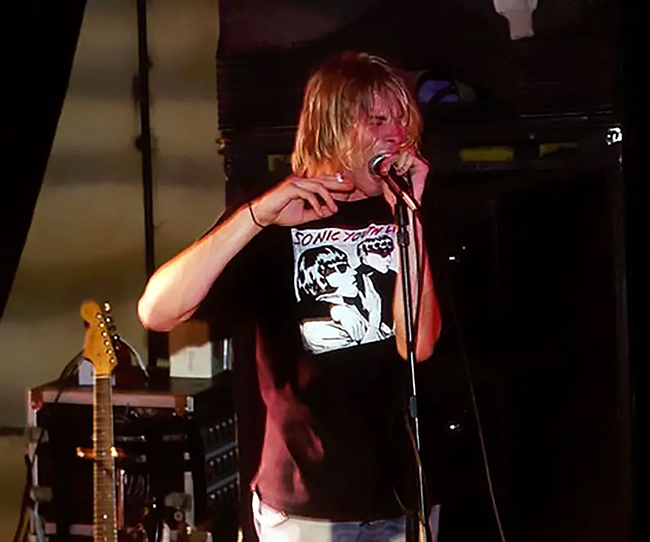
Nirvana frontman and songwriter Kurt Cobain in a still from “1991: The Year Punk Broke.” Photo/courtesy of Dave Markey
“All the bands [in the film] are so playful,” Callaci said. “It’s kind of the sweetness before the machinery kicks in and the major labels and you realize that you’re tethered to this beast, and nobody escapes.”
That applies especially to Cobain, who we see here fresh off recording “Nevermind” with Nirvana bandmates Dave Grohl and Krist Novoselic. The record is still “in the can,” slated for release after the tour, on September 24, 1991. This is Cobain before fame, success, and a heroin addiction proved too much, leading in part to his 1994 suicide at age 27. That sweetness Callaci describes in the film is certainly colored by the knowledge of what’s to come for the sensitive, physically fragile, quiet kid from Aberdeen with the outsized talent.
But “1991: The Year Punk Broke” is a celebration, not a eulogy. It includes raucous live sets by punk progenitors The Ramones, and from Nirvana, Sonic Youth, Babes in Toyland, and Gumball.
“We love the idea of Dave [Markey] just on the fly, being told, ‘Can you bring a super 8 camera and film this thing?’” Callaci said. “And this thing happened; it was right on the precipice of Nirvana breaking big, all these festival shows that summer before ‘Nevermind’ came out.”
Callaci is uniquely qualified to make that observation. The musician, songwriter, author, record label owner, and former longtime Rhino Records manager was embedded in indie-underground music in 1991. He saw firsthand how the culture shifted seemingly overnight after “Nevermind’s” first single, “Smells Like Teen Spirit,” became a phenomenon by year’s end.
“Nobody could have anticipated this happening, really, to a large degree,” Callaci said of the cultural explosion wrought by “Nevermind.”
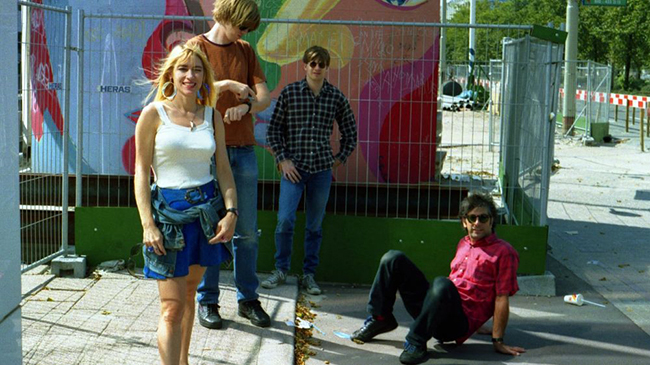
(L-R) Sonic Youth’s Kim Gordon, Thurston Moore, Steve Shelley, and Lee Ranaldo in a still from “1991: The Year Punk Broke.” Photo/by Dave Markey
The film’s format — super 8 — is in itself an unspoken nod to the proletariat DIY punk aesthetic.
“We talk about 4K, high K resolution,” Callaci said. “This was shot on super 8, and this is a film that … anybody can do it.”
And while the film is charmingly low-resolution, the performance audio, taken from mixing board tapes, is anything but. “It’s going to sound great, and it’s going to look like a super 8 film, which is what it is,” Callaci said. The performances, “are just spectacular. And the side footage is just fun. It’s a fun ride.”
Due to legal wrangling, it’s been 15 years since “1991: The Year Punk Broke” has been screened in Southern California. Callaci’s Dirty Opera partner Dimitri Coats’ wife, lawyer Inge De Bruyn, did much of the legal legwork necessary to make it happen, Callaci said. The result is powerful.
“I just think that message of the film is … don’t buy into the bullshit,” Callaci said. “And it’s also a warning: be careful. Be careful when you’re swimming with these sharks.”
Dirty Opera, comprised of Callaci, Coats, and Eddie Gonzalez, is currently working on setting up a Laemmle screening for Markey’s 2025 documentary, “The Secret Lives of Bill Bartell,” about the beloved, widely influential Riverside musician and songwriter, record label owner, police officer, and rodeo bull rider, who died in 2013.
Tickets for Dirty Opera’s 7:30 p.m. Thursday, September 18 screening of “1991: The Year Punk Broke,” with a Q and A with director Dave Markey to follow, are at laemmle.com/film/1991-year-punk-broke.
Public transportation matters
Last week’s decision by the San Bernardino County Transportation Authority Board of Directors to back out of the Gold Line light rail extension segment between Claremont and Montclair [“Gold Line bombshell: Claremont to Montclair segment in limbo,” September 5] is unfortunate for a variety of reasons, and sets back the region’s push toward reestablishing a robust public transportation system just when it should be expanding.
Ask anyone who has traveled in Europe or to American cities such as New York or San Francisco: vigorous and affordable public transportation is an incalculable asset to a city or region. Southern California’s regrettable history in this regard is well documented; at one time Los Angeles had the most extensive electric railway system in the world. Now we have hundreds (thousands?) of vacant, rotting suburban strip malls, hundreds of miles of mostly ugly freeways, astronomical housing costs, and the worst air pollution in the country. Oopsie!
Even though the proposed Claremont to Montclair Gold Line segment is less than a mile, the symbolism of kneecapping light rail’s push from LA County into San Bernardino County can’t be overstated. The segment would have been a big win for long-suffering light rail advocates and locals.
Though the plan to push into Montclair has been scuttled, the forthcoming Pomona to Claremont segment is funded and is still expected to come to fruition. (Earlier estimates for the Pomona to Montclair segment established a spring 2031 opening date. It’s unclear how the change in plans will impact that projection.) Another thing to consider is once Claremont’s station opens, folks from Montclair and to the east will be traveling to and parking here to ride the Gold Line into LA, Little Tokyo, and to transfer trips to Santa Monica or Long Beach. I imagine the traffic impact study of this unplanned influx of cars is already underway.
Thwarting the San Bernardino County section of the expensive but vital push to reestablish Southern California as a region that cares about public transportation is shortsighted and counterproductive. I for one hope the San Bernardino County Transportation Authority Board of Directors will reconsider.





0 Comments