





Bridges is back: A new chapter awaits for Pomona College’s jewel
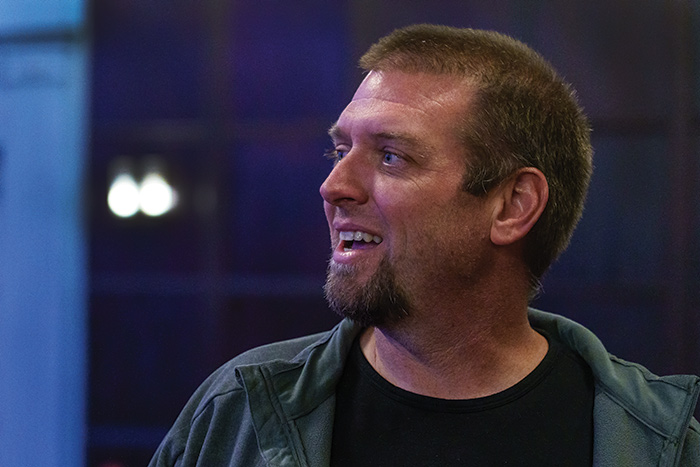
Director of Bridges Auditorium and Public Programming Matt Pavey leads a tour of the reinvigorated venue on December 6. Courier photo/Peter Weinberger
by Mick Rhodes | editor@claremont-courier.com
Fifteen-year-old boys aren’t generally known for making great life decisions, but Matt Pavey is an exception.
After leading a December 6 press tour of the newly reinvigorated Bridges Auditorium, Pavey, director of Bridges Auditorium and public programming, pointed to his house manager and former Claremont High Theater Director Krista Elhai, who was standing nearby. “Talk about full circle here … that was my high school theater teacher,” said the 2004 Claremont High graduate. “She’s actually probably the reason I’m here. I came in with the Claremont High theater program as a freshman or sophomore … and just never left. I think I was volunteering for the first couple months and wouldn’t leave. They finally said, ‘We’ve got to start paying him.’” Now 24 years later, “Krista’s joined us as house manager, and we’re all back together.”
Quiet, hardworking, and eager, Pavey, now 39, eventually worked his way up to lead audio, then technical director, production manager, and six months ago was promoted to director of the building he’s spent more than half his life in.
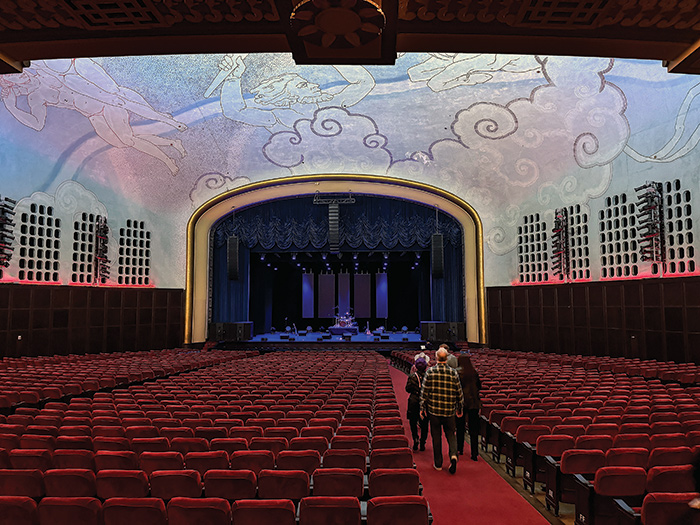
Bridges Auditorium has a capacity of 2,400, 1,800 on the floor and 600 in the balcony. Courier photo/Peter Weinberger
He’s still eager and hardworking, and the self-described introvert is now learning to be the public face of the storied venue that he, along with generations of Sagehens and countless others, has loved.
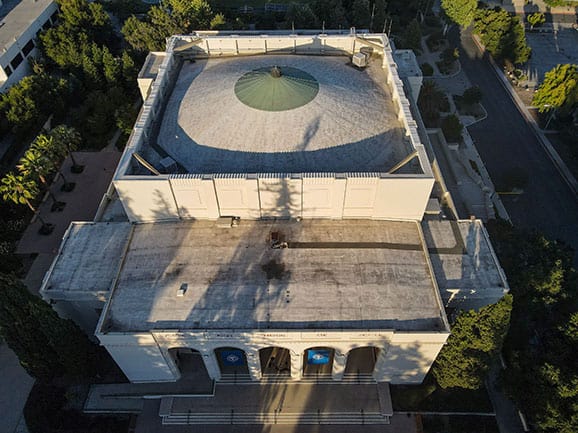
And with his new title has come a mission: he is focused on reestablishing Bridges as a regional live music and performance venue. And who better to remind devotees and introduce a new generation to the unique, historic charms of Bridges Auditorium? The 2,400-seat 1931 architectural jewel is “practically my living room at this point,” Pavey said.
Music, man
Though big name touring acts such as Taylor Swift, John Mayer, and Willie Nelson have made sporadic appearances since the teenage Pavey first became enamored with Bridges in 2001, the venue has been primarily used — some might say underused — for Claremont Colleges and community events.
“When I started here we were doing music; we were doing Willie Nelson [in 2013], we were doing all these shows, and it’s such an amazing experience as you know, concerts in this venue,” Pavey said. “And to have a space like this in your own town in the Village that you can walk to, or for some you can stumble to, to have this here and not use it just felt wrong.”
The old model was safe, assuring Pomona College was exposed to little financial risk.
“Everything was just about breaking even and bringing accessible shows in for the students to see them with $5 tickets or even free tickets for a lot of those shows,” Pavey said. “And when we were bringing in the music years and years ago it was really under this model to break even. It was just to bring music in for the students and never trying to make any money.”
Now with Bridges’ centennial approaching, Pomona has entrusted the reins to Pavey, who has since been working to reposition the architecturally magnificent if underused venue.
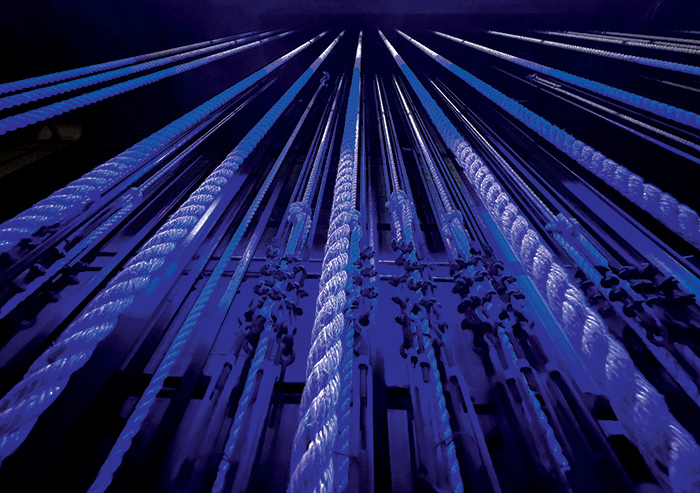
These long metal cables illuminated backstage in pre-show blue are used to hoist and deploy scenery, lighting, audio, and other production elements. Courier photo/Peter Weinberger
“I don’t want to take credit for it, but I feel like I was driving it,” Pavey said when asked what prompted Pomona to change direction. “I was the squeaky wheel around here going, ‘We have to get back to music.’”
Part of his charge is to get Bridges to the point where it can stand on its own financially and bring in revenue for Pomona College and student services. “My goal, selfishly, is I want to hear great music and have great experiences for the community,” Pavey said. “On the other side of that, the business side, yes, we need to start making a little bit of money.”
The first show under Pavey’s watch took place last Friday with local deep cover faves the Dogs and Pink Floyd tribute band Which One’s Pink?
“Just opening the doors and coming out here and shaking hands and smiling, going in and clapping and cheering with the crowd has honestly been a blast. As an introvert, it has been terrifying, but also so much fun as somebody who loves this building.”
Pavey’s vision of bringing touring recording artists to Claremont will start in earnest next March 12 with Minnesota bluegrass jammers Trampled By Turtles, followed by New Orleans “supafunkrock” master Trombone Shorty and Orleans Avenue on March 21, and Rock ‘n’ Roll Hall of Fame legends Cheap Trick on April 21.
Bridges also has holiday shows this month, beginning with Inland Pacific Ballet’s production of “The Nutcracker” December 13-14, and “A Charlie Brown Christmas” December 18. Tickets for all shows and more info are at pomona.edu/administration, search “Bridges.”
Ticket prices will vary depending on artist fees.
“One of our core things that we decided as a group here at Bridges is that we don’t want to be like other venues. We don’t want to gouge people,” Pavey said. “That’s not why we’re here. Experience is number one, not gouging people. So, you come here, you’re looking at free parking. You won’t get that in an LA venue. Our alcohol prices are insane; we’re looking at $10 beers. I don’t know the last time I went to a concert and saw $10 beers. We’re trying to keep all these small add-ons affordable to complete the experience.”
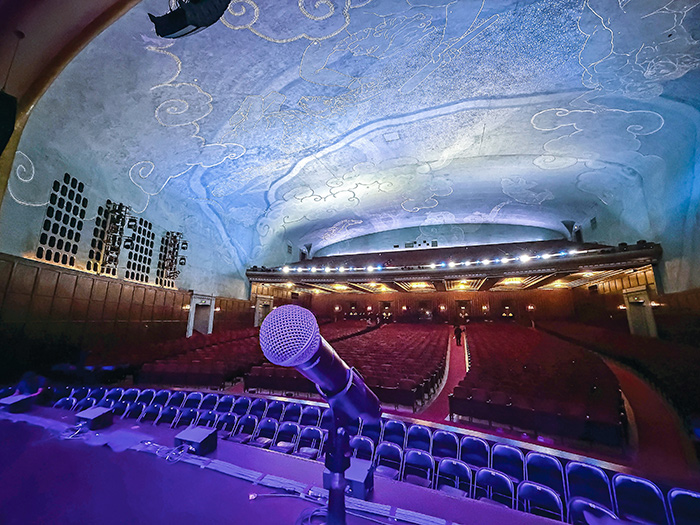
A view from the stage at Bridges Auditorium showing Giovanni Smeraldi’s breathtaking 22,000-square-foot ceiling mural. Courier photo/Peter Weinberger
Concert tours are arranged by agents, and many in the music industry haven’t heard from Bridges Auditorium in 10 years or more. This has presented an early challenge for Pavey.
“We’re not friends yet,” Pavey said of his relationships with agents. “So you’re not getting those friendly deals. You’re not getting the insider, up-to-date info before anybody else.” The agents are “giving us probably higher than normal rates, just testing us. We’re pushing back when we can and trying to keep things as affordable as possible so we can keep the doors open.”
Another hurdle in maximizing Bridges’ potential as a viable regional concert venue has been non-compete or “radius clauses” that venue operators commonly negotiate with artists, which forbid acts from performing within a certain radius — say 50 miles — of a venue for weeks or months before and/or after their appearance. In this scenario, an act that plays a venue in LA may be contractually obligated not to appear at Bridges, which is less than 40 miles from downtown.
“The agents, in defense of the artist, don’t want to burn the LA venues,” Pavey said. “So a lot of this is reprogramming these agents that yes, we’re only 30 miles away from LA, but we couldn’t be further apart. The LA folks are not going to drive east to us. All we’re going to get is Inland Empire people, who come out for great shows, and we’re going to get this local community that chances are, wasn’t going to go out to LA anyway, not for the smaller stuff.
“So we are unique. We’re not competing with the LA market.”
Bridges’ most direct competition in the area is Yaamava Theater, just over 30 miles east in Highland, which books some similar level performers and also requires artists to adhere to radius clauses.
“We can’t compete with a casino,” Pavey said. “They will take a loss on a show for a night because they’re going to make it up at the tables and hotels and things like that. A lot of this is playing nice with them so they don’t get upset and start undercutting all the artists that we want.”
Limitations of century-old charm
The LA Philharmonic was the opening act for Bridges’ October 1931 dedication. With its northern Italian Renaissance design by architect William Templeton Johnson and breathtaking 22,000-square-foot ceiling mural by Giovanni Smeraldi — whose work can also be seen at New York’s Grand Central Station, the Biltmore Hotel in LA, and the White House’s Blue Room — Bridges was widely considered the finest auditorium in Southern California. In October 2003, 72 years after christening Bridges, the LA Philharmonic inaugurated the late Frank Gehry’s masterpiece, Walt Disney Concert Hall in Los Angeles, where it enjoys state-of-the-art amenities to this day.
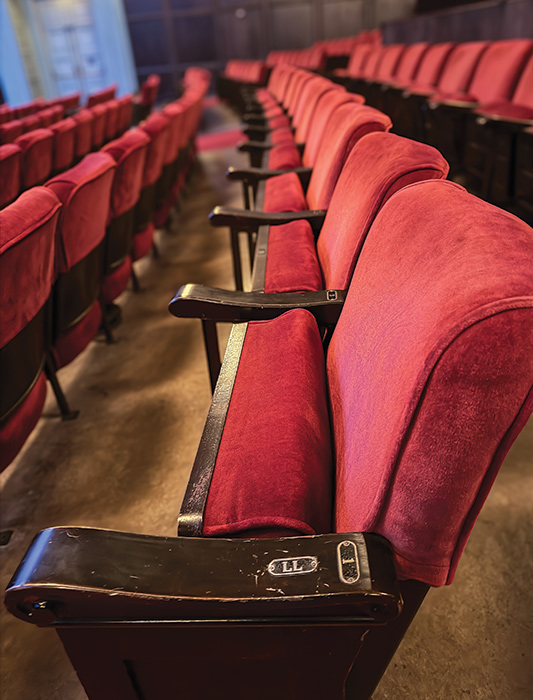
Bridges’ 2,400 seats were reupholstered in the 1970s, but still boast the original 1931 frames. Courier photo/Peter Weinberger
Meanwhile, Bridges is still operating with century-old plumbing and electrical, no air conditioning, and its de facto centerpiece — Smeraldi’s masterpiece — is long overdue for refurbishment to repair cracks and water damage. Pavey also mentioned Bridges’ 2,400 seats (1,800 on the floor, 600 in the balcony), which are still mounted on their original 1931 frames and designed for the much smaller American bodies of the day, with tight aisle spacing, as items he hopes to improve upon going forward.
Pavey said his Bridges team has developed a wish list and turned it over to Pomona College, and a discussion about possible funding sources has begun.
“This whole thing is leading up to our centennial in 2031,” Pavey said. “And I’m staying hopeful that we’re going to get a renovation done as well to keep us going for another 100 years.”
Though its infrastructure may be outdated, one thing that is not lacking is Bridges’ cleanliness. Every surface — from the lobby to backstage — was gleaming on December 7.
“Our maintenance teams and housekeeping teams do a phenomenal job, as you can see,” Pavey said. “But 100 years is 100 years.”
Any other venue with such antiquated quirks — like having just one shower backstage — would be hard pressed to lure touring acts, but Bridges is distinctive, Pavey said.
“I think a lot of the artists who come here once they see the building and they see the charm, the can look past everything,” Pavey said. “I think a lot of people love the older dressing rooms and the older style of things backstage. You honestly don’t see that in other venues. Everything’s very generic, very white wall. It’s not this. This is very unique. So I think that charm is something the artists really appreciate.”
Putting ‘Walter’ to bed
Rumor has long had it that Bridges is haunted by a man called Walter, who is purported to have died during construction.
“I was so burned out about hearing about Walter years ago that I went and pulled every Courier article from 1928 to 1932,” Pavey said. “I pored through every last one of them … and there was no mention of anybody that died.”
Pavey also scoured Bridges’ still fully archived construction logs at Scripps College’s Dennison Library. “I’ve gone through every last one of those, and the only thing that happened during construction was a small fire on the roof during lunch. The roofers left tar going, and it was out before lunch was over.”
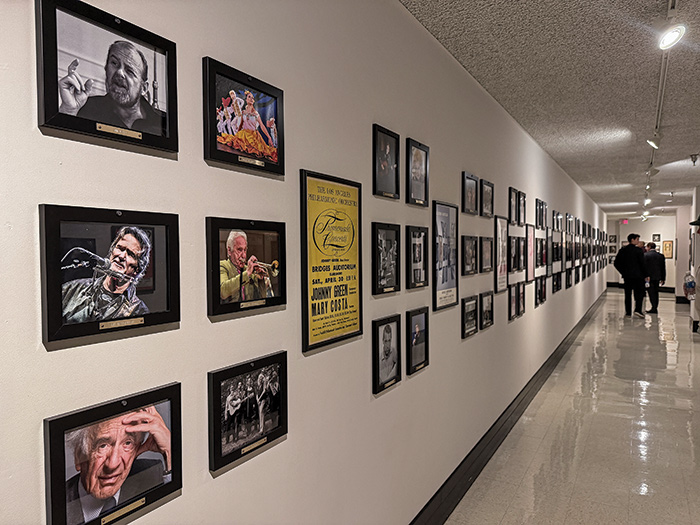
Photos of some of the hundreds of notables who have trod Bridges’ stage over nearly 100 years, including Ray Charles, Sandra Day O’Connor, Steve Martin, Johnny Cash, Amelia Earhart, Lucille Ball, and Maya Angelou, are displayed in a basement hallway. Courier photo/Peter Weinberger
So, after decades of speculation, it turns out the rumors of Walter’s death have been greatly exaggerated.
“I debunked Walter,” Pavey said.
You read it here, folks.
‘The best thing ever’
For Pavey, seeing Bridges coming alive again has been “the best thing ever.”
“Kicking these doors open and letting people in to do exactly what this building is designed for … it feels good,” he said. “It’s an immense amount of pressure … but this is practically my living room at this point. I feel very comfortable here. I feel very comfortable talking about Bridges. But yeah, get me in any other setting and talking about anything else and I’m going to shut down on you.”
1 Comment
Submit a Comment
You must be logged in to post a comment.



Would love to watch Ben Harper perform at Bridges again.