




Council approves changes to federal community block grant
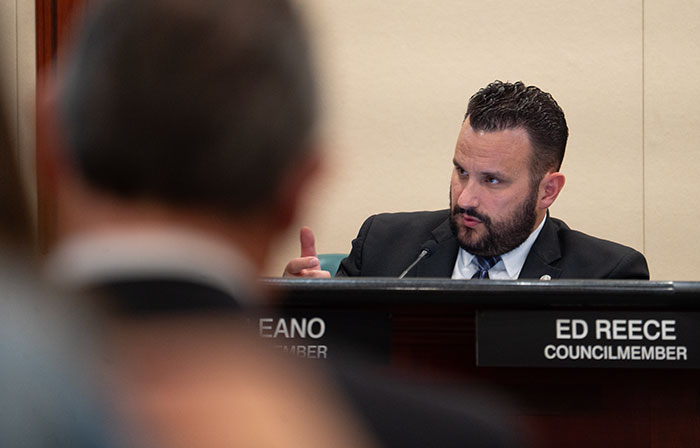
Council member Ed Reece at the November 25 Claremont City Council meeting. Courier photo/Andrew Alonzo
by Andrew Alonzo | aalonzo@claremont-courier.com
The Claremont City Council spent much of its November 25 meeting listening to a legislative update from state Senator Sasha Renee Perez.
After that, it voted unanimously to adopt the state’s updated building codes for local use; and approve funding and an amendment for the city’s housing rehabilitation program, funded through the federal community development block grant.
Senator Perez
Kicking off the meeting was a legislative year-in-review by Senator Perez of California’s 25th Senate District.
Perez highlighted the passage of Senate Bill 124 and SB 581, legislation meant to train and fund the transition of CalFIRE firefighters from nine-month seasonal work to year-round; budget trailer bills SB 105 and 131, which support housing and homelessness efforts; budget trailer bills SB 134 and AB 134 which provide $100 million to cover federal cuts to the Victims of Crime Act program; increasing funding for the California Film and Television Tax Credit program via Assembly Bill 1138; and SB 571, which gives judges the ability to increase criminal penalties for people who are convicted of impersonating first responders and burglarize unguarded homes during emergencies.
Among the bills Perez authored and helped pass this year were Senate Bill 293, the generational homeownership protection act; SB 547, the commercial insurance protection act; SB 610, the disaster protections for homeowners and renters; SB 782, the enhanced infrastructure financing district; SB 98, sending alerts to families in education (SAFE) Act; SB 805, the no vigilantes act; and SB 848, safe learning environments act. Links to the bills’ text are at claremont-courier.com.
Perez also talked about how state efforts to fund municipalities, agencies and organizations affected by the January wildfires.
“We want to ensure that our residents have the resources that they need as they go through the recovery process,” she said. “We faced many challenges with the federal government, and our constituents have faced many delays with [Federal Emergency Management Agency] funding and FEMA assistance. And so, we’re continuing to have to think creatively about how we step in and fill some of those gaps to make sure that those that are facing housing insecurity are not falling into homelessness.”
Community development block grant
Claremont Senior Management Analyst Alex Cousins spoke about the fiscal year 2026-27 — July 1, 2026 to June 30, 2027 — budget and amendments to the city’s community development block grant program. The program, which helps low- and moderate-income people, is funded by the U.S. Department of Housing and Urban Development and administered by the LA County Development Authority.
In Claremont, the grant money funds housing rehabilitation, senior case management, and job creation/business incentive programs.
Claremont estimates it will receive $122,052 from HUD in 2026-27. The council approved the allocation of an additional $5,000 from previously unused program monies, bringing total 2026-27 funding to $127,052.
The council also unanimously approved adding $100,000 in currently unallocated community development block grant program reserves to shore up the current 2025-26 fiscal year’s program budget.
For fiscal year 2026-27, if HUD funding estimates hold the city aims to use $83,744 in community development block grant money on housing rehabilitation, $25,000 for job creation and business incentive efforts, and $18,308 to senior case management.
The council also raised the new rehabilitation program loan maximum to $30,000 and increased the energy efficiency grant cap to $10,000.
The housing rehabilitation program was established in 1975 with a $3,500 loan limit. It was increased to $15,000 in 1991, and to $20,000 in 2005. An energy efficiency improvement grant worth up to $5,000 was added in 2010, the same year the housing rehabilitation’s loan interest went from 5% to 0%.
Other changes include applicants for housing rehabilitation and job creation/business incentive funds are now required to show proof of citizenship and/or eligible immigration status due to President Trump’s Executive Order 14218, “Ending Taxpayer Subsidization of Open Borders.”
“This requirement requires applicants to attest to U.S. citizenship or eligible immigration status and provide documentation for all household members to qualify for assistance under HUD programs,” according to a staff report.
Cousins said the citizenship and immigration requirement will not apply to the senior case management program as it is overseen by Claremont nonprofit AgingNext.
The council unanimously approved an ordinance to amend Claremont municipal code title 15, “Buildings and Construction,” to reflect the incorporation of recent changes to California’s building standards for residential, electrical, mechanical, plumbing, energy, wildland-urban interface, green building standards, and fire codes. Other non-state adopted codes included the 2024 international property maintenance code and the 2026 Los Angeles County fire code.
Mayor Corey Calaycay explained the process for adopting such codes.
“For building codes, we do a first reading and we actually have a report during the first reading,” which was approved October 28. “But then we actually have to have a formal public hearing as a part of the second reading, so that is what this is tonight.”
There were no comments during the public hearing.
The next Claremont City Council meeting is 6:30 p.m. Tuesday, December 9 at 225 W. Second St., Claremont.





0 Comments