



Council approves study on sales tax increase measure
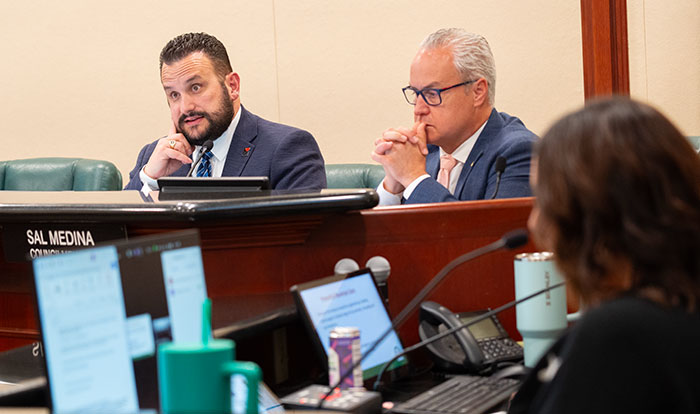
(L-R) Claremont Vice Mayor Ed Reece and Council member Sal Medina at Tuesday’s City Council meeting. Courier photo/Andrew Alonzo
by Andrew Alonzo | aalonzo@claremont-courier.com
The Claremont City Council voted 3-2 Tuesday to explore putting a 1% sales tax increase measure on the November ballot. Vice Mayor Ed Reece and Council member Corey Calaycay voted no.
With the vote, the council allocated a maximum of $37,750 to West Coast political consulting firm FM3 for polling and research, with the results presented on or before June 9.
Claremont’s current sales tax rate is 9.75%, of which a 1% local tax is estimated to yield approximately $10.4 million for the 2026-2027 fiscal year, according to a staff report. The city’s existing 1% local tax is based on where the sale happens. The new proposed 1% transactional use tax is based on where the buyer lives or where the product is delivered. So, a car sold at Claremont Toyota always generates the 1% local tax for Claremont, but the proposed 1% transactional use tax would stay in Claremont only if the buyer registers the car here. The city estimates it would generate approximately $6.7 million annually.
Under state law, sales tax rates in California cannot exceed 10.75%, with some exceptions.
“This additional revenue could be used to enhance several of the priorities and objectives that have been identified by the community and the City Council, including park and facility improvements, enhanced maintenance of City infrastructure, and new/expanded programming,” read the staff report.
Resident Douglas Lyon spoke in opposition during public comment.
“We already pay some of the highest taxes in the country,” Lyon said. “We don’t need to pay any more taxes. What we need is our local elected representatives and our state elected representatives to spend the money more wisely and more prudently and more judiciously, and not raise our taxes every time they think they need some more.”
Finance Director Jeremy Starkey reminded the council that Claremont Unified School District recently announced its intention to explore placing a facilities bond initiative on the November ballot, and the LA County Board of Supervisors recently voted 4-1, with Supervisor Kathryn Barger opposed, to place a temporary ½ cent general sales tax measure on the June 2 primary ballot.
The LA County measure spans five years and is meant to “offset anticipated federal funding reductions under H.R.1 that would significantly impact County health care and safety-net services,” according to the staff report. H.R. 1, President Donald Trump’s “One Big Beautiful Bill Act,” became law in July 2025.
Leano asked City Manager Adam Pirrie how the LA County measure, if it passes in June, would affect Claremont’s proposed sales tax increase should voters approve it in November.
“The County of Los Angeles … is also pursuing a transaction and use tax that is a sales tax, but our understanding is that they have sponsors for state legislation to exempt that half cent sales tax from the state cap,” Pirrie said. “If that’s successful, then there would be no impact to the one cent or the 1% that we could pursue in our measure. If for any reason that exemption from the cap was not granted by the state legislature, it would reduce the amount that we could ask voters to approve to half a cent.”
Leano inquired about the legal implications in the event Claremont’s 1% tax increase was filed with the Los Angeles County’s Registrar-Recorder’s office, but later reduced to half a cent following state legislation exemptions. City Attorney Alisha Patterson said she has spent “a lot of time” researching the question, but did not yet have an answer.
“Apparently this is unprecedented,” Patterson said. “And so that’s something that we would need to revisit as to whether anybody has sorted out what happens when you have dueling measures on the ballot and both cannot simultaneously be fully adopted.”
Pirrie seemed confident the city would be in the clear.
“If the city proceeded with a one cent sales tax measure and it passed and for whatever reason LA County’s temporary measure passed and it was adjudicated that both could go into effect, it would mean that the city’s one cent authorization would be reduced to half a cent while that temporary county measure was in place,” Pirrie said. “And if it were not extended in in 2031, then the city could then begin collecting the 1 percent tax.”
Both Council member Sal Medina and Leano said the topic needs more research before it can be put before voters.
Reece was skeptical about the timing and usefulness of the proposal.
“It’d be great to have the additional revenue,” Reece said. “It would do some great things for this community and the residents, but I’m not sure I could spend [$37,750 on a study] if I don’t think the rest of it will pass, if we even get there based on the current economic environment.”
Calaycay said given rising gas and oil prices due to the conflict in the Middle East, and increased cost of living, it was “a little bit insensitive at this time to be looking for more increases.”
Mayor Jennifer Stark broke the deadlock with her yes vote, arguing in favor of seeing what the consulting firm’s research yields.
If the measure makes it to the November ballot and is approved, the new tax will go into effect April 1, 2027. The last proposed sales tax increase brought before Claremont voters was Measure CR, a ¾ cent ask in 2019, which was rejected.
City passes priorities, objectives for 2026-28
Following months of community input, the council voted unanimously to adopt the updated 2026-28 City Council priorities and objectives, a list of several initiatives and work items that guide how the city spends its revenue during the 2026-27 and 2027-28 fiscal years.
The plan has seven priorities: “preserve our natural, cultural, and historic resources; strengthen long-term fiscal and organizational health; invest in the maintenance and improvement of our infrastructure; ensure the safety of our community through community-based policing and emergency preparedness; increase livability in our neighborhoods and expand opportunities for our businesses; promote community engagement through transparency and communication; and develop anti-racist, anti-discrimination policies and plan to achieve community and organizational diversity, equity and inclusion.”
The second priority, “strengthen long-term fiscal and organizational health,” was revised from, “maintain financial stability.”
The next council meeting is 6:30 p.m. Tuesday, March 24 at 225 W. Second St., Claremont.

0 Comments