





Council report: City projects budget surpluses through 2035
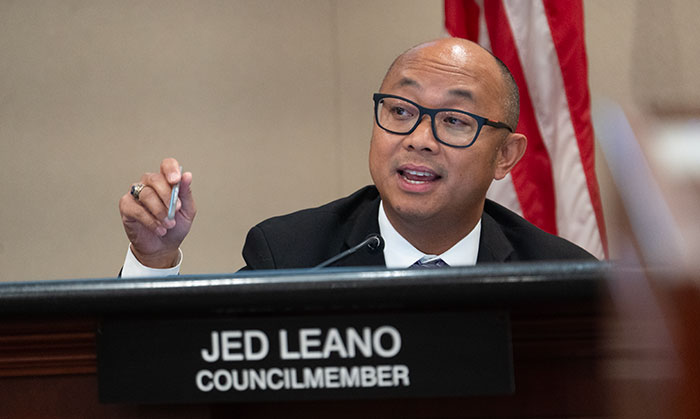
Claremont City Council member Jed Leano at the November 12 meeting. Courier photo/Andrew Alonzo
by Andrew Alonzo | aalonzo@claremont-courier.com
Claremont City Council assigned grant funding to organizations as part of its community-based organization general services and homeless services/critical needs program on November 12 and heard its financial forecast for the next decade via a long range financial plan report.
Community grants
The council voted unanimously to allocate $160,500 in American Rescue Plan Act funds to 27 organizations who applied for the city’s community-based organization general services and homeless services/critical needs program. The aim of the program is to partially or fully fund community projects that address either need in the community.
The budget for the city’s general services category was $100,500, the homeless services/critical need category, $60,000.
Claremont After-School Programs received of $15,000 from general services category. Others included $8,000 to Claremont Educational Foundation, Claremont Lewis Musuem of Art, and Inland Valley Repertoire Theatre; $7,500 to AgingNext; $6,500 to Anthesis; $6,000 for Shoes That Fit, Sustainable Claremont, and VNACare; $5,000 to AbilityFirst; $4,500 to Girls Scouts of Greater Los Angeles-La Casita Day Camp; $4,000 to California Botanic Garden, Claremont Community School of Music, and Claremont Heritage; $3,000 to The Claremont Chorale and Vineyard Touring Opera Company; and $2,000 to The Clinebell Institute.
For homeless services/critical needs, $11,500 was given to Inland Valley Hope Partners; $10,000 to St. Ambrose Episcopal Church and Claremont Meals on Wheels; $7,000 to Crossroads, Inc.; $5,000 to Service Center for Independent Life; $3,500 to Claremont Canopy, Foothill Family Shelter, Pacific Lifeline, and Newcomers Access Center; and $2,500 went to The Economy Shop.
One of the main talking points at the meeting was why Claremont United Church of Christ’s $20,000 funding request to start an overnight parking program at a nearby parking lot was denied by the community and human services commission. Management analyst Michelle Castillo said it was mainly due to the project’s lack of data and program structure.
“The ad hoc [committee] and then the commission did review the application, but at this time there was no data as the program is not up and functioning at this time,” Castillo said. “They were very adamant that it’s not a ‘no’ forever. It is just, at this time the program is not operational, so they could not award funds. But they were very adamant that if the group gets up and running next year that they resubmit their application to be considered for next year’s funding.”
For more information about the organizations that received funding and their respective projects, search “agendas” at claremontca.gov, click “city council agendas” and navigate to the November 12, 2025 special meeting. The report is attached to item 12.
Long range financial plan
Claremont Finance Director Jeremy Starkey delivered the city’s 2026-2035 long range financial plan, or LRFP, a financial forecast used by the city for long-term planning purposes.
“The LRFP includes a forecast for 2025-26 and the years to follow, however this document itself is not a budget for the future years it portrays,” read a staff report. “It does however provide an overview of the City’s financial capacity based on assumptions for the next ten years, providing the City Council, management, and citizens a financial outlook beyond the biennial budget cycle. It can also serve as a planning tool for longer-term priorities and needs.”
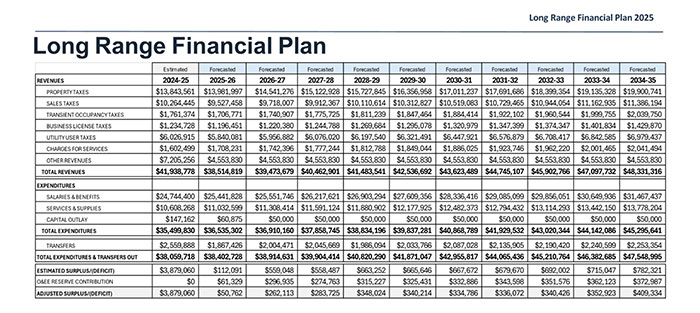
Claremont’s 2026-2035 long range financial plan, which projects surpluses every year through 2035.
Some of the report’s assumptions include city staffing remaining unchanged through 2035; budgeting to ensure the city maintains a runny day fund of about 30% of its overall budget;
general fund revenues such as property, sales, transient occupancy, utility, and business license taxes and service charges seeing a 2% increase; general fund expenditures, including payments to the California Public Employees’ Retirement System, increasing by 2%; and other categories such as “services and supplies” and “transfers out” seeing 2.5% increases.
The city expects to see a $3,879,060 surplus at the close of fiscal year 2024-25, this after total revenues of $41,938,778 are collected and total expenditures of $38,059,718 are made, according to the report. The report also projects surpluses in subsequent years through 2035: $50,762 in 2025-26; $262,113 in 2026-27; $283,725 in 2027-28; $348,024 in 2028-29; $340,214 in 2029-30; $334,786 in 2030-31; $336,072 in 2031-32; $340,426 in 2032-33; $352,923 in 2033-34; and $409,334 in 2034-35.
To view Claremont’s long range financial plan, search “agendas” at claremontca.gov, click “city council agendas” and navigate to the November 12, 2025 special meeting. The report is attached to item 13.
The next Claremont City Council meeting is at 6:30 p.m. Tuesday, November 25 in council chambers, 225 W. Second St., Claremont.





0 Comments