





County releases Rios autopsy, toxicology report
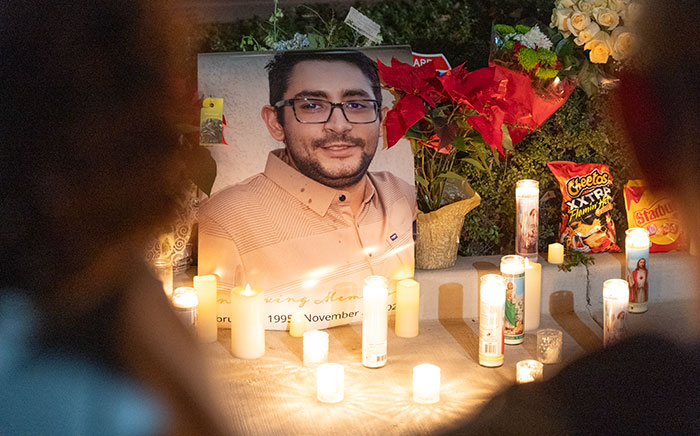
A December 1, 2025 candlelight vigil for Diego Rios near Claremont Boulevard and Andrew Drive. Courier photo/Andrew Alonzo
by Andrew Alonzo | aalonzo@claremont-courier.com
On February 12, the Los Angeles County Medical Examiner’s Office released its death investigation summary and report for Diego Rios, the 30-year-old Rancho Cucamonga man who died November 28, 2025 following a Claremont Police Department traffic stop.
The medical examiner’s “summary and opinion narrative” reads,
“On November 28th, 2025, this 30-year-old male was found to be unresponsive after being handcuffed following a physical altercation involving prone restraint by law enforcement personnel. The encounter between the decedent and law enforcement personnel was initiated due to a 9-1-1 call stating that the descendent was acting erratically and driving away in a vehicle. During the traffic stop the decedent exited the vehicle and law enforcement personnel attempted to place him in handcuffs. Eventually he was taken to the ground and restrained in a prone position while handcuffs were being applied. Once the handcuffs were placed, he was found to be unresponsive and resuscitative efforts, including administration of Narcan, were attempted. He was transported to the hospital via ambulance and death was pronounced in the emergency department.
“External examination revealed blunt force trauma including scattered abrasions and contusions predominately involving the torso and extremities. Internal examination revealed pulmonary edema and moderate to focally severe atherosclerotic cardiovascular disease. There were no acutely fatal traumatic injuries.
“Postmortem toxicology detected cocaine and its metabolite benzoylecgonine in Mr. Rios’ system. Cocaine is a stimulant narcotic which can have multiple adverse effects on the cardiovascular and central nervous systems. These effects can be suddenly fatal on their own and/or exacerbate underlying natural disease processes.
“Body camera footage of Mr. Rios’ encounter with law enforcement personnel was reviewed. It showed the use of a choke hold and prone physical restraint, including a knee on Mr. Rios’ right upper back, during his interaction with law enforcement personnel. The choke hold itself did not incapacitate Mr. Rios as he continued to move and react after it was released. At autopsy there were no traumatic injuries to the anterior or posterior neck. The knee on his right upper back did not cause any fractures or injuries to internal organs. Based on the video footage there does not appear to be an overt asphyxial event throughout the encounter. However, the temporal relationship between the prone physical restraint and cardiopulmonary arrest suggests that these two events were likely not simply coincidental. Based on the autopsy findings, toxicology testing, and body camera footage Mr. Rios’ death was multifactorial in etiology. Autopsy cannot determine the extent to which each individual factor played a role in death.
“The cause of death is cardiopulmonary arrest due to effects of cocaine and atherosclerotic cardiovascular disease in the setting of prone physical restraint. The manner of death is homicide due to volitional human involvement regardless of the intent of any individuals’ actions.”
The medical report summary noted that cocaine was found in Rios’s body and that he had “moderate to focally severe” atherosclerotic cardiovascular disease as his left anterior descending coronary and right coronary arteries had about 70-80% stenosis, or abnormal narrowing of a blood vessel, his left circumflex coronary artery about 50%; he had pulmonary edema, or excess fluid buildup, in his left and right lungs at 700 and 750 grams, respectively; multiple contusions on his arms; subcutaneous hemorrhaging — bleeding beneath the skin — on his back; and subgaleal hemorrhaging — bleeding beneath the skin — on the left side of his scalp. Superficial abrasions and scrapes were also noted on his arms and knees.
Though noting the use of a choke hold by Claremont Police Department Corporal Benjamin Alba in the moments before Rios lost consciousness, the examiner found “no traumatic injuries of the neck.”
Rios’ death is still under review by LA District Attorney Nathan Hochman’s Justice System Integrity Division, which evaluates allegations of criminal misconduct and prosecutes public officials who engage in criminal activity in their official capacities. A parallel investigation by the Sheriff Department’s Homicide Bureau is also ongoing. Claremont officials have vowed to release the findings to the public once they have been finalized.
Claremont Public Information Officer Bevin Handel did not respond to requests for comment.



0 Comments