





Faith leaders, government, police explore ICE preparedness
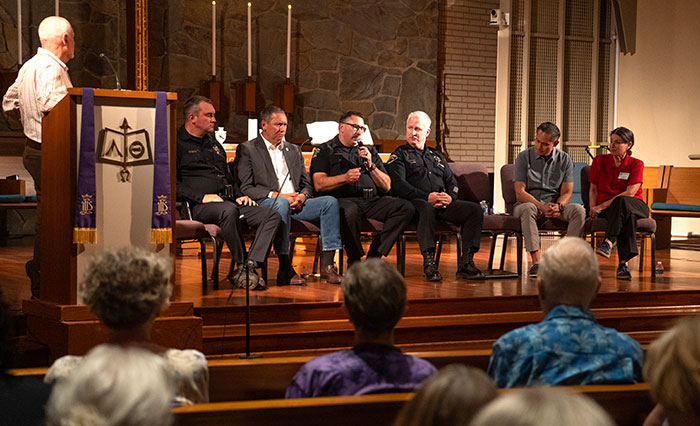
(L-R) United Church of Christ clergyman Sid Mohn, Pomona Police Department Corporal Jeffrey Hayward, Pomona Mayor Tim Sandoval, La Verne PD Captain Travis Tibbetts, Claremont PD Captain Robert Ewing, retired police officer Robert Allas, and Claremont Mayor Jennifer Stark took part in a March 18 panel discussion on ICE preparedness. Courier photo/Andrew Alonzo
by Andrew Alonzo | aalonzo@claremont-courier.com
Panelists from local government and law enforcement took part in a March 18 public forum aimed at providing clarity for residents on their policies and procedures for dealing with federal Immigration and Customs Enforcement interactions.
More than 100 people were on hand at Claremont Presbyterian Church to hear from Claremont Mayor Jennifer Stark, Pomona Mayor Tim Sandoval, Claremont Police Department Captain Robert Ewing, Pomona PD Corporal Jeffrey Hayward, La Verne PD Captain Travis Tibbetts and retired police officer Robert Allas. The event was facilitated by Pomona Valley Spiritual Leaders for Justice.
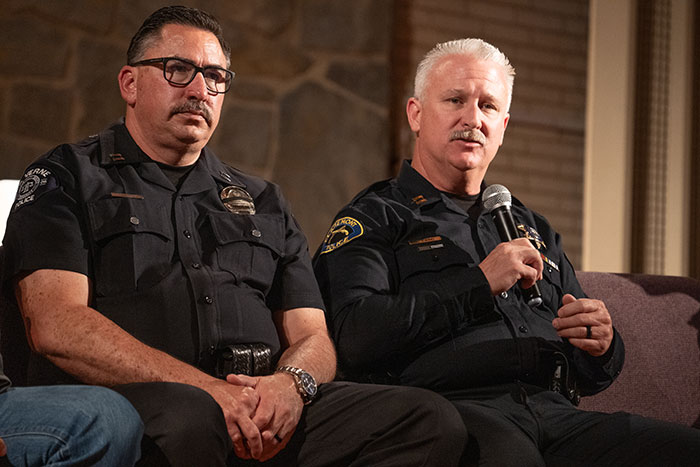
(L-R) La Verne Police Department Captain Travis Tibbetts and Claremont PD Captain Robert Ewing at a March 18 discussion about ICE and the federal agency’s violent, sometimes deadly tactics. Courier photo/Andrew Alonzo
The primary topic was how to keep citizens safe in the face of ongoing and unprecedented lethal violence from federal ICE and Customs and Border Protection agents against immigrants, legal residents, witnesses, and protesters.
Much of the discussion was moderated by United Church of Christ clergyman and Pomona Valley Spiritual Leaders for Justice coordinator Sid Mohn.
“We organized this because we knew that ICE enforcement casts a pall on law enforcement in general, and communities were beginning to interpret ICE tactics to also be tactics … and a lack of professionalism amongst local law enforcement officers,” Mohn said. “We thought it was important to have clarification as to how local law enforcement is trained around constitutional rights, around legal standards, as well as professionalism, to illustrate the critical difference with ICE agents.”
The meat of Wednesday’s forum focused in knowing federal immigration agents’ legal limits.
“Congressional discussions around guardrails for ICE, which is holding up the U.S. Department of Homeland Security funding, those guardrails are essential,” Mohn said. “They’re essential for ensuring our constitutional rights, ensuring human rights, ensuring compliance with standards of professional law enforcement around matters such as judicial warrants, the use of force, etcetera, etcetera. We do not want a paramilitary force operating in our communities and around our country. This is an erosion of democratic commitments. This is important not only to counter ICE abuses, but also to protect our democracy as a nation.”
After the moderated talk, the floor was opened for questions from the audience. Topics ranged from advice on community safety during ICE raids, to how citizens should go about documenting ICE safely. Claremont United Church of Christ Co-Pastor Jacob Buchholz asked law enforcement officials, “How would you all respond to a report from a resident of your communities reporting that ICE is violating their rights?”
“It very much depends on the circumstances and in the totality of what’s occurring there,” Tibbetts said. “When I said earlier I have a lot of reservations of a La Verne police officer going head-to-head with a federal agent or being outnumbered by them, I mean I take that seriously. Because one of my responsibilities is to protect not only the community, but the officers that serve that community. And we do respond to every call for service, so there would be some level of obligation to respond to assess what’s going on. As far as how we proceed from there is really going to be a decision point at the time.”
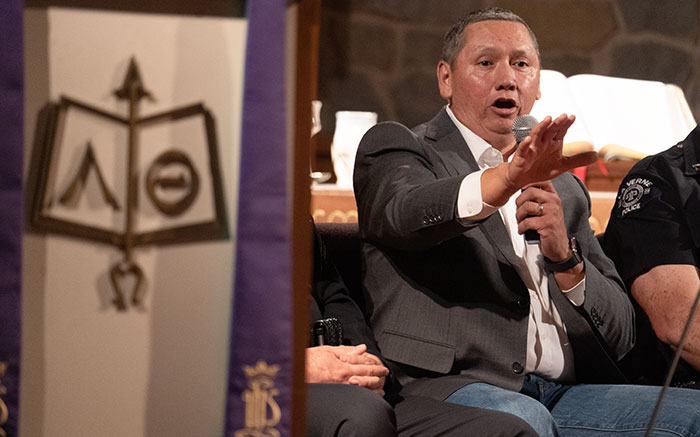
Pomona Mayor Tim Sandoval during the March 18 discussion about ICE at Claremont Presbyterian Church. Courier photo/Andrew Alonzo
One questioner asked what agency is the primary investigative body in allegations of ICE and/or CPB misconduct. Hayward said it would be federal authorities such as the Federal Bureau of Investigation. Sandoval followed up with information on the state’s role.
“Yes, it is true that the state doesn’t have the authority [to investigate], but it does not mean the state is not documenting what has happened,” Sandoval said, “which really underscores the tremendous challenge when you have a federal government that is clearly aligned with the reason why we’re here, which is a complete unconstitutional violation of people’s basic liberties and a right to due process … for many, many members of our community.”
Tibbetts said local law enforcement agencies are not notified of ICE’s presence in their cities.
“They don’t tell us anything,” he said. “So, we are exactly like you all, in the unknown when they’re coming into town or what they’re doing. So please remember to give us grace as police officers because we don’t know. Sometimes, to be honest, the community knows more than we do because they have the luxury of being on social media at the time when sometimes we don’t.”
Pomona Fellowship Church of the Brethren Pastor Julie Wheeler closed the forum with a prayer and call to action.
“We need you in the streets of Pomona. We need your action,” Wheeler said. “Inaction is complicity as well. This is a time where we just need your bodies out there. We need you to shop in Pomona. We need you to walk the streets. We need you to be at Home Depot. We need you to be buying drinks from the fruit vendors. We are the ones that are going to keep us safe. Unfortunately, we probably will not come together until all hell breaks loose.”
Ewing echoed Wheeler’s call for the public to document ICE interactions whenever possible.
“We’re not getting those calls because if they do come into the city, we’re getting zero notification,” Ewing said. “So, by having people out there, those citizens that are out taking that upon themselves to record interactions of what ICE is doing with our folks that live within our own communities, that’s going to be extremely impactful. Because when the attorney general for California actually decides to do something, he’ll have all the ammunition in order to move forward.”
Stark offered her post-meeting analysis:
“I’m grateful to Pomona Valley Spiritual Leaders for Justice for bringing us together tonight to confront the failures between federal ICE agents and local law enforcement,” Stark said. “The Constitution promises due process and protection from unreasonable searches, yet those rights are being violated. Groups like ICE Out of Pomona continue to train constitutional observers and empower community members to stand in solidarity. Accountability will take time, but we must remain steadfast and united in the belief that our American experiment can live up to its promise of justice for all.”




0 Comments