





Fate now uncertain for Claraboya pine trees
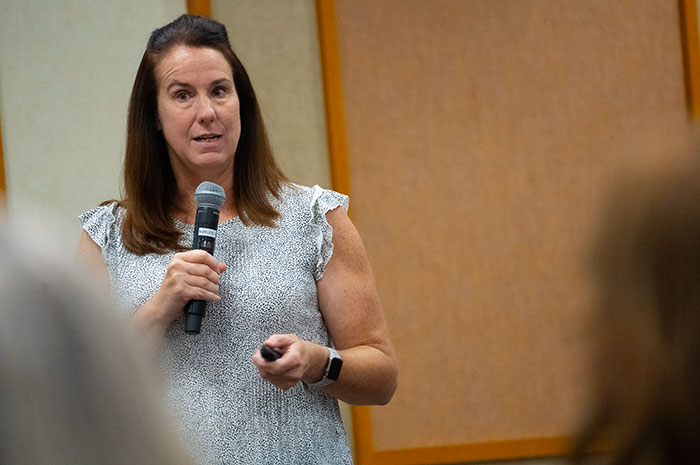
Community Services Manager Cari Dillman during Monday’s tree safety meeting at the Hughes Center. Courier photo/Andrew Alonzo
by Andrew Alonzo | aalonzo@claremont-courier.com
Claraboya residents and city staff met at the Alexander Hughes Community Center Monday to discuss the fate of 207 city-owned pine trees in the north Claremont neighborhood.
The seeds of Monday’s discussion were sown in January, when the Claremont City Council voted unanimously to update its tree policies and guidelines manual, directing staff to develop a removal and replacement plan for Claraboya’s pines.
The action followed windstorms in January 2025 that felled five pines and a massive event in 2022 that claimed 70 city pines, according to Community Services Manager Cari Dillman.
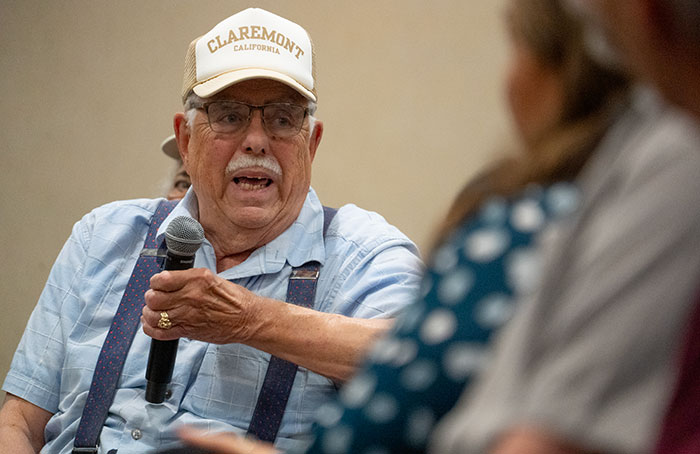
Claraboya resident Harold Gault during Monday’s tree safety meeting at the Hughes Center. Courier photo/Andrew Alonzo
“Due to the recent wind and fire storms, safety has become a bigger concern than the benefits of these trees,” Dillman said. “And a lot of community members have come out to City Council and tree committee, community and human services commission asking for these trees to be removed for safety reasons.”
Dillman said the various species of pine in Claraboya — Canary Island, Torrey, Aleppo, and Japanese black — have been deemed safe by city arborists. “They are free of pests, disease, any kind of stability, structural issues, anything of those sort,” she said.
The objective of Monday’s meeting was to discuss if the environmental benefits of the trees outweigh the negative impacts of them in the neighborhood, Dillman said.
The city surveyed residents ahead of the meeting:
Of the 151 respondents, 60%, or 87, believed the trees’ existing negative impacts outweigh the positives; 35% believed the opposite; and 5% did not have an opinion. Negative examples included uplifted concrete, surface root exposure, and pine cone and needle litter. Positives included shade, neighborhood character, carbon sequestration, and wildlife habitats.
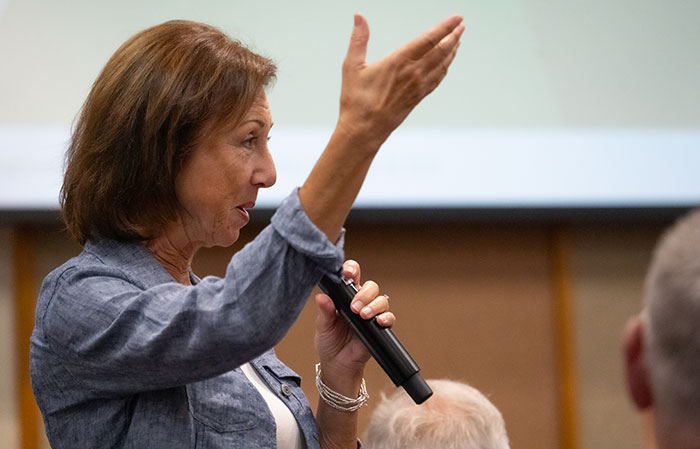
Claraboya resident Connie Fuentes during Monday’s community meeting. Courier photo/Andrew Alonzo
Much of the talk Monday was about safety and the fact that first responder access to the neighborhood is only accessible via Mountain Avenue.
“I’ve been vacillating on this topic, back and forth back and forth, and I’m scared to death of someone losing their life because they [first responders] can’t get past the tree when it falls,” Claraboya resident Connie Fuentes told the Courier. “However, I think the risk of that is so small, so I’m in favor of keeping the trees.”
Two residents said they were in favor of removing the pines on Monday. One said a city-owned pine recently caused more than $100,000 worth of damage to his property and he was planning to file a claim against the city.
Another resident who lived in the neighborhood during the 2003 Grand Prix Fire that destroyed 65 homes in Claremont brought up the trees’ potential to catch fire. Dillman confirmed the entire Claraboya neighborhood falls into Cal Fire’s “very high,” category, its highest fire severity zone designation.
Following the Courier’s September 26 report on fire safety in the city, “Fire safety: the forever topic,” city staff were asked if the California Department of Forestry and Fire Protection had a role to play in deciding whether the pines stayed or went. Dillman said no, adding the city had walked the area with its Los Angeles County Fire Department and US Forest Service partners, who deemed the pines safe.
Another talking point was how the city maintains its canopy. The city trims all its trees over five years, tackling a new grid area each year. The agreement with West Coast Arborists for tree maintenance is worth $716,000 annually.
Dillman said removing the pines and replanting new trees would cost $49 per trunk diameter inch. That figure does not include any hardscape or roadway damage, which could increase costs.
By the end of the meeting, most people agreed that if a pine is healthy and not a hazard, the city should leave it be and work to maintain it properly, and if a tree is deemed unhealthy or a hazard, it should be removed and replaced.
“Basically, the general consensus of the majority of the people in this room is proper tree trimming and leave our trees alone,” one Claraboya resident said. “But that actually wasn’t in the survey, was it?”
Although the tree manual does not allow for the removal of a tree for nuisance debris — for example, excess pine cone or needle accumulation — the city can enact a program called “proactive removal and replacement.”
“This is when a group of trees in a certain area or a certain species of trees necessitate removal for various reasons,” Dillman said. Those reasons in Claraboya are tied to community concerns and “monoculture,” where one species dominates in a single area, which could leave it vulnerable to disease or pests, Dillman said.
It’s unclear what city staff will recommend for Claraboya’s pine tree question. Dillman said staff will put the item on the agenda for the November tree committee meeting.
“As anticipated, we heard a variety of opinions and concerns from the residents most affected by the trees,” Dillman wrote in an email. “Moving forward we will attempt to address the many concerns when developing a plan for the future of the pine trees.”





0 Comments