





First Amendment: Is it being silenced? Experts weigh in
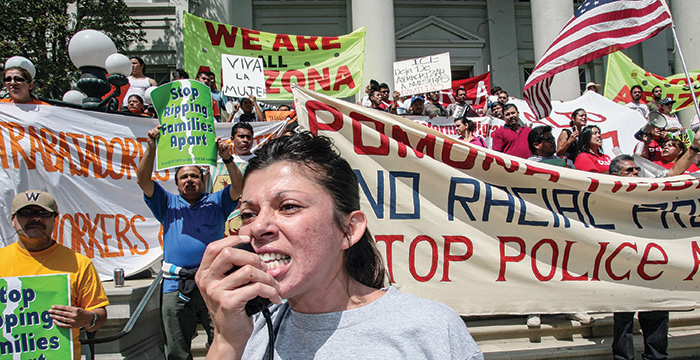
Claremont has a long history of demonstrating for a wide variety of national issues. Back in 2010, Veronica Alvarado led a group of immigrants’ rights protesters outside Pomona College’s commencement ceremony where Homeland Security Secretary Janet Napolitano spoke. Courier file photo
by Andrew Alonzo | aalonzo@claremont-courier.com
From hand selecting the journalists allowed in the White House press pool to threatening to revoke the licenses of media organizations broadcasting unfavorable comments about the president, the opening months of Donald Trump’s second term have proved particularly impactful with respect to the First Amendment.
Many have asserted our First Amendment freedoms of speech, press, religion, petition, and assembly are under attack.
“I don’t think the words in the First Amendment are going to go away anytime soon, but will people feel safe to exercise those rights without losing their job or without being assaulted or without being killed?” said David Snyder, executive director of First Amendment Coalition. “That I think, unfortunately, is a much more open question than it has been in a very long time in our country.”
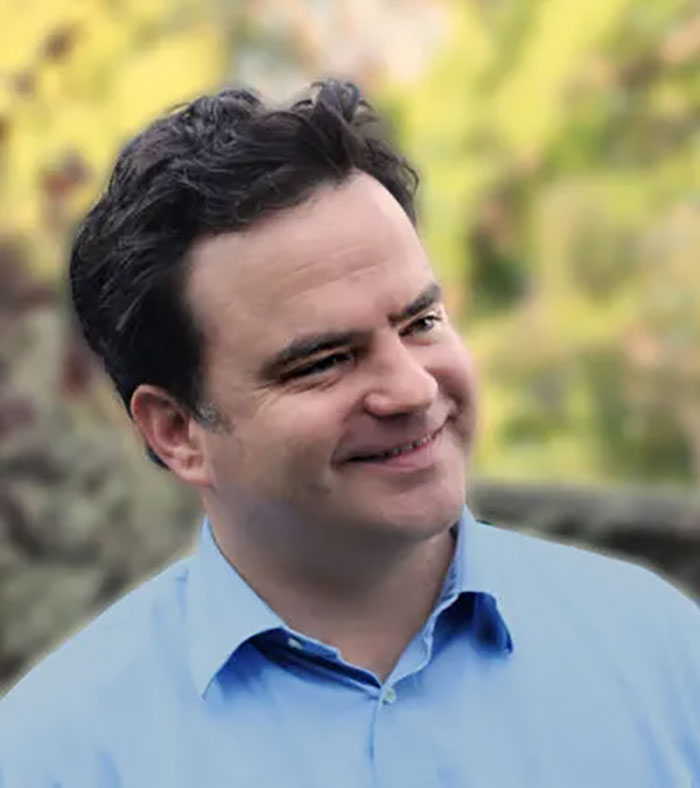
David Snyder, executive director of First Amendment Coalition. Photo/courtesy of First Amendment Coalition
A number of lawsuits and settlements between Trump and major media organizations, his well-publicized disdain for the media in general, and Department of Homeland Security arrests and deportations of people speaking out against the genocide in Gaza, such as Mahmoud Khalil, have put First Amendment protections front and center in Trump’s second term.
And the ripples have been felt here in Claremont.
Last year, Pomona College and other Claremont Colleges saw multiple protests calling for divestment from corporations profiting from Israel’s offensive in Gaza. In 2025, such a demonstration has yet to occur on any Claremont Colleges campus.
The First Amendment has “time, place and manner restrictions,” but government cannot engage in any sort of regulation meant to prohibit or silence speech or favor other kinds of speech, according to George Thomas, Claremont McKenna College’s Burnet C. Wohlford Professor of American Political Institutions.
Thomas stopped short of naming Trump’s threats as the cause of the lack of protest at the Claremont Colleges. “I’d be hesitant … because I feel like we need to do a study and see the evidence, but I mean certainly it looks like it’s intended for it and it almost would be weird if there’s not,” he said.
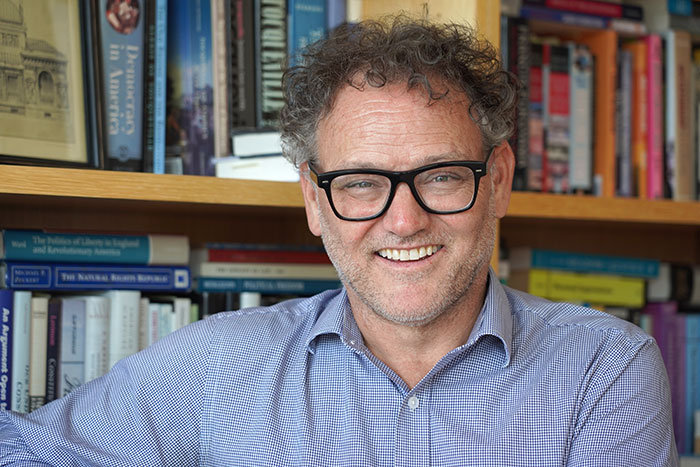
George Thomas, Claremont McKenna College’s Burnet C. Wohlford Professor of American Political Institutions. Courier photo/Andrew Alonzo
Thomas cited the story of Rumeysa Ozturk, a Tufts University graduate student who was arrested by Immigration and Customs Enforcement outside her Boston home on March 25 then detained in rural Louisiana for six weeks. All this after she criticized the Massachusetts school’s response to human rights violations in Gaza in a 2024 op-ed in Tufts’ student newspaper. “That’s going to silence people,” he said. “My biggest worry is that students will self-censor when it comes to ideas.”
The First Amendment Coalition’s Snyder said press freedoms have faced increased hostility during Trump’s second term, referencing the barring of an Associated Press reporter from the White House pool after AP refused to use “Gulf of America” in its reporting, and settlements between Trump and ABC and CBS.
Ken Miller, director of the Rose Institute of State and Local Government at Claremont McKenna College. Photo/courtesy of Claremont McKenna College
“If those lawsuits had continued, it’s virtually certain that they would have been thrown out,” Snyder said. “Instead of fighting those battles as CBS and ABC would have I’m sure in past years, they settled with Trump, paid him $16 million. And that’s a very troubling sign when two media entities of vast resources capitulate to legal threats that really were baseless.”
Snyder also cited the First Amendment Coalition’s own ongoing lawsuit against the Los Angeles Police Department and LA County Sherriff’s Department, alleging the agencies targeted the press with “less than lethal rounds” during recent protests in LA, calling it “a clear, direct frontal assault on freedom of the press. They’re [LAPD, LA Sheriff’s] not under the control of the White House, obviously, but I think the tone set by the White House is really important.”
A recent Gallup poll found trust in the media continues to trend lower, fed in part by more than a decade of Trump and his allies demonizing the press as an “enemy of the people.”
“My point is that when our public discourse is falling to such a level, I think it’s incumbent upon political leaders to, A, resist the urge to demonize the media because it’s convenient, and, B, to communicate the absolutely crucial role that a free press plays in maintaining our democracy,” Snyder said. “It really is essential to the healthy functioning of the democracy for one simple reason: if the people are going to run the government through their elected representatives, they have to understand what those elected representatives are doing.”
Thus far, it appears locally that First Amendment freedoms of assembly, religion, or petitioning the government have not been curtailed. Claremont has seen multiple anti-Trump protests this year at Indian Hill and Foothill boulevards. Elsewhere though, such as in Los Angeles, things have been much different.
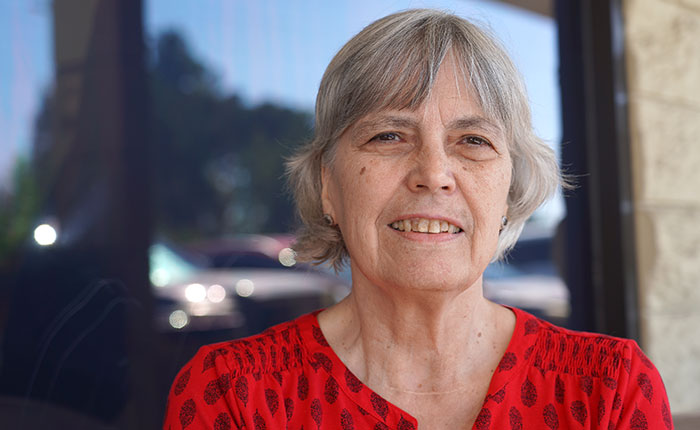
Jean Schroedel, Professor Emerita of Political Science at Claremont Graduate University. Courier photo/Andrew Alonzo
“I think heavy police presence, heavily armed police presence, and military presence all combined sends a message to think twice before you go out to the streets to protest what the federal government is doing,” Snyder said.
Still, protesters here and across the nation remain active in great numbers.
“But this is the thing about chilling effects: it’s hard to prove a negative,” Snyder said. “It’s hard to demonstrate the people who decided not to show up because of what they’re seeing on the television. It’s not as if demonstrations have been ground to a halt or maybe even slowed. But I am confident, although I couldn’t prove it, that there are many more people who would be out, but for the sort of performative violence that police have engaged in.”
Ken Miller, director of the Rose Institute of State and Local Government at Claremont McKenna College, said in his opinion the First Amendment right to petition the government has been threatened. “There are certainly authoritarian elements of Trump policies,” Miller said. “I don’t think that one can say that the administration has sought to prevent citizens from continuing to protest and seek redress of grievances from government.”
Asked how religious freedoms had been affected by the second Trump administration, Claremont Graduate UniversityProfessor Emerita of Political Science Jean Schroedel cited a July 7 Texas court ruling that saw the Internal Revenue Service carve out a caveat to the longstanding Johnson Amendment that had prevented houses of worship and some nonprofit organizations from endorsing political campaigns, essentially reversing that rule, and mentioned recent Immigration and Customs Enforcement raids in sacred spaces. She also referenced the U.S. Office of Personnel Management’s July 28 memo, “Protecting Religious Expression in the Federal Workplace,” allowing government employees to engage in religious speech at work, and the White House establishment of an “anti-Christian bias task force” in February. She also named the administration’s pause on refugee admission, adding, “Because the vast majority of refugees coming to the U.S. actually are Christians, one could argue this is anti-Christian.”
Recent reporting from CNN, Politico, and PBS has suggested the Trump administration is pushing Christian nationalism.
“I think it’s a backdrop,” Schroedel said. “I mean, getting people used to ideas,” such as questioning a women’s right to vote. “Excuse me, but just the fact that these discussions are being out there and in the media normalizes stuff. I’m not going to say everybody who’s associated with Trump and with the Republican Party is into that. But there is an element, and an element that’s normalizing some pretty terrifying things.”
Miller was circumspect: “There are lively First Amendment protected activities still going on in this country, even as the administration pursues a set of policies that might violate other constitutional rights,” he said.
Snyder said those that fear a weakening of the First Amendment should mobilize and make their voices heard.
“Unfortunately, it can feel more perilous now to exercise these rights than it has in quite some time,” Snyder said. “But that makes it all the more important … And I’m optimistic that the American people won’t stand ultimately for these most precious rights to be infringed, and the way to ensure that that doesn’t happen is to exercise those rights.”


0 Comments