





Police commission sets April 2 meeting amid questions about Rios death
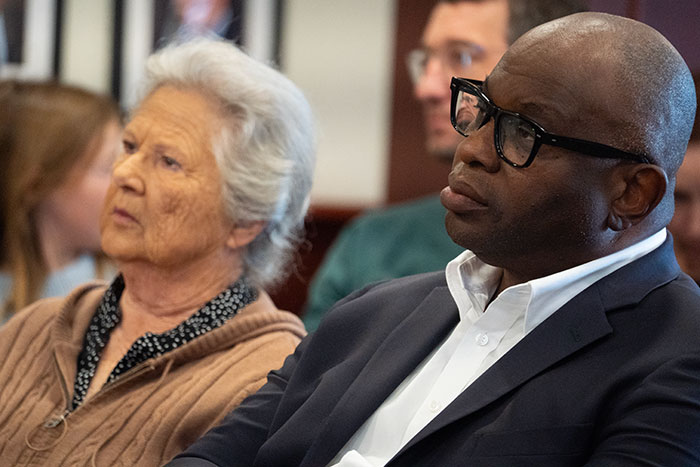
(L-R) Claremont Police Commission members Vickie Noble and Aundre Johnson pictured on January 31. photo/Andrew Alonzo
by Andrew Alonzo | aalonzo@claremont-courier.com
Since the November 28, 2025 death of Diego Rios following a traffic stop by Claremont police, which the Los Angeles County Medical Examiner’s office has ruled a homicide, the city’s police commission and City Council have been peppered with requests for more transparency.
The commission canceled its February 5 meeting due to a lack of business, according to a notice posted at claremontca.gov. The move did not sit well with people speaking during public comment at the February 10 City Council meeting.
“I would also like to ask why the February 5 police commission’s public meeting was canceled due to lack of business when there, as has been discussed, a homicide at the hands of police officers … here in the City of Claremont,” said Francis Curry, a local college student.
The commission’s next meeting is set for 7 p.m. Thursday, April 2 in council chambers, 225 W. Second St. City Manager Adam Pirrie said that meeting may include a discussion on the disclosure of information related to use of force incidents.
On Monday, Claremont Public Information Officer Bevin Handel addressed the cancellation issue in an email.
“At the January 13, 2026 City Council meeting, Mayor Stark requested staff agendize an item to be presented to the Police Commission with information on the laws and statutes that govern public disclosure of information and records relating to use of force incidents, including timelines the City must comply with,” Handel wrote. “Given the staff resources necessary to prepare the staff report and presentation and meet mandated posting requirements, agendizing the topic for the February 5, 2026 Police Commission was not feasible. Therefore, the presentation was scheduled for the next regularly scheduled Police Commission meeting of April 2, 2026.”
Pirrie said as much at the February 10 council meeting.
“It’s strictly a staff capacity issue,” Pirrie said. “As most people in the community know, our police department is spread thin and it’s simply a matter of allocating staff time to be able to … do the necessary research and draft the reports for that April meeting. And that’s the meeting that we’ve targeted to bring that item to the police commission.”
On January 27, City Attorney Alisha Patterson said the council cannot agendize an internal review of the findings of Rios’s case — despite public calls to do so.
“We had calls for an item to be agendized so that the council could review what happened and that’ s just not something that this council is allowed to do,” Patterson said. “There are a lot of laws and procedures and rights that police officers have that dictate how these situations are handled and it’s just not part of the legal process that these are handled publicly in a city council meeting or any other public type of meeting.”
Handel explained the process behind canceling police commission meetings.
“The Police Chief consults with the Chair of the Police Commission on agenda items and cancellations, as necessary” she wrote. “Other Police Commission members do not have a role in the agenda setting process or decision to cancel a meeting.”
None of the seven police commissioners — chair Alison Fung, Tim Dunfee, Frank DeLeo, Mario Hernandez, Aundre Johnson, Vickie Noble, or Nona Tirre Miranda — responded to requests for comment.
The Claremont Police Commission was formed December 12, 2000 and held its first meeting in March 2001.
“The formation of the Police Commission came after more than a year of community engagement and dialogue following the shooting death of Irvin Landrum in 1999,” Handel wrote. “In the wake of the shooting, the City Council established a Community Dialogue Planning Committee to provide a series of community listening sessions and accept public comment. One of the recommendations of the Community Dialogue Planning committee was to establish a Public Safety Advisory Committee, later named the Police Commission.”
Claremont Municipal Code chapter 2.43 outlines the commission’s purpose and duties. It is viewable at ecode360.com/43831371.
The commission is responsible for providing a forum on police issues, issuing recommendations to the City Council, city manager, and police chief on police issues, and promoting education and communication between Claremont residents and CPD. It has the power to “review and comment on Police Department policies, procedures and practices, and to assist in setting goals for the Department that reflect community values” and “To provide a forum to address concerns, complaints and commendations regarding the Police Department and to receive reports on the progress or conclusions of investigations, when legally possible,” according to the code.
Other powers include reviewing annual and quarterly reports presented by the police chief, and monitoring reported data on stops, arrests, citations, field interview cards, and police logs. The City Council, city manager or police chief can also direct the commission to carry out duties.





0 Comments