





Proposition 50 would bring local, national changes

(L-R) U.S. Rep Judy Chu of California’s 28th Congressional District, and U.S. Rep Norma Torres of the 35th Congressional District. Chu/Courier file photo, Torres/courtesy of Norma Torres
by Andrew Alonzo | aalonzo@claremont-courier.com
If Proposition 50 passes November 4, and California redraws maps for its 52 U.S. House of Representatives districts, Claremont will say goodbye to long-time Democratic rep Judy Chu and the 28th District, and say hello to fellow Democrat Norma Torres’ and the 35th.
“Representing Claremont has been an honor and a privilege, and I’m proud of the work I’ve done with this incredible community,” Chu wrote in an email. “And while my district may change, I will continue to fight for policies important to Claremont like protecting our public lands, supporting higher education, and bringing costs down for working families.”
Torres responded similarly. “No matter how district lines change, I would represent Claremont the same as I do with all cities I represent; I would keep Claremont’s priorities front and center in Washington and fight to bring federal resources home,” Torres wrote in an email.
Both Chu and Torres support Prop. 50, which is officially known as “The Election Rigging Response Act.” If voters approve it, it will stay on the books through the 2030 election cycle, after which the state will return to the Citizens Redistricting Commission, an independent body charged with drawing California’s electoral maps after each census. If voters reject the measure, the state’s congressional maps would remain unchanged.
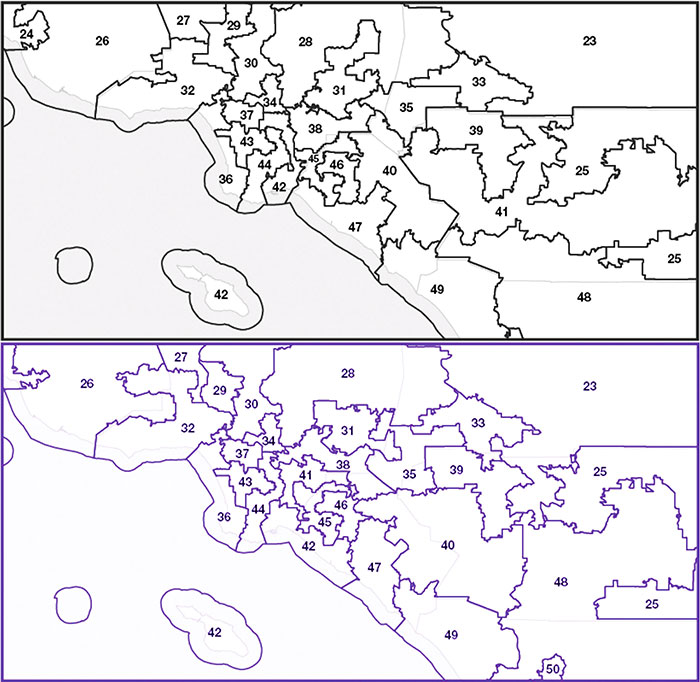
The current 2025 district map is on top, compared to the bottom (blue) map if Prop 50 passes. Claremont would be part a new District 35.
Proposition 50 is the only measure on the 2025 special election ballot. It is a recent development in direct response to similar moves in several Republican controlled states, including Texas, which recently approved redistricting at the direct request of President Donald Trump.
“President Trump pushed very hard with Governor [Greg] Abbott in Texas to undertake this mid-census redistricting, which Texas law makes it very possible for doing so,” said Zachary Courser, director of Claremont McKenna College’s Policy Lab. The Texas Constitution calls for a simple majority from the state senate and house to approve off-year redistricting, an easy task in the state’s Republican dominated legislature. Texas’s new maps could result in a net gain of five Republican seats in the U.S. House, strengthening the slim GOP majority.
California’s response, Prop. 50, could negate Texas’ gains in the House by adding five additional Democratic seats in the U.S. House.
California’s Constitution mandates voter approval in a special election to initiate mid-census redistricting. If Prop 50 is approved, California’s new maps would be used for the 2026, 2028, and 2030 election cycles. In 2031, the state’s independent redistricting committee would resume redrawing maps using updated census data.
Courser said Paul Mitchell, owner of Redistricting Partners and vice president of Political Data Inc. was the prime director of the proposed new California maps, which have received the blessing from the state’s majority Democratic leaders. The state’s independent citizen commission had no input, according to a statement at wedrawthelines.ca.gov.
Currently, Chu’s District 28 includes Wrightwood, Claremont, a portion of Upland, Rancho Cucamonga, portions of Glendora, and much of the Angeles National Forest. Torres’ District 35 encompasses Chino, Ontario, Pomona, and portions of Upland, Montclair, Fontana, Bloomington and Eastvale, among other cities.
Prop 50’s approval would result in District 28 absorbing the mountainous stretch of Angeles National Forest currently in District 31, and shedding Claremont, while stretching a bit further east into San Bernardino County.
“Approximately two-thirds of the 35th congressional district would remain the same under Prop 50, while also expanding the district to include areas with historical ties — like Pomona and Claremont, as well as Bloomington and Fontana, and extending the district into nearby communities in Riverside County,” Torres’ staff wrote in an email.
The Democratic Club of Claremont supports Prop. 50.
“It is a crisis response to redistricting in Texas and Missouri,” club president Anne K. Turner said. “We feel very strongly that we are at a pivotal point where we must strengthen our position in the federal government and that the place that we can do that is in Congress.”
Fabian Valdez Jr., a data scientist and demographer with the No on 50 campaign, argues Claremont would be lumped into a district that has different demographics.
“Claremont, which used to be in a district that had a heavier Asian population, represented by an Asian representative, and had a little more upper middle class, was in line with Pasadena and San Marino, is now in a district that is more in line with Ontario, Fontana and Chino,” Valdez Jr. said. “Not to say it has nothing in common, but those areas are more agricultural-based traditionally and tend to have a much more working class and Hispanic population than Claremont does.”
Turner has a different view.
“For Claremont specifically, we have always been represented by Judy Chu. [Prop 50] would move us to be represented by Norma Torres, but it would also balance us because Claremont would balance sort of Chino, Chino Hills, which is also in Norma Torres’s district,” Turner said. “What we’re trying to figure out is how to create maps that are more balanced where we don’t have these … deeply blue areas of the map; that we have more balanced areas of the map.”
Valdez Jr. argues Prop. 50 is overreach by state lawmakers.
“What this Prop 50 is saying is: not only do Republicans in the state not deserve representation that they want to vote for, but these competitive areas … [that] typically draw more moderate candidates in both rounds, these competitive seats shouldn’t exist either, because we need to have Democratic representation only,” Valdez Jr. said. “And then the third thing they’re doing is they’re saying we don’t have the timing because this all has to happen very quickly in order to get things ready for the primary.”
Turner argues Prop. 50 does fairly represent citizens in the proposed districts. She also noted it goes beyond redistricting.
“We are having the Constitution violated. We are having the National Guard used as a military force in our state. We have a president who is punishing people who didn’t vote for him,” Turner said. “When the framers built the Constitution of the United States, they never built it with safeguards for this kind of president, and so we have to take radical action, revolutionary action, to try to protect the citizens of the United States of America.”
Arguments for and against Prop. 50 are included in the California Secretary of State’s voter guide at voterguide.sos.ca.gov.
Those who have not yet registered to vote can do so online at lavote.gov or at local polling places. Vote centers will open later this month at the Claremont Unified School District offices, 170 W. San Jose Ave., and Granite Creek Community Church, 1580 N. Claremont Blvd. Ballot drop boxes will be located at Claremont Helen Renwick Library, 208 N. Harvard Ave., and the Alexander Hughes Community Center, 1700 Danbury Rd.






0 Comments