





SCIL hopes to continue backup battery program
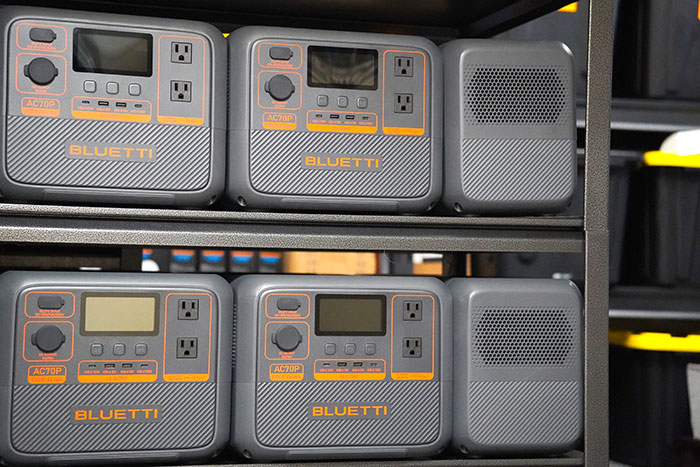
On October 17 Claremont nonprofit Service Center for Independent Life received notice that Southern California Edison was terminating funding for its Disability Disaster Access and Resources program, which had provided high wattage portable batteries like these to needy people in disaster prone areas. Courier photo/Andrew Alonzo
by Andrew Alonzo | aalonzo@claremont-courier.com
As executive director of Service Center for Independent Life, part of Larry Grable’s job entails ensuring needy people get the accommodations they need to live self-sufficiently.
One of those resources has been the California Disability Disaster Access and Resources program, which is facilitated by the California Foundation for Independent Living Centers. The program supplies people in disaster prone areas with high wattage portable batteries to keep electrical dependent medical and other devices powered during emergencies and public safety power shutoffs. In 2023, Southern California Edison inked its first contract with California Foundation for Independent Living Centers to fund the program.
But on October 17 SCIL received some bad news: Edison was terminating its funding effective October 31. Now SCIL can no longer supply batteries to vulnerable people, and must now refer them to 211.
“They told us that because of the [California Public Utilities Commission’s] findings that they were not allowed to have our program because it was the same as what 211 was doing for them, plus their own battery program,” Grable said. “They think that we were ‘duplicative.’”
That argument is referenced in page 434 of California Public Utilities Commission’s decision at docs.cpuc.ca.gov, search “D2509030.”
“Given the comprehensive support SCE already proposes to provide to customers, we find SCE’s funding request for the Disability Disaster and Access Resources program to be duplicative and unnecessary,” the finding reads.
Grable contests the move.
“We do education. We do one-on-one personal plans. We do the trainings. We do so much more,” he said. “Basically, all they think it is is that we’re just giving them batteries and 211 does it, we do it, and then [Edison] has their own battery program.”
The Disability Disaster Access and Resources program was founded following the 2018 Camp Fire, the deadliest in California history, which killed 85 people and burned 153,000 acres in the Butte County town of Paradise.
Subsequently, Pacific Gas and Electric Company, or PG&E, “was sued and the [California Public Utilities Commission] told them they needed to create a program that took care of the … access and functional need communities,” Grable said. “So, with [California Foundation for Independent Living Centers] help, we met with PG and E and put together the [Disability Disaster Access and Resources] program, which was to buy batteries, give away batteries, do trainings, make sure people know exactly what they need to do themselves — not only their family, their animals — and that everything else be prepped.”
To date, SCIL has delivered 241 batteries in Los Angeles and San Diego counties. About 40 remain on hand at its Claremont office.
“I’m going to give these out eventually. I’ve just kind of come up with a new liability waiver because Edison’s not involved anymore, so the liability falls on me,” Grable said. “So, I’ve got to make sure a lawyer looks at that because somebody could misuse it and burn up their house. And I don’t want to be liable for that.”
For Grable, the abrupt end to the program represents another obstacle for vulnerable Americans in the wake of the ongoing government shutdown.
“There’s so many reasons that people need external power if their power goes out,” Grable said. “I mean, if some of these people don’t have some of the what they have, yeah, there’s no doubt they’d die.”
SCIL and its clients aren’t going down without a fight, Grable said.
“We’re doing a letter campaign. We’re doing a phone call campaign. And we’re really targeting [California Public Utilities Commission] because it was their finding that told Edison it didn’t have to do this,” Grable said.
Grable said he will find a way to continue the life-saving program.
“I’m looking at grants, other grants to supplement the funding that we’re getting,” he said. “I love this program. I helped to initiate it. We’ve just got to find more funding or have [California Public Utilities Commission] change their mind and tell Edison, ‘Yes, you can fund them,’ We’ve got to continue this. People with disabilities and seniors, they need it.”






0 Comments