





The AI juggernaut, and your money

by Donald Gould
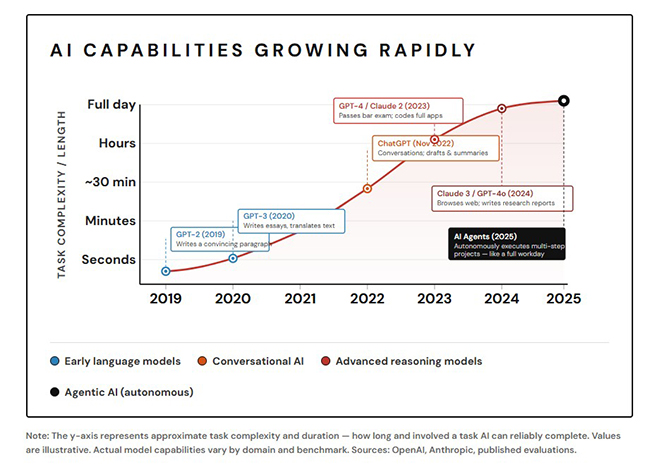
If you love trains, you understand the big difference between knowing a train is due soon and actually seeing the massive engine rounding the bend. For months or even years, artificial intelligence experts have told us to prepare for the arrival of an AI that builds ever more powerful versions of itself. Well, now it’s in sight, horn blaring and ground shaking.
Over the past few weeks, leading AI developers Anthropic and OpenAI have each released new versions with computer programming capabilities that veteran software engineers describe as both astonishing and terrifying. The AI can now do software coding at a level comparable to experts with decades of experience. Soon, its capabilities will zoom past that.
Concurrently, we are told that much of the latest AI was built by the AI itself. This so-called “self-recursive” activity implies ever more powerful AI models, released with increasing frequency.’
Productivity up. Unemployment to follow?
The most immediate impact of these developments is felt by software coders themselves. Suddenly, they are vastly more productive, as AI can now employ an army of virtual agents to quickly do most of the previously laborious coding work. But this same advance might also make many coders redundant. We read stories of Stanford grads with computer science degrees — once a golden ticket to lucrative employment — facing a more difficult entry level job market.
Of course, AI’s impact doesn’t stop with coders. In a world where almost every business is to varying degrees a technology enterprise, the implications are enormous. Over time, as with technological advances dating back at least to the start of the Industrial Revolution, we can expect AI to take over a wide range of tasks currently performed by humans.
The optimistic take on this envisions a future of greater output and wealth, with employees quickly elevating their work to more valuable activities. The more worrisome outlook is that AI advances quicker than the average worker can adapt, leading to high levels of unemployment. Such impact would be most immediately felt in white collar jobs that are mostly performed on a computer. However, in time, AI-enhanced robotics could replace blue collar workers, too.
AI and your investments
The stock market is doing its best to digest all the AI news. We see its verdict rendered in the daily movement of stock prices, much of it very volatile of late. Right now, there are many more questions than answers. Here are a few that are top of mind.
The tech giants (Google, Meta, etc.) are pouring hundreds of billions of dollars annually into building data centers in a sort of AI arms race that many view as winner-take-all. How will they earn a fair return on these massive investments? And what becomes of the losers in this race?
AI can help companies in many ways, including enabling the creation of new products and services, increasing worker productivity, and reducing labor costs. Will these benefits more than offset the potential reduction in consumer demand resulting from an AI that puts people out of work?
It appears AI can quickly replicate complex software that may have taken thousands of engineers decades to build and refine. Does this mean AI will ultimately bankrupt countless companies whose primary value resides in their proprietary software?
Economist Joseph Schumpeter coined the phrase “creative destruction” to describe the process by which technological advances lay the groundwork for both the introduction of the better mousetrap and the obsolescence of what came before. With AI, it is very possible we will witness creative destruction of a scale and speed well beyond anything ever experienced.
What is an investor to do in the face of all this? It is impossible to know in advance who the winners and losers will be in the brave new world of AI. The possibility that there will be a very small number of big winners and a much larger number of losers makes the task more challenging still.
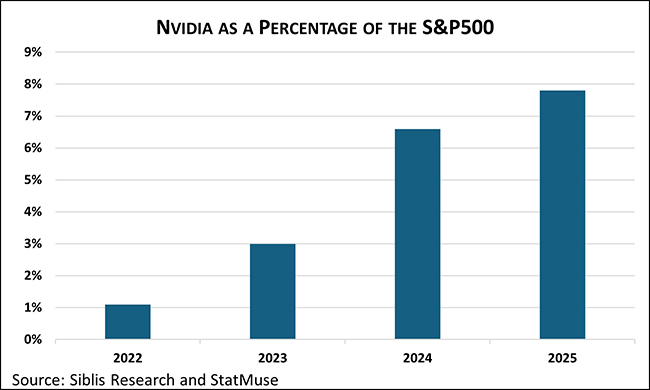
It is wisely said that if you must own the needle in the haystack, you should buy the haystack. Put another way, stay diversified. Index funds — which own the entire market — ensure that you will participate in the growth of the market’s top performers. A prime example is Nvidia, maker of the graphics processors so critical to AI. Its share of the S&P 500’s total value grew from about 1% to well over 7% in just the past three calendar years, which is even more remarkable considering that the index nearly doubled in that timeframe.
It also makes sense to diversify across asset categories, for example stocks, bonds, real estate, and even perhaps precious metals such as gold.
Diversification cannot ensure success. But in the face of AI-fueled rapid change with unpredictable consequences, it might just make failure less likely.
Don Gould is president and chief investment officer of financial advisory firm Gould Asset Management of Claremont.





0 Comments