





The kids are right
by Mick Rhodes | editor@claremont-courier.com
On February 4, more than 700 Claremont Unified School District students walked out of classes to take part in an anti-Immigration and Customs Enforcement protest at Indian Hill and Foothill boulevards.
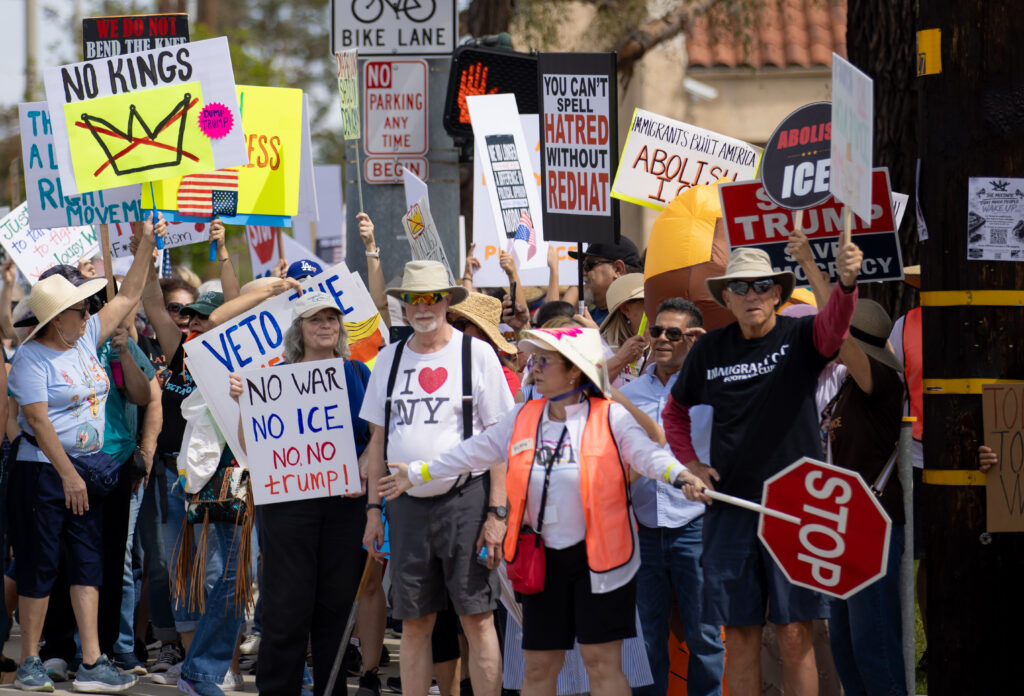
The event was rowdy, but peaceful. Nobody was hurt or arrested. Several kids toted signs with profane messages and shouted slogans that included expletives, much like the many other large protests we’ve seen at that intersection since the beginning of the second Trump administration. A small group of CUSD teachers and administrators were on hand to help with crowd control and ensure the kids didn’t spill out into the street at the busy intersection and risk getting hit by passing cars.
It was a loud, colorful, and quick protest, just 90 minutes long. We reported on it next day, “The kids are all right: CUSD students demonstrate against ICE.”
I was inspired to see hundreds of young people exercising their First Amendment right to redress their government. I remember a few short years ago hearing parents lament how much of this generation didn’t stand for anything. And here was clear evidence to the contrary. Brilliant.
But some have disagreed. Since then the Courier has published letters from adults calling the action a waste of time, “performative,” and criticizing the kids’ “lack of dedication.”
The Courier has reported on anti-Trump protests in Claremont since his first election and in earnest since he took office a second time in January 2025. Kids have been present at every demonstration, as has profane speech and signs. I’ve seen people crawl up on top of rocks in the median and other objects at some demonstrations.
So why has the kids’ protest unleashed such ire?
Some complain the kids missed 90-minutes of instruction to take part in the protest. Fair enough. But the protest was voluntary. Kids who disagreed with the anti-ICE message or were simply uninterested stayed in class. School wasn’t canceled.
Even so, I would argue the time spent engaging directly with the First Amendment via experiential learning far outweighs the 90 minutes of classroom time lost. Could one dream up a more effective tool for a government instructor to teach about the U.S. Constitution and its Amendments than to take part in safe, supervised political protest? I don’t think so. Do you?
And in fact, your government seems to agree. “The Role of Experiential Learning on Students’ Motivation and Classroom Engagement,” republished in 2021 by the National Institute of Health’s National Library of Medicine, states, “The present review is significant for the learners as it allows them to model the appropriate behavior and procedures in real-life situations by putting the theory into practice. Indeed, this method helps learners think further than memorization to evaluate and use knowledge, reflecting on how learning can be best applied to real-world situations.”
Some of the kids were no doubt there because they wanted to get out of class, and yes, some misbehaved. Anyone who’s ever had a house full of teenagers knows some are loud, some are messy, and yeah, some are inappropriate. But most of them — like the overwhelming majority on February 4 — are smart and respectful.
I know some of the kids who protested February 4 and why they were there. They have the same concerns we do; they stand against what the Trump administration is doing to our immigrant neighbors and those who are putting their bodies, livelihoods, and reputations on the line to protect them and document the abuses.
Further, the Claremont kids are part of a long line — a grand tradition even — of American high school student protesters who have been maligned by adults as insignificant and unserious, unworthy of anything but derision and often, violence.
Widespread U.S. high school student activism first emerged during the civil rights movement in the early 1960s. In 1963, more than 1,000 high school kids skipped class and marched through the center of notoriously racist Birmingham, Alabama to protest racial segregation as part of the Birmingham Children Crusades. Predictably, the local police responded with clubs, firehoses, and attack dogs. Tens of thousands of high school students across the country participated in boycotts, walkouts, sit-ins, and pickets during this time. “In Chicago alone, some 27,000 to 35,000 students boycotted school on Oct. 14, 1968 to demand community control of Black schools and other educational reforms,” according to the nonprofit, nonpartisan National Constitutional Center. “Similarly, one of Boston’s largest student protests came in the spring of 1971, when over 50% of Black students staged a citywide strike to protest ‘endemic racism, system-wide segregation, and poor education.’” High school kids across the nation were also instrumental in shining a light on the widely unpopular Vietnam War.
After the Supreme Court affirmed the landmark 1969 Tinker v. Des Moines Independent Community School District case, 7-2, Justice Abe Fortas spoke for the majority: “It can hardly be argued that either students or teachers shed their constitutional rights to freedom of speech or expression at the schoolhouse gate.”
American high school students’ widespread activism led to the publication in 1970 of “The High School Revolutionaries,” edited by Marc Libarle and Tom Seligson, and a raft of similar accounts of school-aged civil rights and peace advocates.
High school students have played a vital role in standing up for democracy and the Constitution, and against war and state sponsored brutality for more than 60 years, and I’m proud of the Claremont kids who picked up the thread on February 4.
Here’s to hoping the experience lit a fire beneath them to continue to get out in the streets and make their voices heard.
If not now, when?

0 Comments