





Viewpoint: The U.S. Forest Service has a ‘one tree fire’ problem
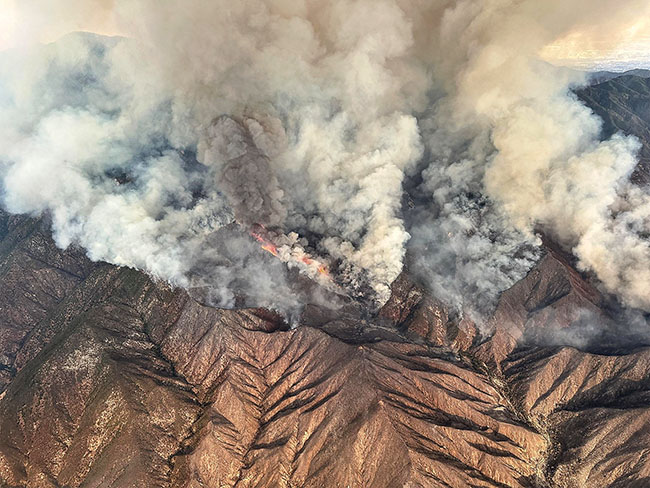
The Bridge Fire ignited September 8, 2024 in the Angeles National Forest near the Cattle Canyon Bridge and rapidly spread toward Mount Baldy Village, prompting mandatory evacuations and destroying 20 homes. The wildfire eventually scorched 56,030 acres, making it the third largest in California in 2024. Courier photo/Peter Weinberger
by Char Miller | Special to the Courier
Once burned, twice shy. That adage warning against duplicating past errors appears to have framed the U.S. Forest Service’s strategy fighting the July 21 Sugar Fire. If so, the agency made a mistake when it immediately suppressed the small outbreak rather than manage it to achieve key ecological benefits.
Located near Sugarloaf Mountain in a remote stretch of the San Bernardino Mountains, the Sugar Fire was so tiny that the Forest Service initially estimated at one acre, before downgrading it to one-eighth of an acre.
The reason? Only one tree was burning.
That’s what caught my eye when I spotted the San Bernardino National Forest Wildfire Alert for the Sugar Fire — “One-Tree Fire in Hard-to-Reach Area.” What was unusual was how quickly firefighters were dispatched, along with a relatively large aerial response, which included water tankers and a helicopter. The chopper ferried firefighters to a landing zone from which they hiked through tough terrain to reach the blaze. As they labored uphill, water tankers dumped their payloads “to help keep fire small until boots on-the-ground fire fighters … can confirm it is put out,” according to the Forest Service.
This is not just a story about skillful firefighters doing good work. There are several other issues that emerge from this narrative that require closer examination. Let’s start with the concept that fire can be beneficial. Yes, it can be a destructive force, as January’s brutal Los Angeles firestorms made clear. But foresters also know it has regenerative qualities if properly managed. And in a high-elevation, backcountry forest that has not burned in a while why not manage the fire rather than immediately suppressing it? Doing so would have enabled the Sugar Fire to reduce fuel load, restore ecosystems, and enhance forest health.
Think of it this way: we can use fire to fight fire.
The Forest Service did not adopt this tactic with the Sugar Fire, and I think I know why. In mid-July 2021, there was another single-tree fire. Lightning had struck a lone pine rooted in a high Sierra ridge on the Humboldt-Toiyabe National Forest, and the agency sent an assessment team to the site. They reported that the smoldering tree posed little risk of flaring into a serious fire.
A week later, heavy winds sent sparks flying from that one tree into nearby brush and canopy, fueling the Tamarack Fire’s rapid escalation. By July 20, it had burned 68,000 acres, and by which point a political firestorm had exploded. Politicians in California and Nevada attacked the agency’s failure to stamp out the fire when it had the chance to do so. Feeling the heat, then new agency chief Randy Moore directed personnel to immediately extinguish all fires regardless of size or site.
That still makes sense in heavily populated areas where the risks to life and property are great, such as when the Bridge Fire blew up around Mount Baldy Village in September 2024. Yet even in that local scenario, scientific research indicates that fire suppression alone doesn’t make forests (or communities) more fire safe. Considerably more effective is what’s called “thin-burn” treatments. That is, managing and/or controlling fire in combination with mechanical thinning to reduce fuel load and tree density. This approach prioritizes proactive management rather than reactive fire suppression, patience rather than haste.
With the tiny Sugar Fire, the Forest Service shied away from that data-driven, savvier policy and swiftly snuffed out this one tree burn.
Char Miller is a professor of environmental analysis and history at Pomona College. His latest book is “Burn Scars: A Documentary History of Fire Suppression, From Colonial Origins to the Resurgence of Cultural Burning.”







0 Comments