





Viewpoint: Evidence, not fear, should dictate fate of Claraboya’s pines
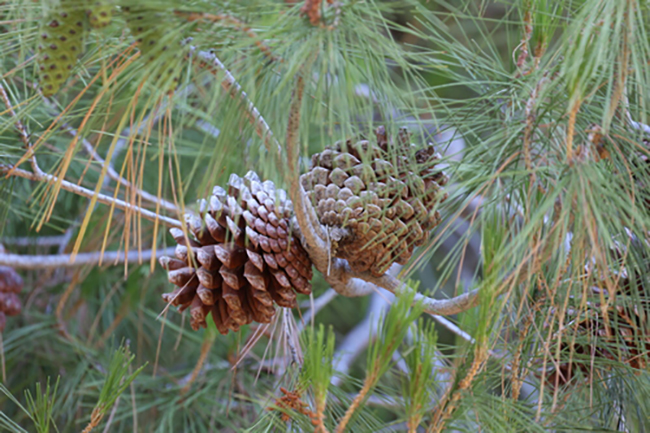
Photo/by Eric Cleveland
by Drew Ready, Char Miller, and Fred Roth
It is vital to acknowledge the trauma and fear that recent windstorms and wildfire events have generated in Claremont. The instinct to protect our families, homes, and neighbors is universal.
However, the recent call to preemptively remove 207 pines in Claraboya — based on the fear that a tree might fall and block a roadway during a wildfire — ignores urban forestry best practices, directly contradicts our city’s general plan commitments to protect the values that trees provide, and creates a terrible precedent that could put street trees at risk in many other neighborhoods built in Claremont’s very high fire severity zones.
The primary flaw in Michael Hertel’s Courier Viewpoint [“Claraboya’s pines must go,” November 14), in which he promotes the removal of 207 healthy pine trees, is the dangerous generalization that all pines in Claraboya present the same failure hazard. In the field of urban forestry and arboriculture, the standard is to assess risk of failure tree-by-tree, not by species or generalized groups. Tree stability is dictated by an individual tree’s root and branch structure and health, not merely by the type of tree or location.
The industry standard “tree risk assessment” process requires that tree risk assessment qualified arborists evaluate the “likelihood of failure” against the “likelihood of impact” and include an assessment of the consequences. Skipping this important analysis and cutting down a tree simply because a different tree somewhere else failed is akin to condemning a house because a neighbor’s house has foundation issues. We must also consider the hard evidence: not one of the deeply rooted pines in Claraboya fell during the severe windstorms of 2022 and 2025.
The wholesale removal of these trees would be a drastic measure that sacrifices the enormous ecological and economic benefits these trees provide. In a region frequently plagued by inland valley smog, these large conifers act as massive, irreplaceable air filters. Their needles intercept particulate matter year-round, directly protecting the respiratory health of residents. Their large canopies collect rainfall, reducing the velocity of rain and runoff and allowing water to percolate slowly rather than flooding the streets below. Removing the pines would also reduce shade, increase temperatures, and intensify the “heat island” effect, leading to higher energy costs for cooling and increased heat-stress risks for walkers and residents.
These trees also provide essential habitat and nesting locations for birds, including raptors like hawks and owls, nature’s most effective form of rodent control. Moreover, tall trees serve as windbreaks; removing them can expose homes to higher wind speeds, increase fire intensity, and structural damage during storms.
The Claraboya pines are also a significant financial asset. Using the cost approach method to tree valuation, these 207 pines have a replacement value that reaches into the millions of dollars. Claraboya’s pines also provide direct financial benefits to Claraboya homeowners. Studies consistently show that homes with mature tree canopies command higher sales prices than those without. Claremont’s general plan speaks to these economic values and our commitment to protecting them.
We should not let the memory of recent fires drive us to make rash decisions. Before any irreversible tree removal is allowed, the city should undertake a comprehensive assessment by tree risk assessment qualified arborists who specialize in tree risk and fire preparedness specialists who understand threats to evacuation routes. Claremont can employ more frequent inspections and increase pruning cycles if these are suggested by experts. Los Angeles County Fire has professional foresters on staff who work regularly with foothill communities on these issues; they were, for example, critical to the post-Padua fire restoration of Sycamore Canyon. Residents can also secure additional information from the LA County Fire Department about defensible space, home hardening and emergency preparedness at wildfirela.org/fire-safe-councils.
By doing our due diligence, we can protect public safety without sacrificing Claraboya’s pine trees and the many benefits they provide.
Drew Ready is a certified Arborist and Claremont resident. Char Miller is the W.M. Keck Professor of Environmental Analysis and History at Pomona College. Fred Roth is Professor Emeritus, Cal Poly University, Pomona and a certified urban forester.





0 Comments