





60 years of changing lives at San Antonio High School
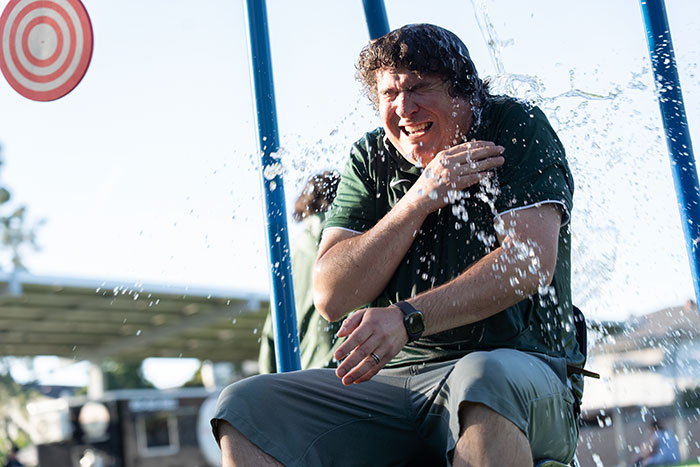
San Antonio High social studies teacher Tyler Baugh gets soaked at the school’s 60th anniversary celebration on Wednesday. Courier photo/Andrew Alonzo
by Andrew Alonzo | aalonzo@claremont-courier.com
Students attend San Antonio High, Claremont’s continuation high school, for many reasons. Some are working through behavioral or attendance issues. Others are short on credits and need an accelerated schedule to graduate. Still others are just looking for an alternative learning environment.
“You’re expecting the worst because you were sent there obviously for a reason, right? And not a good reason,” said 26-year-old Tere Bueno, who graduated from SAHS in 2019. “I was sent there because I had a really hard time going to school. But I was going through really hard family changes; my grandma had just recently passed and I was not coping well.”
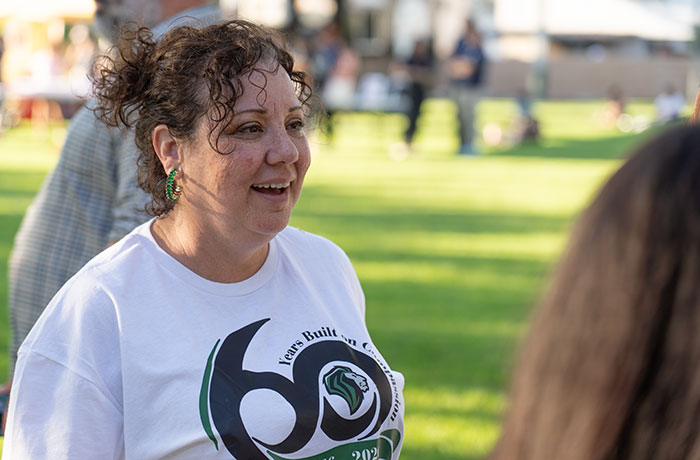
San Antonio High School Principal Andrea Deligio at the school’s 60th anniversary celebration on Wednesday. Courier photo/Andrew Alonzo
But like with so many other students who may be going through something, it turned out San Antonio was a good fit.
“After being there for even a week, the difference was so shocking that to a student it’s almost like you don’t know how to take it,” Bueno said. “You’re like, should I be happy that it’s not at all what I expected, or do I feel like I’m being suffocated from all the attention and all the like, everyone here wants me to succeed” atmosphere?
That stark contrast is by design. Administrators have made it their mission to forge a new identity for the campus. And people are noticing.
San Antonio has been on a string of academic wins of late. On March 11, it was named a 2026 Model Continuation High School by State Superintendent of Public Instruction Tony Thurmond. It was the fifth time the state has honored the school in this way. The award celebrates its “exemplary instructional strategies, flexible scheduling, and strong guidance and counseling services that support students who are at risk of not completing their education,” according to a news release. San Antonio has also been named an Apple Distinguished School twice, in 2018-21 and 2021-24, and is the only continuation school in the world to receive such a distinction, according to San Antonio High School Principal Andrea Deligio.
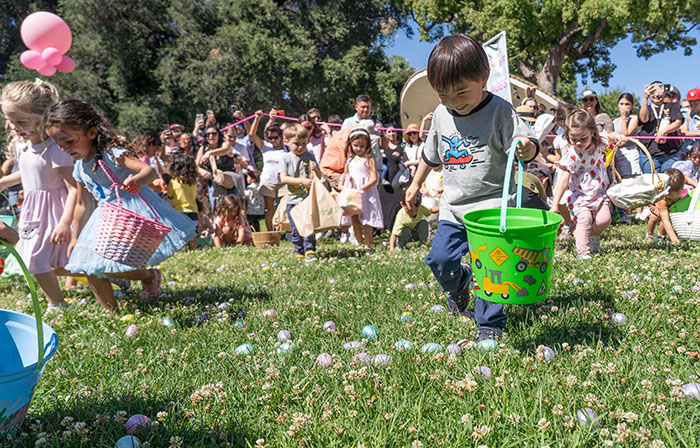
News of the school’s latest accolade comes as it celebrates its 60th year. On Wednesday, alumni, teachers, and administrators were on hand for a carnival-style open house with games, a dunk tank, a photo booth, face painting, and lots of food.
But even with state and national recognition, San Antonio finds still itself dealing with a familiar topic: perception.
Deligio leads the effort today, speaking about her school’s attributes frequently in public forums.
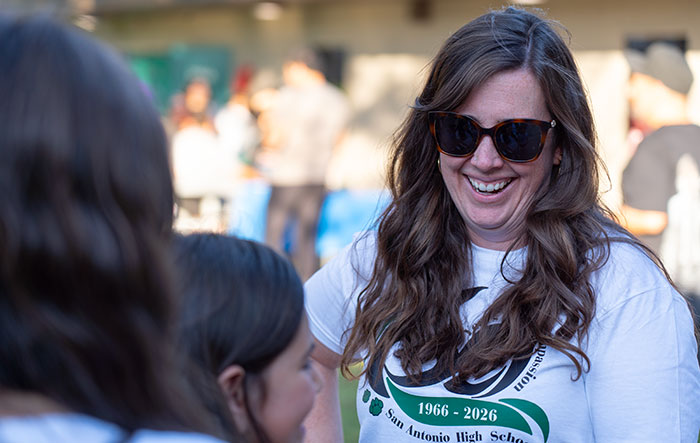
San Antonio High English teacher Melissa Gaw at the school’s 60th anniversary celebration on Wednesday. Courier photo/Andrew Alonzo
“Little by little, it gets the message out,” Deligio said. “Nothing changes because you come down here. It doesn’t mean that you’re bad, doesn’t mean that you’re not smart; it means you found a way to navigate with an incredible amount of resilience.”
Long-time SAHS English teacher Melissa Gaw sees the school as providing equal opportunities for students from all learning backgrounds. “It’s not a punishment,” Gaw said. “They need a different environment and we’re going to give them that different environment. And then therefore they’re going to be able to access everything that their education should offer them.”
Deligio agreed.
“I think the word ‘continuation’ is misleading because continuation makes it sound like you’ve got to 12th grade and now you’re going to keep going, whereas this is more of an alternate placement,” she said. The principal acknowledged the school had its ups and downs in the past, “But this is not the 90s,” she said. “This is completely different.”
Part of that shift in tone has been aided by updated guidance from the state.
“To really understand continuation, you need to know that about 20 years ago now, the [state education] code changed,” Deligio said. “When I first started doing discipline in another district back in 2003, if you found somebody that had some type of substance on them, like marijuana for instance, you would just do an involuntary transfer to a continuation school and there was no remediation, no restorative practices in place, and high suspension rates.
“Now the education code really puts more things in place so that there’s restorative practices for kids. There’s different types of interventions so continuation doesn’t become a dumping ground for behavior issues. This is where kids go because for whatever reason they need a smaller setting. They need to make up credits.”
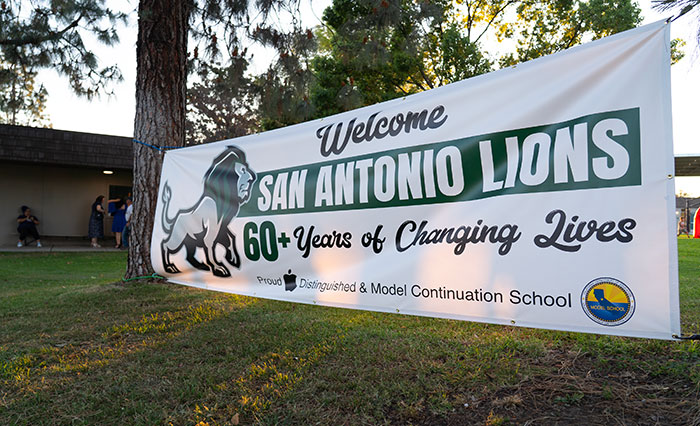
Former and current staff, students, supporters, and family members celebrated San Antonio High’s 60th anniversary on Wednesday. Courier photo/Andrew Alonzo
But state law can only take a school so far. It’s down to the people — the students, teachers and administrators — who make or break a campus, and the support system at San Antonio is robust.
“The first thing that I heard when I came here was that every student has somebody,” Deligio said. “It might be a teacher, it might be the office manager, it could be the counselor, but everybody has their go to adult that they can rely on.”
John Ramirez, a 2024 SAHS grad, is a product of that culture.
“They actually sat down with me and showed me, you need this class, this class, and this class to graduate,” Ramirez said. “And you are going to pass this because I believe in you. It was that type of thing … It’s like, wow man, I’ve got to try now. It’s different when people outside believe in you because it’s not that common, especially if you meet them for the first time and they automatically put all their trust in you that you’re going to graduate.”
Teachers like Gaw know buy-in is critical for any sort of breakthrough.
“They realize after a while that us being annoying or being too much is just that like, we love them and we care for them and we want them to do their best,” Gaw said. “They buy into that family vibe pretty quickly.”
Deligio said this approach — meeting kids where they are to helping them meet their goals — is crucial.
“Every person that comes through here — doesn’t matter if they’re current students, recent alumni, been out of school 40 or 50 years — they all say the same thing: ‘San Antonio saved me.’ And that’s a big deal.”
Graduates concur.
“It really changed my life,” Ramirez said. “My freshman and sophomore year [at Claremont High] I basically failed every single class that was given to me, which is why I went to San Antonio. My junior year, which was my first year there, I got straight As. It was the first time I’ve ever even gotten more than one A in a class. But it always goes to the teachers. They see you as more than a student. They see you as like an actual person succeeding.”
“It’s not that bad school at all,” said Eli George, class of 2025. “I would say if you have any inclination of the bad school, any feeling that it is and you’re believing what everyone is telling you, just go see for yourself and talk to one staff member there and you’ll see the difference. It’s really not that bad school. It’s honestly an amazing school, dare I say better than CHS.”
Gaw said those types of breakthroughs — turning around perceptions of kids who once dreaded school — are what make the job worthwhile.
“I just think it’s backwards to think of it as like, oh, we’re just changing these kids. No, we’re not changing these kids,” Gaw said. “We’re just removing the barriers and the obstacles and the tension and the stress so that they can surface that best version of themselves.”
Looking at the next 60 years, Deligio envisions San Antonio still being that alternative learning opportunity for Claremont students.
“Coming to school here and transferring here is not a punishment,” Deligio said. “This is a different way of getting to that goal of having a high school diploma.”
San Antonio will graduate its 60th class on June 11.

0 Comments