





CUSD Board of Education report: Vista to reopen preschool
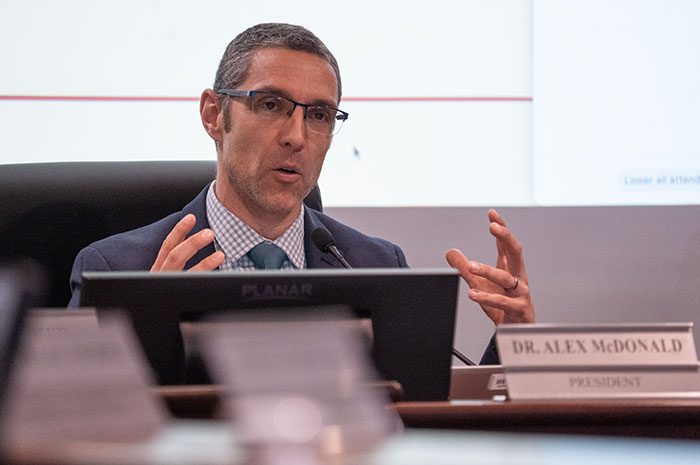
Claremont Unified School District Board of Education President Alex McDonald at the January 15 meeting. Courier photo/Andrew Alonzo
by Andrew Alonzo | aalonzo@claremont-courier.com
The Claremont Unified School District Board of Education heard the latest update to its Equity Action Plan and took final steps to reopen Vista del Valle Elementary’s preschool at its January 15 meeting.
Vista to reopen preschool
Vista’s preschool, closed three years ago due to low enrollment, will reopen February 17.
“The changing landscape of early childhood programs has now stabilized and parents in the community are again expressing need for additional preschool enrollment,” read agenda item 16.01. “As part of the licensing process for the reopening of the Vista site, a resolution is needed to update required documents.”
“This is just the final step that the team needs,” said Assistant Superintendent of Student Services Kevin Ward. “It’s an authorization to authorize the … child development director to be a signatory for that program.”
Shortly after, state licensing requirements were completed, capping a near nine month process to reopen the preschool. Enrollment is currently open. Parents can call (909) 398-0331 to inquire.
Equity advisory council, action plan updates
Natalie Taylor-Barbiera, CUSD’s director of educational services, delivered the annual update to the 2023-2027 Equity Action Plan, with various goals tied to the six focus areas of the CUSD commitment.
The goal of academic achievement and instruction was to grow English language arts and math scores and increase the percentage of students who meet University of California or Cal State entrance requirements by 3% annually. The targeted groups — Black, Hispanic, economically disadvantaged, English learners, students with disabilities, students experiencing homelessness, and foster youth — fell below the district’s averages on the annual California Assessment of Student Performance and Progress test.
CUSD overall
- ELA: the percentage of students meeting or exceeding English language arts rose 3.4% to 63.8% in 2025. It was 60.4% in 2024.
- Math: the percentage of students meeting or exceeding math standards rose 1.4% to 54.2%. It was 52.8% in 2024.
- The percentage of students who meet University of California or Cal State entrance requirements decreased by 0.8% to 63.8%. It was 64.6% in 2024.
Asian
- ELA: up 2% from 2024 (79.8%) to 81.8%.
- Math: up 3.6% from 2024 (76.9%) to 80.5%.
- Students meeting University of California or Cal State entrance requirements: down 1.5% from 2024 (85.1%) to 83.6%.
Black
- ELA: up 2% from 2024 (43.7%) to 45.7%.
- Math: down 2.3% from 2024 (31.8%) to 29.5%.
- Entrance requirements: up 0.8% from 2024 (51.4%) to 52.2%.
Hispanic
- ELA: up 4.3% from 2024 (49.1%) to 53.4%.
- Math: up 2.4% from 2024 (39.5%) to 41.9%.
- Entrance requirements: up 0.8% to 52.9%. It was 52.1% in 2024.
White
- ELA: up 3.1% from 2024 (70.7%) to 73.8%.
- Math: down 0.5% from 2024 (65.3%) to 64.8%.
- Entrance requirements: down 0.7% from 2024 (70.2%) to 69.5%.
Economically disadvantaged
- ELA: up 2.9% from 2024 (50%) to 52.9%.
- Math: up 1.3% from 2024 (41.2%) to 42.5%.
- Entrance requirements: up 2.1% from 2024 (54.2%) to 56.3%.
English learners
- ELA: up 2.3% from 2024 (7.9%) to 10.2%.
- Math: down 0.9% from 2024 (12.9%) to 12%.
- Entrance requirements: up 13.9% from 2024 (8.3%) to 22.2%.
Students with disabilities
- ELA: up 5.3% from 2024 (23%) to 28.3%.
- Math: down 1.8% from 2024 (22.8%) to 21%.
- Entrance requirements: down 1.6% from 2024 (14.5%) to 12.9%.
Students experiencing homelessness
- ELA: down 1.3% from 2024 (27.6%) to 26.3%.
- Math: up 5% from 2024 (16.9%) to 21.9%.
- Entrance requirements: down 13.3% from 2024 (33.3%) to 20%.
Scores were not reported for foster youth as the student group consists of 10 or fewer students, which is below the minimum size for reporting.
Goals in focus areas two, the whole child, and four, student and staff safety and wellness, are to show 95% of students think school is a place they feel they belong and are included in activities by 2027 according to LCAP data. In 2025, 89% of grade four through six students agreed, up 2% from the 87% in agreement in 2024. For seventh through 12thgraders, 84% agreed in 2025, up from 79% in 2024.
The goals for area three, access and equity, are to decrease students suspension rates and increase the career technical education pathway completion rate by 1% annually.
CUSD overall
- Suspension rate: students reportedly suspended at least one day in 2024-25 was at 1.8%, down slightly from the 2.4% reported in 2023-24.
- Career technical education completion: students reportedly completing career technical education courses was down 9.3% from last year to 29.2%. It was 19.9% in 2024.
Asian
- Suspension rate: remained at 1% in 2024-25, the same as 2023-24.
- Career technical education completion: up 10.6% to 15.1%. It was 4.5% in 2024.
Black
- 6%, the same as 2023-24.
- Down 11.2% to 17.4%. It was 28.6% in 2024.
Hispanic
- 2% in 2024-25, down by 0.5% from 2023-24 (2.5%).
- Up 8.4% to 28.8%. It was 20.4% in 2024.
White
- 6% in 2024-25, down by 0.5% from 2023-24 (2.1%).
- Up 13.1% to 36.5%. It was 23.4% in 2024.
Economically disadvantaged
- 6% in 2024-25, down by 0.8% from 2023-24 (3.4%).
- Up 3.4% to 22.6%. It was 19.2% in 2024.
English learners
- 4% in 2024-25, down by 0.1% from 2023-24 (2.5%).
- Up 2.8% to 11.1%. It was 8.3% in 2024.
Students with disabilities
- 3% in 2024-25, the same as 2023-24.
- Up 12% to 32.3%. It was 20.3% in 2024.
Students experiencing homelessness
- 8% in 2024-25, down by 2.2% from 2023-24 (7%).
- Up 13.3% to 20%. It was 6.7% in 2024.
Foster youth
- 2% in 2024-25, up significantly by 15.7% from 2023-24 (6.5%).
- Not reported.
The goal of focus area five, having engaged families and community partners, is to create a parental advisory council for CUSD’s Black families by the end of the current school year, adding to the existing equity advisory council, district English learner advisory committee, special education parent advisory committee, and advisory councils for foster and LGBTQ+ youth.
The district’s goal for area six, optimized financial and human resources, is that by June 2027, “the racial/ethnic demographics of certificated staff, classified staff, and management will be increasingly proportionate to the racial/ethnic demographics of the student population.”
The racial demographics of CUSD’s 6,133 students in 2024-25 were as follows:
- 47% Hispanic/Latino
- 26.4% White
- 11% Asian
- 6.1% Two or more races
- 4.2% Black
- 2.1% Filipino
- 0.3% American Indian/Alaskan native
- 0.1% Pacific Islander
- 2.5% Declined to say
The racial demographics of CUSD’s 719 staff members in 2024-25 were as follows:
- 43.8% White
- 39.8% Hispanic/Latino
- 5.6% Asian
- 3.9% Black
- 1.5% Pacific Islander
- 0.3% American Indian/Alaskan native
- 0.1% Two or more races
- 3.6% Declined to say
Per the report, the percentage of white certificated, classified and management staff in proportion to white students rose across the board. Meanwhile, Asian, Black, and Hispanic staff in proportion to their respective student demographics rose slightly between 2024 and 2025.
The board approved the updates with a 5-0 vote.
The next CUSD Board of Education meeting is 6 p.m. Thursday, February 19 at the Kirkendall Education Center, 170 W. San Jose Ave., Claremont.





0 Comments