




CUSD looking at floating new bond measure
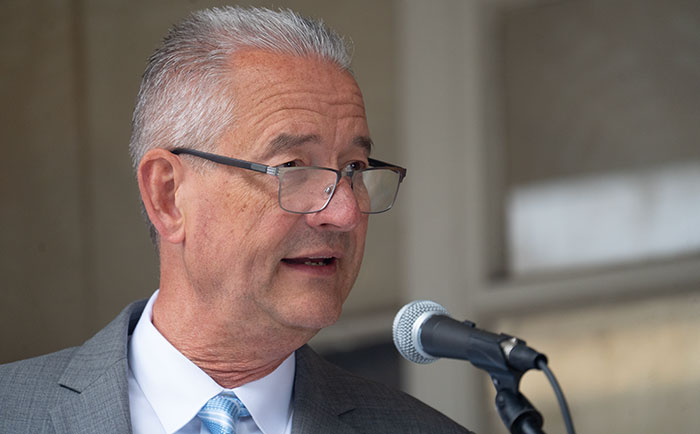
CUSD Superintendent Jim Elsasser at the February 19 Board of Education meeting. Courier photo/Andrew Alonzo
by Andrew Alonzo | aalonzo@claremont-courier.com
Claremont Unified School District is exploring the possibility of asking voters to approve a new facilities bond as part of the November 3 election. The announcement was made at the February 19 Board of Education meeting.
If Claremont voters approve it, the potential new bond it would go into effect after the $48.9 million Measure Y bond, which voters approved in 2000, is retired in 2029.
The size of the potential bond has not been determined, but CUSD Superintendent Jim Elsasser said the district would “make a commitment … to only charge what taxpayers are currently paying on Measure Y, which is $31.96 per $100,000 of assessed [property] value.”
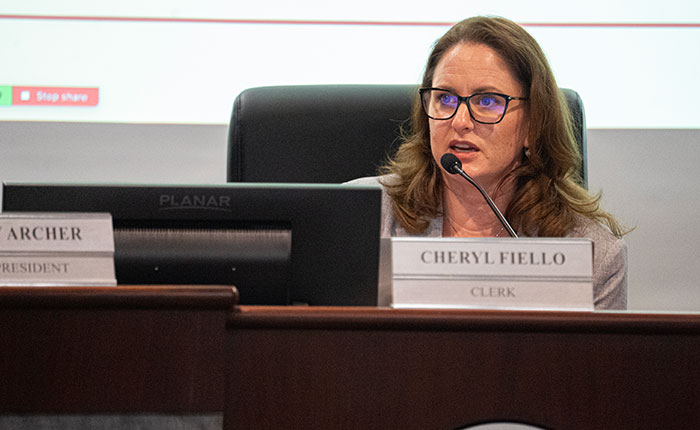
CUSD Board of Education Clerk Cheryl Fiello at the February 19 meeting. Courier photo/Andrew Alonzo
The potential bond would address aging infrastructure and campus safety throughout the district in a time when CUSD is mired in an $11 million deficit for fiscal year 2025-26.
“Under California’s Proposition 39 framework, local school bonds can be approved with a 55% vote if the measure includes specific accountability requirements,” CUSD spokesperson Elaine Kong wrote in an email.
CUSD has identified “broad, districtwide facility needs focused on addressing safety, infrastructure and HVAC, as well as modernizing classrooms, restrooms, kitchens and other learning spaces,” Kong wrote. “The purpose of this phase is to document overall facility conditions and urgency and then help inform how potential projects and funding strategies could be prioritized for Board and community discussion.”
“One example is changing all the door locks throughout the entire district to keycards, which would allow a secretary in the office to hit a few keystrokes on the computer that would immediately lock down every door on the campus,” Elsasser said.
The district has been exploring the possibility of asking voters to approve a new bond for some time. In the lead up to last week’s announcement, if formed a focus group comprised of presidents from its three employee associations, Claremont Faculty Association, Claremont Management Association, and California School Employees Association, and 22 community members.
Kong said the Board of Education will study the issue over the next three months. This will include analyzing the results of the 834 parents, students and educational partners who responded to CUSD’s recent facilities master plan survey, pinpointing costs, shaping project categories and priorities, eliciting further community input, and preparing materials for public board discussions.
“We will schedule meetings over the next three months and then we’ll gather all of that feedback and I’ll present that to the board on June 4,” Elsasser said. “And then at that time, based on the feedback, [we’ll] make a decision whether or not we want to proceed or not. And if [the board wants] to proceed, then on June 18 [it] would pass a formal resolution that would then start the process for getting the measure on the ballot on November 3.”
Should a bond proposal come before the Board of Education, “it would include clear project descriptions and public accountability measures so taxpayers can track how funds are spent,” Kong wrote.
Other recent successful bond measures include 2016’s Measure G, which “authorized the district to issue no more than $58 million in general obligation bonds” to fund projects such as “portable-to-modular classroom replacement, roof replacement, renovating two swimming pools and locker rooms, modernizing the CHS gymnasium, and construction of the Dr. Brett O’Connor Student Center and kitchen at CHS,” Kong wrote.
Measure CL, a proposed $95 million bond to upgrade CUSD buildings and equipment, failed in 2010.
“It is important to note that school bond funds can only be used for facilities and capital improvements, not for day-to-day operating costs like staffing or instructional programs,” Kong wrote.
CUSD Board of Education Vice President Kathy Archer and Clerk Cheryl Fiello spoke in favor of exploring a bond measure. Fiello, a former CHS science teacher, noted how she was impacted by moneys from measures Y and G.
The bond funds “completely changed my working conditions and what I experienced every day in teaching there, and the opportunities that I was able to provide my students in those lab facilities,” Fiello said. “So that that completely changes teaching and learning.”
The next Board of Education meeting is at 6 p.m. Thursday, March 19 at 170 W. San Jose Ave., Claremont.



0 Comments