





CUSD teachers frustrated over workload, wage stagnation
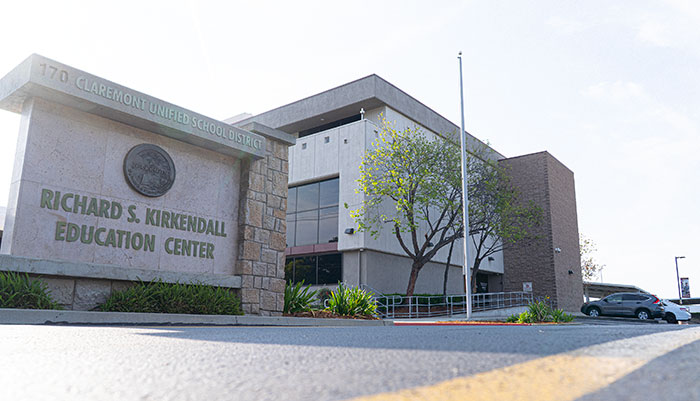
CUSD teachers are negotiating with the district for a pay raise after years of what they say is salary stagnation. Courier photo/Andrew Alonzo
by Andrew Alonzo | aalonzo@claremont-courier.com
Following years of stagnant salaries and recent news that the Los Angeles County Department of Education was monitoring Claremont Unified School District’s finances, CUSD teachers stepped forward at the April 2 Board of Education meeting to voice concerns over morale, workload, and compensation.
Longtime CUSD teacher Jennifer Gomez said her data found CUSD teacher salaries did not keep pace with surrounding districts, despite rigorous requirements.
“In many districts, teachers reach the highest salary with a bachelor’s degree plus 60 additional units,” Gomez said. “In Claremont, teachers must go further. We must pursue a bachelor’s degree plus a master’s degree, plus 75 additional units to reach top salary. We are asking for more education and more investment from our teachers, and we are paying them less in return. That is not just a compensation issue, that is a values issue.”
The board last approved a 1% pay raise for teachers, education specialists, speech-language pathologists, counselors, nurses, psychologists and clinical therapists in September 2025. The district projects a $10.8 million deficit this year and additional shortfalls in 2026-27 and 2027-28.
Regarding teacher workload, Claremont High special education instructor Shane Hile said, “This is not just teaching, it is case management compliance, crisis response, and instruction all at once.”
Hile, a CHS teacher for 16 years, said morale is at an all-time low during his tenure.
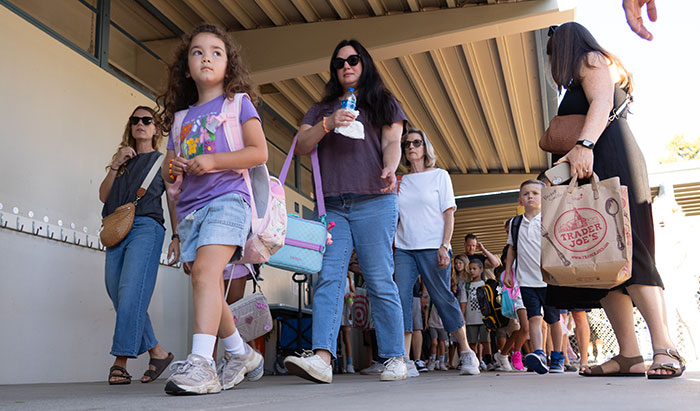
Students, families, and teachers pictured recently at Condit Elementary School. Courier photo/Andrew Alonzo
“When teachers feel consistently underpaid, morale drops, and when morale drops, retention suffers, and when the retention suffers, students lose expectations of their educators,” Hile said. “The compensation right now just with what we’re doing doesn’t seem like it’s matching with what we’re doing as far as compensation. The expectations continue to grow, the needs are more intrusive, the paperwork increases, the responsibility increases, but the compensation has not yet increased. This imbalance is not sustainable.”
Gomez said CUSD’s compensation package has resulted in the district becoming a point of entry for new teachers. “This district is becoming a training ground where new teachers come to gain experience and then leave for better paying career districts,” Gomez said.
Another cause for concern among CUSD teachers has to do with recent news of upcoming drastic increases in their health insurance contributions. A February 27 email from the district’s Shared Decision-Making Benefits Committee informed CUSD employees that beginning January 1, 2027 single medical plan co-pays would increase from $145 to $320; two person plans from $270 to $570; and family co-pays would rise from $395 to $745, an 88% jump.
The committee, made up of representative from CUSD’s three unions, cited rising premium costs and its inability to continue to subsidize employees’ health insurance to the degree it has in the past as reasons for the cost increase.
“It is important to note that the last increase to employee paid health and welfare contribution rates occurred in 2011,” read the February 27 letter. “For more than a decade, the Health & Welfare Fund absorbed rising healthcare costs through reserves, plan adjustments, and one-time fiscal support. This includes an increase in the District contribution over the last 14 years from $6,052/[full-time equivalent] in 2012 to the current contribution of $10,352/FTE. While these efforts helped maintain stability for employees, they are no longer sufficient given ongoing cost trends.”
Though the communication came from union reps, including Claremont Faculty Association, the teachers’ union, the message did not sit well with El Roble Intermediate School teacher Stephanie Gutierrez.
“Doubling our health care premiums is an insult to the people who dedicate their lives tirelessly to our community and raising the next generation,” Gutierrez said. “The decision to increase our premiums must be reversed.”
Claremont Faculty Association Vice President and CHS teacher Melissa Wonnacott implored the board to keep teachers “at the forefront of every decision” as contract negotiations continue and CUSD addresses its budget challenges.
LCAP update
CUSD Assistant Superintendent of Educational Services Julie Olesniewicz reported on local control accountability plan survey results from the school community. Surveys of CUSD students, staff and educational partners yielded 6,200 responses and the following data, which is viewable on the April 2 agenda at cusd-claremont.community.highbond.com:
- Of the 1,184 fourth, fifth and sixth-grade students polled, 79% reported enjoying going to school and 21% disagreed. Reported concerns were early start time, academic stress, and “bullying and peer meanness, including identity-based remarks.”
- About 2,509 students in seventh through 12th grade responded, with 86% saying they feel they belong or are included in activities, 14% did not. One bullet of concern stated, “Students report name calling and use of slurs regarding, race, gender identity, physical appearance, learning differences, religious affiliation, and sexual orientation, with the vast majority being about race.”
- Some 1,766 students indicated having positive feelings about their teachers and schools, but also noted overwhelming workloads. They advocated for flexible timelines to accommodate extracurricular activities and more intentional lesson and homework structure, Olesniewicz said.
- Of 456 responses, 64% felt CUSD and school site leadership adequately address student behaviors on campus; and 53% felt they had time to meet their professional responsibilities. Concerns ranged from special education services, funding, to teacher compensation and retention.
- Some 2,051 parents and community members were surveyed, with 60% reporting they were aware of requirements for University of California and California State University admission; and 76% agreeing their child’s school provides them with resources for reaching California standards. Concerns included campus security, discipline protocols, technology usage and academic support.
Olesniewicz gave a short overview of recent engagements with educational partners before explaining recent changes to the LCAP document, which included CUSD’s foster youth of about 23 students recently falling into a “red area” in chronic absenteeism and suspension rate on the California School Dashboard, leading to the district to be declared needing “differentiated assistance.”
“This means we must include all of their data in the LCAP and demonstrate how we will support these students in these areas,” Olesniewicz said.
Additionally, CUSD must show how San Antonio High plans to use carry-over monies from its recent allocation of California Local Control Funding Formula equity multiplier funding, and how the district plans to use unexpended learning recovery emergency block grant funds.
CUSD will revise the plan over the coming weeks and post an updated draft by May 22 at cusd.claremont.edu/page/lcff-lcap. The updated LCAP will be presented at a June 18 public hearing at the district office. The board is expected to act on the LCAP and budget at a special meeting on June 22.
Election set
The board voted unanimously to order November 3 elections for CUSD Board of Education Trustee areas one, three, and four currently held by Kathryn Dunn, Richard O’Neill, and Alex McDonald, respectively. Maps are at cusd.claremont.edu, select “Board of Education.”
The next Board of Education meeting is set for 6 p.m. Thursday, May 7 at 170 W. San Jose Ave., Claremont.




0 Comments