





New CGU center explores the science of happiness
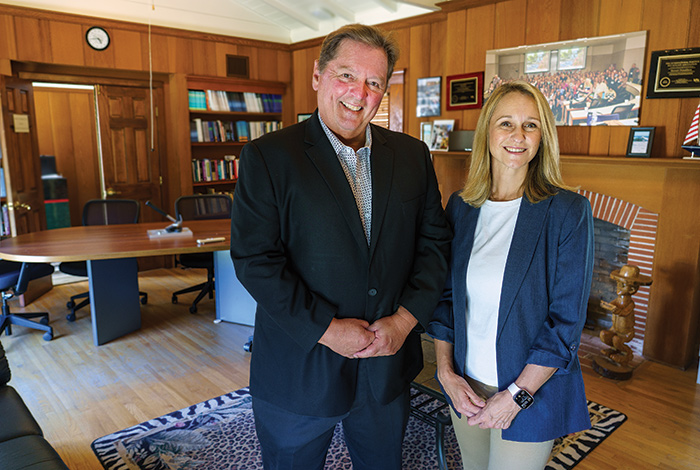
Stewart Donaldson, distinguished university professor at Claremont Graduate University and president of the Claremont Flourishing Center, and Tatiana Shemiakina, a CGU Ph.D. student and CFC’s director of operations. Courier photo/Peter Weinberger
by Lisa Butterworth
When Bobby McFerrin released “Don’t Worry Be Happy” in 1988, it became a bona fide hit. It’s an impossibly catchy song, but what makes it such an enduring classic is its universally aspirational sentiment, which, of course, existed long before McFerrin’s a cappella interpretation.
And yet it’s a directive easier said than done. That is, unless you understand the science-backed markers of a happy life, and learn how to cultivate them in your daily existence. This is the mission of the newly established Claremont Flourishing Center at Claremont Graduate University, sponsored by the Rekhi Foundation for Happiness, in the hopes of boosting wellbeing, in Claremont and beyond.
In the scheme of things, the scientific study of happiness is a relatively new area of research, especially the field of positive psychology, which developed about 25 years ago, said Stewart Donaldson, a distinguished university professor at CGU, and president of the Claremont Flourishing Center.
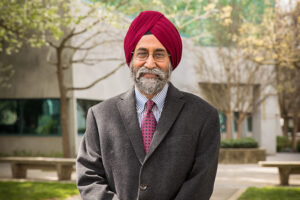
Rekhi Singh, founder of the Rekhi Foundation for Happiness. Photo/by Andrea Price
“A lot of people who deal with this topic deal with it from experience, from philosophy, religion,” Donaldson said. “We were inspired and charged to use the most scientific methods possible to study these topics.”
Donaldson, who has lived in Claremont for more than 25 years, began his academic career in applied psychology, “trying to use our knowledge in psychology to make a difference in the world,” he said. This drive led him to positive psychology, and when Donaldson was dean, he brought one of the founders of the field, Mihály Csíkszentmihály, to CGU; in 2006 they launched the school’s first Ph.D. programs in positive organizational psychology and positive developmental psychology. Since then, the school’s faculty has “trained hundreds of doctoral students and master’s students who are applying these principles out in the world,” Donaldson said.
That’s why, when Donaldson met Rekhi Singh, the founder of the Rekhi Foundation for Happiness, at last year’s Western Positive Psychology Association meeting, the benefits of a partnership were obvious. The Rekhi Foundation is based on the belief “that happiness is a skill that can be learned and cultivated,” as stated on its website, and the organization partners with universities around the world to spread joy and well-being. Since 2016, it has founded more than 60 centers like the CFC in six countries, including Singapore, India, Pakistan, and Sri Lanka.
At Claremont Graduate University, positive psychology research and expertise are already well established. What the Claremont Flourishing Center now offers is the ability to share this knowledge, along with practical ways to implement it.
“There is a lot of academic literature, but if you are not a scientist, if you don’t know how to read all this, you will never apply it,” said Tatiana Shemiakina, a CGU Ph.D. student and CFC’s director of operations. “I see Claremont Flourishing Center as a bridge between these two worlds of academia and practice.”
The CFC’s first order of business is to develop a training program for faculty of the other Rekhi-sponsored centers, so they can teach the latest science on human flourishing and happiness. But the focus is local, too. “Part of our founding gift is to also help our own community flourish,” Donaldson said. “We’re beginning to partner with different organizations at the Claremont Colleges, and we’re also planning to move into the community, possibly into some of our senior communities,” adding he hopes local organizations interested in this type of programming will reach out.
The workshops and webinars CFC will offer are all free of charge. They are rooted in the nine building blocks of human flourishing, “blocks that we’ve found scientifically that help people reach their potential,” Donaldson said. The first building block is positive emotions, and the experience of “joy and gratitude and love and so forth,” Donaldson said. The second is engagement. “How engaged are you in life? Do you get into the moment? Do you experience something we call flow, which is our optimal experience in life?” he said. The third, positive relationships, is one of the strongest predictors of happiness. Meaning and purpose make up the fourth building block, and achievement — “Are we accomplishing things in our life?” Donaldson said — is the fifth. The last four blocks are physical health, mindset, environment, and economic security.
“What we found is when you measure all of these and you put them all into one measure, and you try to predict who’s having a good life, this is the strongest measure we’ve ever come across — stronger than IQ, stronger than many famous things,” Donaldson said. “They’re building blocks, though, that you don’t just get or master. You have to work on them daily.”
That will be the focus of CFC programming, to get this knowledge “out of the classroom, into the world,” Donaldson said, with workshops on topics like the power of positive emotions and love, the importance of gratitude, and getting the most out of your physical well-being. In other words, cultivating happiness.
Judging by the growing interest in positive psychology, it’s a subject matter people are particularly drawn to right now. “We were talking with someone on the Pitzer campus, and we said, ‘What are your students hungry for?’ And she said, ‘How do you flourish in these times? They all want to give up. They’re so depressed by what’s going on, how people are being treated,’” Donaldson said. “This is a conversation that people really want to have.”
It’s a conversation Donaldson and his CFC collaborators, including Shemiakina and CFC’s Director of External Affairs Zachary Swanson, hope can lead to far greater things. “If you look at our country right now — and I don’t have to argue that we’re not going in a good direction very hard these days — we’re going to need to do something very different in the future,” he said. “And we have the scientific research to suggest ways now how to be better as a community, as an organization, and as a species.”
For Swanson, it’s about giving people agency to help alleviate their suffering by sharing “science-informed ideas and practices that they can use in their own language, in their own lives, in their own ways.” Shemiakina agreed: “My dream is that [the CFC] is a worldwide source of different tools, approaches, where anyone can come and find whatever is necessary right now for flourishing, for happiness, for teaching, for spreading flourishing all over the world.”






0 Comments