





‘Returning to Listen’: Deep connection to Johnson’s Pasture drives artist’s new exhibit
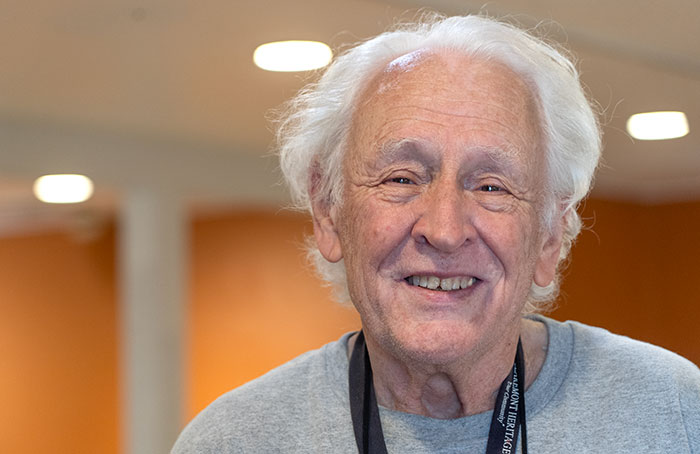
Artist Kendall Johnson’s “Johnson’s Pasture: Returning to Listen,” opens at 6 p.m. Saturday, March 7 at Claremont Heritage’s Ginger Elliott Gallery, 840 N. Indian Hill Blvd. Courier photo/Andrew Alonzo
by Andrew Alonzo | aalonzo@claremont-courier.com
Artist Kendall Johnson has had a lot to think about over the past decade. But the subject matter to which the 81-year-old returns most often remains constant: Johnson’s Pasture. The 186-acre plot of land, now part of Claremont Hills Wilderness Park, belonged to his family until about 1956.
Johnson will return to it at 6 p.m. Saturday, March 7, when his exhibit, “Johnson’s Pasture: Returning to Listen,” opens at Claremont Heritage’s Ginger Elliott Gallery, 840 N. Indian Hill Blvd. The show includes about 30 mixed media works, poetry, and photography and is curated by Carina Arias. It comes a decade after his previous show at Claremont Heritage, which focused on Johnson’s Pasture through the lens of aging.
This new exhibit continues in that vein. It addresses changes brought by human activity on the land, local wildfire disaster history, climate change, and uncertainty caused by the unraveling of the Environmental Protection Agency under the Trump administration.
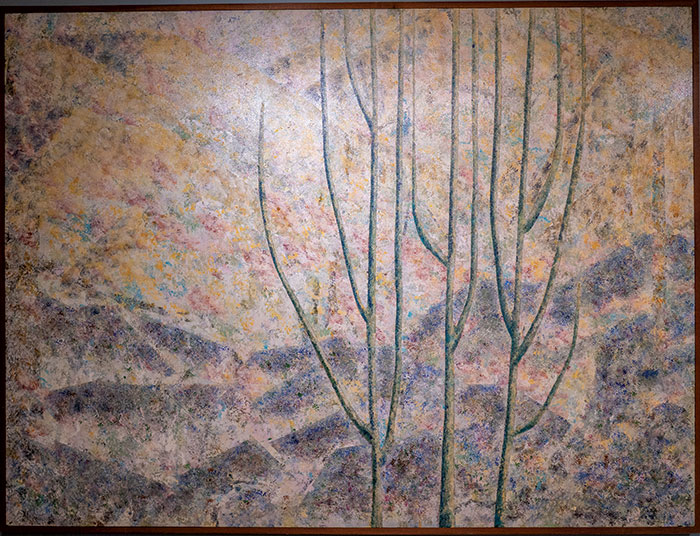
This untitled painting by Kendall Johnson is part his new exhibit, “Johnson’s Pasture: Returning to Listen,” opening at 6 p.m. Saturday, March 7 at Claremont Heritage’s Ginger Elliott Gallery, 840 N. Indian Hill Blvd. Courier photo/Andrew Alonzo
Johnson is more concerned than ever about public land preservation, at Johnson’s Pasture and elsewhere.
“The brush is getting drier and thinner, and trees are losing limbs, and trees are falling,” Johnson said of his family’s former land. “It’s being remodeled before our very eyes. So this time, when I went to think about the place and walk it and look at it again, I took a different tack; it’s not about nostalgia. It’s not about seeing it as this wonderful sylvan setting that’s a relief from urbanization. That time is now being challenge by the changes in the world. I don’t think that we can rest easy thinking a city can protect it for very long, because the political situation has really shifted, and all public lands are now at risk. They are being sold out to private companies for maximum profit and what used to be a protected place can no longer assume that protection.
“There’s a sadness here for me. It’s not what it used to be.”
Claremont purchased the land in 2007. Since then Johnson has noticed more people frequenting the trail.
“After that, it suddenly became a very popular place to go and the social media got a hold of it,” Johnson said. “A place that usually had maybe 10 visitors on a weekend, now has several hundred. And that’s not the worst of it; the worst of it is that the climate is changing and with it, the land. And so with warming and with prolonged drought and with the increased intensity and size of fires, all of a sudden the place can’t hold its biotic mass that it could be before.”
Johnson is hoping his new exhibit will show viewers a new perspective of the land, which was abundant in his youth when his family hosted Sunday picnics and firing range practice there, and eucalyptus and pines were plentiful.
“What I’m trying to do is kind of say, look, we can’t look at this piece of wildness land the same way as we used to,” he said. “What is it really? What does the land itself tell us about where it’s going? … My hope is that people will not lose hope in wildland, this or other wildland, but rather see it as the precious part of our world that exists.”
Johnson said the exhibit is partly a rallying cry. “This call to action has to do with more of an inner call within ourselves. This is about how we can sharpen the way we look at the world,” he said.
He talked about the importance of open space.
“We didn’t grow up in cities as a species,” he said. “There were no cities until we built them. There were vast plains and we grew up developing our various facilities like eyesight, hearing, and intuitive sense and aesthetic sense. We grew up developing those for our own survival. We walk up in the wildland and suddenly we shift inside, and we start hearing things more acutely. We look to see; we don’t look to take in the spectacle. But rather we look to construct meaning out of what we’re seeing.”
At 81, Johnson visits Johnson’s Pasture on an “as needed” basis.
“I hear the city closing in, I hear everything going to hell in a bucket in my life, I go up there,” he said. “I need to reconnect with the world, I go up there. It serves a variety of purposes; it’s a refuge and a solace and a way to reconnect with a world that’s a lot more real than the plastic fantastic on internet.”
“Johnson’s Pasture: Returning to Listen,” opens at 6 p.m. Saturday, March 7 at Claremont Heritage’s Ginger Elliott Gallery, 840 N. Indian Hill Blvd. It is on view through March 28. Johnson will lead a free and open to the public artist talk at 6 p.m. Thursday, March 26. The Ginger Elliott Gallery is open 10 a.m. to 3 p.m. Monday through Friday by appointment. Admission is free. Call (909) 621-0848 for more information or to make an appointment.


0 Comments